
The Brand Codes Register is the dated, versioned record of the distinctive assets every ad must carry, so a brand is recognised before it is read and consistency stops depending on whoever happened to make the ad.
Key takeaways
- Seven code categories are registered, and every ad carries a defined minimum of them. Nothing ships that a stranger could not attribute.
- Codes are property, not preference. A code changes by dated ruling, never because somebody got bored of it.
- The bar is high and mostly unmet: of more than 5,000 brand assets Ipsos and Jones Knowles Ritchie tested, only 15% reached the top tier, where an asset is both recognised and attributed to its brand.1
- Governance Flags mark every asset as locked, provisional or retired, so the register shows its own state at a glance.
- Romaniuk's rule is the operating discipline: when a change to a code is proposed, the default answer is no, and evidence does the overruling.2
Why do most brands fail to be recognised?
Because their assets were never built to be recognised without the name attached. A distinctive asset earns its keep when an audience can attribute an ad to the brand from that asset alone, and most brands have nothing that clears that bar. What they have instead is a logo, a colour they like, and a font somebody chose in 2019.
The measurement is public and unflattering. Ipsos and Jones Knowles Ritchie tested 5,046 assets belonging to 523 brands with over 26,000 respondents, and only 15% of those assets reached Gold, the tier where an asset is both widely recognised and strongly linked to its brand.1 The rest are assets in the sense that a business owns them, and not in the sense that anybody recognises them.
What makes this expensive is that distinctiveness compounds and inconsistency resets it. Professor Jenni Romaniuk of the Ehrenberg-Bass Institute states the mechanism plainly: "Inconsistencies in colours, fonts, logos and the like are the enemy of distinctive asset building".3 Every ad that quietly drops a code is not neutral. It spends a little of what the previous ads built.
What goes in the register?
Seven categories, each with its exact specification and its current status. Colour by hex value. Typography by family and weight. The wordmark and its clear space. Layout signatures. Photographic or illustration treatment. Sonic cues where they exist. And the verbal assets, meaning the phrases the brand owns and uses the same way every time.
| Category | What is registered | How it fails |
|---|---|---|
| Colour | Exact values, and the role each colour plays | Approximation, and a palette that grows a shade per campaign |
| Typography | Families, weights, and the hierarchy they express | Substitution when a licence is missing |
| Wordmark | The file itself, plus clear space and minimum size | Redrawing, recolouring, or letting a model generate it |
| Layout and composition | The structural signatures a viewer learns | Reinvention per ad, so nothing accumulates |
| Imagery treatment | The consistent look applied to every image | Drift, one campaign at a time |
| Sonic | Whatever the brand sounds like, where it has a sound | Silence on the assets where it would carry |
| Verbal assets | The owned phrases, worded identically every time | Paraphrase, which is how a slogan becomes a sentence |
Each entry carries a Governance Flag: locked, provisional or retired. Locked assets are used as specified and changed only by dated ruling. Provisional assets are in test and marked as such, so nobody mistakes an experiment for law. Retired assets stay in the register with their retirement date, because knowing what a brand used to use is how you read its old material honestly.
How many codes does an ad have to carry?
A defined minimum, checked at brand QA, and the count is set per client rather than guessed per ad. The test is whether somebody who has seen the brand before could attribute the ad without reading the name. An ad passing every other check and failing that one is an ad working for the category instead of the business.
The minimum exists because codes are cheap to drop and expensive to rebuild. Any individual omission is defensible on the day, and the sum of a quarter's defensible omissions is a brand nobody has learned. This is also why the check is mechanical: a human reviewing their own work under deadline will find a reason, and a checklist will not.
In practice
Run the squint test on every finished ad. Blur it until the words are unreadable and see whether it is still obviously yours. If the answer depends on reading the wordmark, the codes are not doing their job and the ad is renting recognition from the logo.
When does a code change?
On a dated ruling supported by evidence, and never on a feeling. Romaniuk's instruction is to "switch your default answer to 'no'" when a change is proposed,2 and the reason is that the people closest to a brand see its assets hundreds of times more often than its customers do. Staleness is almost always an internal sensation rather than a market condition.
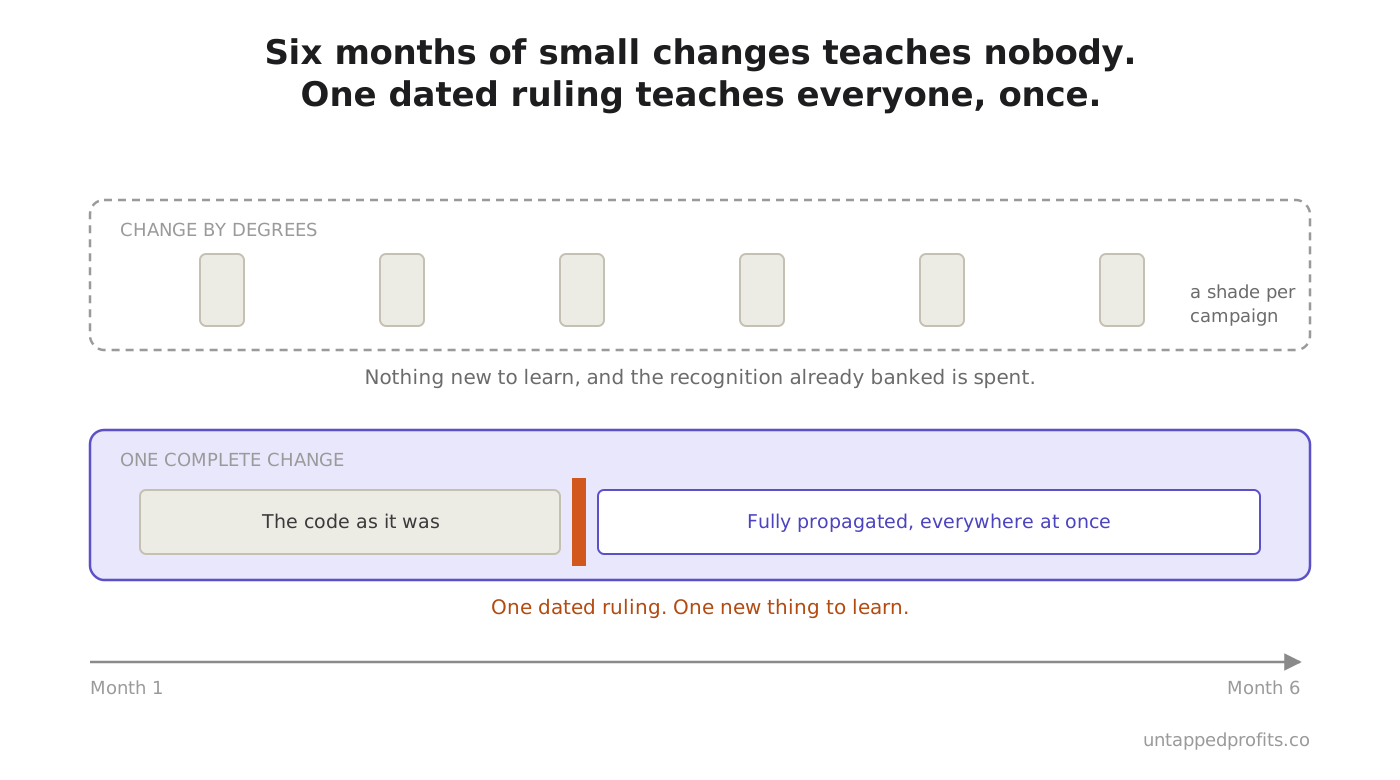
When a change is genuinely warranted, it is made completely rather than gradually. A palette that shifts by degrees across six months teaches an audience nothing and costs the recognition already banked, while a clean, dated, fully propagated change gives them one new thing to learn. The register records what changed, when, and why, so the reasoning survives the person who made it.
Watch for
The provisional asset nobody ever ruled on. It gets used because it was there, appears in enough ads to look official, and eventually becomes the brand by accumulation rather than decision. Review the provisional list on a schedule and force each one to be locked or dropped.
Frequently asked questions
Isn't this just a brand guidelines document?
Guidelines describe and the register governs. A guidelines PDF sits in a folder and gets consulted when somebody remembers, while the register is checked at brand QA on every asset and carries a status flag per entry. The practical difference is that the register can fail an ad.
What if a client has no distinctive assets yet?
Then the register starts nearly empty and that is the honest state to publish. Assets get chosen deliberately, marked provisional, used consistently for long enough to mean something, and then locked. Building distinctiveness is slow, and pretending a new brand already has it is how businesses skip the part that works.
Doesn't consistency get boring?
It gets boring internally, long before it registers externally. The people who see the brand forty times a day are not the audience, who see it twice. Vary the ideas as widely as you like. The codes are the constant that lets all that variety still add up to one brand.
How does this work with AI generation?
By making the codes specifications a machine can be held to, which is exactly what the Production Module does with them. And by removing from the machine what it cannot do reliably: the wordmark is placed as a real file, never generated, because a near-logo is a forgery.
Who owns the register?
The client, and it lives in their Cartridge. The structure is the method's and every value in it belongs to that business, which is the Seam Rule applied to brand law. Nothing in a register crosses to another client.
The bottom line
Recognition is built by repetition and destroyed by drift, and drift almost never arrives as a decision. It arrives as a series of small, reasonable omissions nobody logged. The register makes the codes explicit, flags their status, sets a minimum every ad must carry, and requires a dated ruling to change any of it. Do that and a business gets recognised before it gets read, which is the only moment most advertising has.
Where this connects
The register is enforced at brand QA in The Review Seams, carried into static production by the Production Module, and applied to synthetic presenters in Synthetic Assets. It constrains what survives The Five Gates, its changes are ruled under The Operator's Laws, and it lives in the client Cartridge described in Engine, Cartridge and Connectors. Back to the One Brain Method hub.
Part 5 · Creative Production · Chapter 16 of the One Brain Guide
Previous: Creative Production ·
Next: The Five Gates ·
All chapters
Sources
- Ipsos and Jones Knowles Ritchie, Be Distinctive. Everywhere., 14 June 2023, testing 5,046 brand assets across 523 brands with more than 26,000 respondents. 15% of assets tested reached the Gold tier, meaning high recognition combined with strong brand attribution. Ipsos sells brand asset testing and JKR is a brand design agency, so both have a commercial interest in a finding that most brand assets are weak.
- Professor Jenni Romaniuk, Ehrenberg-Bass Institute, The Four Commandments: future proofing a brand's identity: "switch your default answer to 'no'".
- Professor Jenni Romaniuk, Ehrenberg-Bass Institute, Brands of Distinction.
Every statistic and quotation on this page has been checked against its primary source. Last verified 24 August 2026.
Free guide
Take the method with you. The complete One Brain Method as one PDF: every chapter, the diagrams, and every named framework, ready to hand to whoever runs your marketing. Enter your email and it's yours.
Want a brand that gets recognised before it gets read?
Book a 30-minute call → See what it takes to have this installed