
A search account is shaped as much by what it refuses to match as by what it bids on. Everything else in search, from structure to copy to budget, is downstream of that one discipline, and accounts that skip it pay for the difference every day.
Key takeaways
- The named framework is The Negatives Discipline: a layered, evergreen negative architecture built from long-term query patterns, not a weekly scrape of bad terms.
- Search is the demand-harvesting role, which makes it the channel most likely to be credited for demand it did not create. When eBay switched off its brand-keyword ads in a large-scale field experiment, natural search immediately absorbed almost all of the lost clicks.1 That is why brand and non-brand are separated as a reporting rule rather than a naming convention.
- Structure follows intent. Each ad group is built around a single unified intent, and ad-to-landing-page congruity is the governing constraint. Where the page cannot support the theme, the structure is wrong or the page is missing.
- Search owes the rest of the system its query data, written back as customer intelligence. Search terms are the market describing its own problem in its own words, so they belong in the Memory rather than dying in the account.
- Platform recommendations and auto-applied changes are findings, not decisions. Analysis runs free because reading is reversible, and account edits wait for a ruling because spending is not.
What is a search account actually buying?
Attention that already exists, at the moment it surfaces. Nobody types a query because an ad prompted them to. The demand arrived from somewhere else: a problem that worsened, a recommendation, a piece of content, a campaign in another channel. Search buys the right to be present when that demand becomes a search box.
That makes search the most flattering channel in any account. Every metric it reports looks strong because it is measuring people who had already decided to look. The question a method has to answer is not whether search performs. It is which part of that performance the spend caused.
This has been tested properly rather than argued. Thomas Blake, Chris Nosko and Steven Tadelis ran a large-scale field experiment at eBay and found that when brand-keyword paid search was switched off, almost all of the lost click traffic, 99.5% of it, was immediately captured by natural search, and that brand-keyword ads showed "no measurable short-term benefits."1 For brand keywords, they concluded, natural search is close to a perfect substitute for paid.
That finding does not settle whether a given business should run brand terms. Competitors bidding on your name, a thin organic listing and marketplace dynamics all change the calculation. What it settles is the reporting question: an account that blends brand and non-brand into one number is reporting something shown under experiment to contain a large amount of substituted traffic. The same failure in a different costume is Your Google Ads Agency Reports Weekly Optimizations.
How does the Negatives Discipline work?
By building the negative architecture once from long-term patterns, then maintaining it as hygiene rather than rebuilding it weekly. The two jobs are distinct in scope rather than in method, and treating the recurring one as if it were the foundational one is how accounts end up with thousands of individual negatives and no architecture.
- The foundational build. Query history across a long lookback, read for systemic, evergreen waste patterns rather than individual bad terms. Sets are layered at account, campaign and ad-group level, classified by pattern type (wrong intent, wrong geography, wrong product, job-seeker, competitor, research-stage), and every proposal is checked against the existing lists so only genuinely new exclusions ship.
- The recurring pass. Cost-ranked triage of the period's search terms. The weekly form takes quick wins only, and the thematic work belongs to the monthly cycle. It also runs in the other direction, surfacing terms that are converting and are not yet targeted.
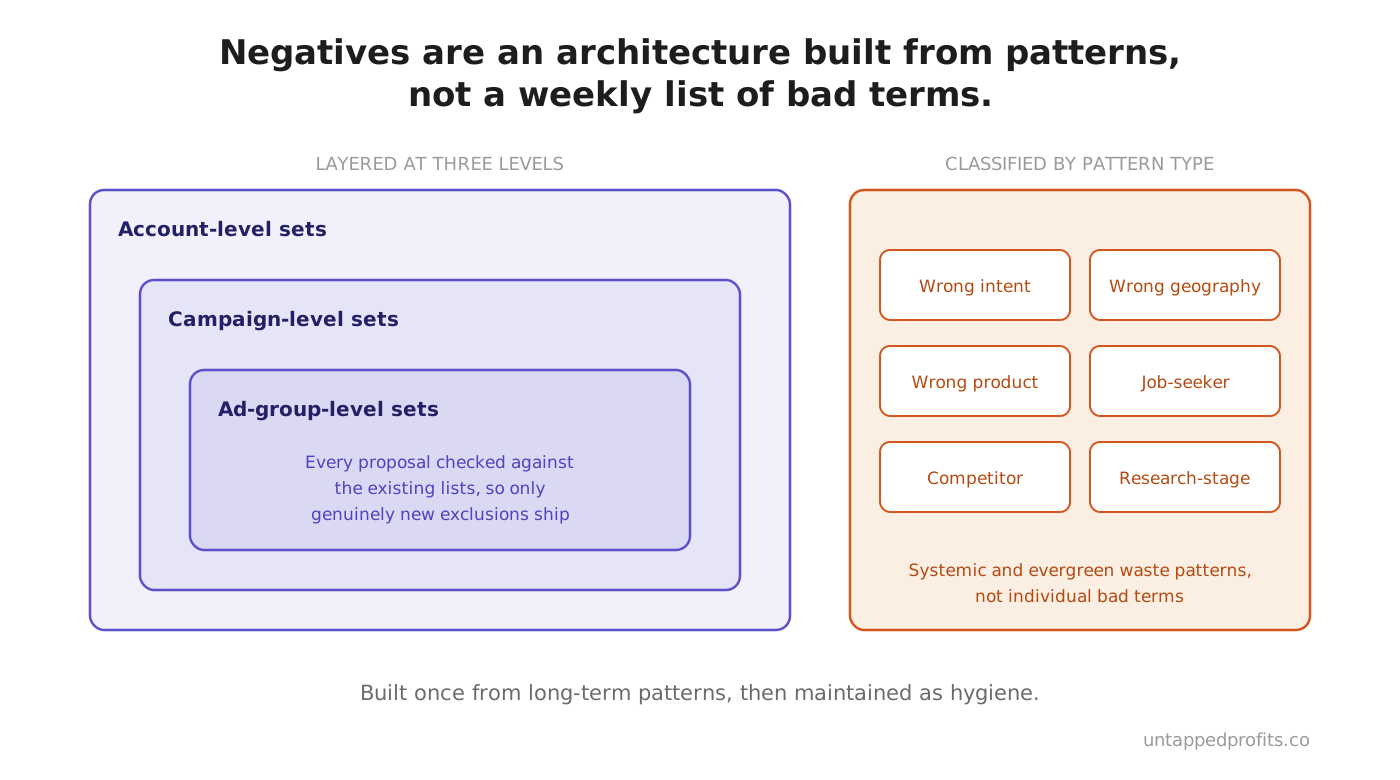
The discipline earns its name because of what it protects. Every dollar spent on a query the business cannot serve is spent twice: once on the click, and again on the distortion it feeds into automated bidding, which learns from whatever it is given. A layered negative architecture is the cheapest structural work available in a search account, and it is the work most often replaced by a weekly glance at the search-terms report.
| Brand terms | Non-brand terms | |
|---|---|---|
| What the click measures | Demand the business already built | Demand meeting the business for the first time |
| What it proves | The name is known and the listing is reachable | The offer competes on the open market |
| Credit it may claim | Defence and recovery | Acquisition |
| What a rising number means | The demand-creating channels are working | The offer or the targeting is working |
| Reported | Separately, always. Never blended into one account cost per acquisition. | |
In practice
Run the negative build before touching structure, bids or copy. Waste removed at the architecture level does not come back, while waste removed term by term returns next month wearing a different phrase. The foundational pass is a one-time cost with a permanent return, and it makes every later analysis easier to read.
Watch for
An account migrating toward its cheapest conversions. Every individual decision is defensible and the destination is an account that only harvests. The signal is a rising share of spend on brand terms and retargeting while total new-customer volume stays flat.
How is a search account structured?
Around real intent, consolidated rather than fragmented. Query data is clustered semantically by shared intent, classified by what the searcher is actually doing, from informational through to transactional, then grouped into candidate ad groups from those clusters rather than from a keyword tool's suggestions.
Two principles govern the result. Each ad group is built around a single unified intent, because an ad group serving two intents cannot serve either with the right message. And ad-to-landing-page congruity is the governing constraint: keyword theme, ad copy and destination must agree, and where the page cannot support the theme, the honest conclusion is that the structure is wrong or the page does not exist yet.
That second principle is Funnel-First Buying expressed in search terms, and it is the reason a structure exercise sometimes ends in a page brief rather than a campaign build. Keyword tooling cannot find positions nobody has claimed — Why the Best Content Positions Can't Be Found in Any Keyword Tool shows why — so query data is treated as raw intelligence, never as a planning tool on its own.
Who decides what changes in the account?
The Operator, on a proposal, every time. Auto-applied recommendations, broad-match expansions, smart defaults and optimisation scores are all proposals from a party whose objective overlaps with yours without matching it. They are read, they are sometimes right, and they enter the account when they are ruled on.
The asymmetry underneath that is worth stating plainly. Analysis is read-only and safe to run as wide as you like, because the worst case is a weak suggestion nobody acts on. An account edit spends real money and a large one can restart automated bidding's learning, which destroys the evidence you were about to act on. Read freely, act deliberately. The argument in full is Stop Automating Across Phases.
Two evidence rules follow it. Every finding carries its figures, because "the campaign became much less efficient" is not a finding and a stated movement with its numbers is. And where actual performance has diverged from target consistently over a window, targets move by a small increment rather than a correction, because a large move restarts learning.
What does search owe the rest of the system?
Its query data, written back as customer intelligence. Search terms are the least filtered statement a market ever makes about what it wants, phrased in the market's own words rather than the brand's. That material belongs in the Memory, where Customer Intelligence can use it and the next campaign inherits it.
The split follows the standard rule. A pattern in how a category of buyer phrases a problem is method and goes to the Memory. What this particular business's buyers ask for is client-specific and goes to its Cartridge. Neither belongs only in an export nobody opens again, which is the difference between an account that accumulates and one that only reports.
Frequently asked questions
Should we bid on our own brand name?
It depends on conditions the method can name even though it cannot decide them for you: whether competitors are bidding on your name, how strong your organic listing is, and whether your marketplace rewards defence. What the method decides is that the answer gets tested instead of assumed, and that brand spend is reported separately whichever way it goes.
What match types should we use?
That is a platform tactic, and platform tactics rot faster than a reference work can track them. Match-type choices are findings measured against the Campaign Plan's KPI, and whichever way a test goes the result is written back so the question is not reopened from zero next quarter. The durable part is the negative architecture, which is why it gets the chapter's named framework and match types do not.
Should we accept auto-applied recommendations?
Read them, rule on them, and turn off automatic application. Findings Are Not Decisions applies with particular force to a machine working for someone else, and the setting that applies changes without asking you is the one most likely to move spend past a decision nobody made.
Our conversion tracking might be wrong. Where does that sit?
Before everything. An account with broken tracking is unmeasured rather than underperforming, and every improvement made on top of it is guesswork wearing a report. Tracking integrity is the first thing read in Account Analysis, and it is checked weekly rather than when something looks wrong.
If search only harvests demand, why run it at all?
Because harvesting is a real job and somebody will do it. The demand exists whether or not you are present when it surfaces, and being absent hands it to whoever showed up. The error is not funding search. It is funding search and then reading its numbers as evidence that the demand-creating channels are unnecessary.
The bottom line
Search collects demand the rest of the system created, which makes it the easiest channel to over-credit and the cheapest one to waste. Build the negative architecture from long-term patterns before anything else, structure ad groups around single intents with pages that can keep the promise, separate brand from non-brand in the reporting because the experimental evidence says they measure different things, and let no platform recommendation change the account without a ruling. An account run that way stays honest about what it caused. One run on a blended number will always report that search is your best channel.
Where this connects
Search runs the demand-harvesting role set out in Paid Acquisition, against the KPIs in The Campaign Plan. Its governing ruling discipline is The Operator's Laws. Its query data flows back through The Return Arrow into The Memory, and its tracking is audited in Account Analysis. On attribution windows, see Your Ad Platform Is Hiding 60% of Your Returns by Design. On what machine buyers will do to this channel next, see Buyer Agents Don't Compress Funnels, They Audit Them. Back to the One Brain Method hub.
Part 4 · Paid Acquisition · Chapter 13 of the One Brain Guide
Previous: Meta Ads ·
Next: Account Analysis ·
All chapters
Sources
- Thomas Blake, Chris Nosko and Steven Tadelis, "Consumer Heterogeneity and Paid Search Effectiveness: A Large Scale Field Experiment", Econometrica, Vol. 83, No. 1 (January 2015), pp. 155-174. The paper reports that "brand-keyword ads have no measurable short-term benefits", and that "almost all (99.5 percent) of the forgone click traffic from turning off brand keyword paid search was immediately captured by natural search traffic." The experiment was run at eBay, a large marketplace with exceptionally strong brand recognition, so the substitution effect for a less known brand may be smaller.
Every statistic and quotation on this page has been checked against its primary source. Last verified 24 August 2026.
Free guide
Take the method with you. The complete One Brain Method as one PDF: every chapter, the diagrams, and every named framework, ready to hand to whoever runs your marketing. Enter your email and it's yours.
Want a search account judged on money instead of clicks?
Book a 30-minute call → See what it takes to have this installed