
The Review Seams are the four human checkpoints in creative production: hook cold-read, hook finalisation, render critique and brand QA. Each sits at a point where quality can silently die between a locked decision and a published ad.
Key takeaways
- Four seams, in order: hook cold-read, hook finalisation, render critique, brand QA. Each catches a class of failure the others structurally can't.
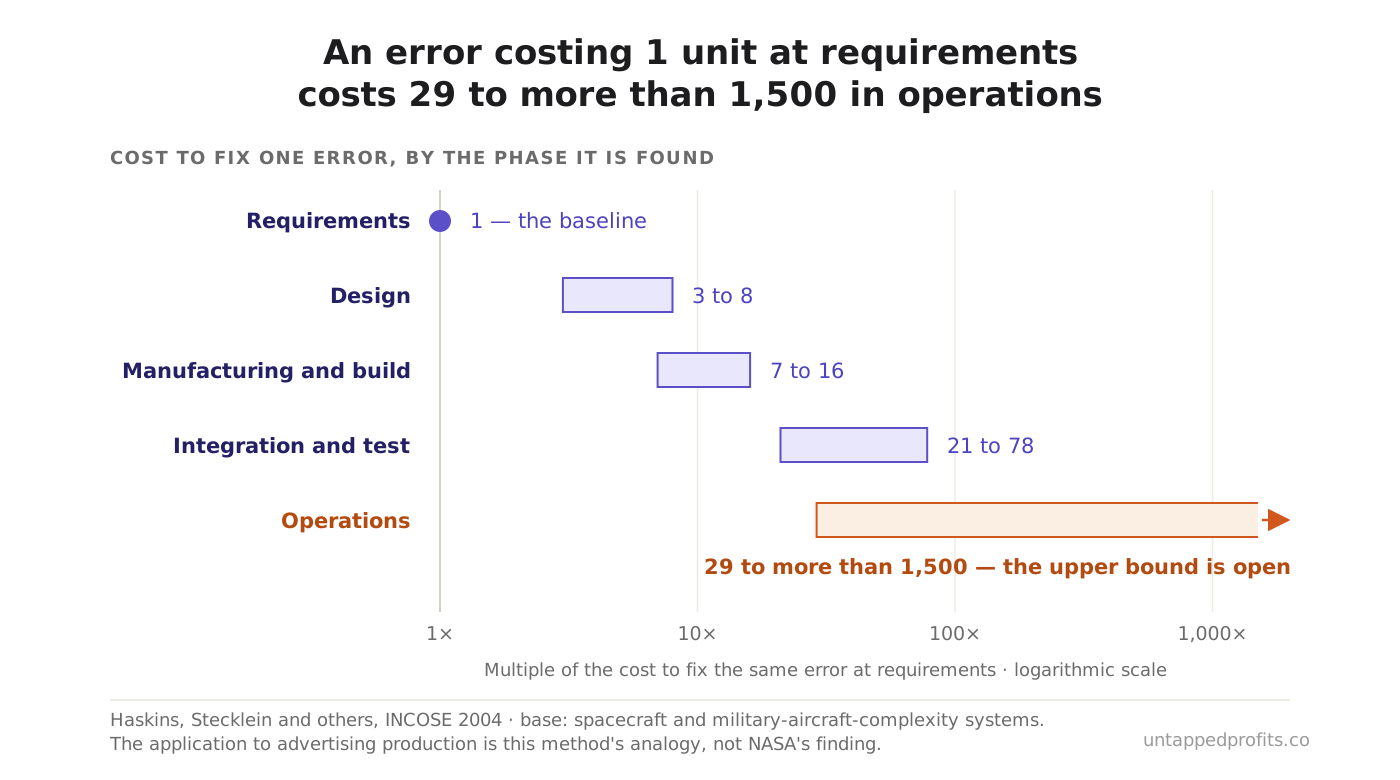
- The cost curve is an engineering law: NASA's error-cost study found a defect costing 1 unit at requirements costs 29 to more than 1,500 units in operations.1 Every seam exists to move a catch further left along that curve.
- The Ship Threshold is a numeric bar plus a production-gate pass. The number exists so affection can't negotiate.
- Text Fidelity is the hardest line: one hallucinated character in a locked string fails the ad, with no materiality debate.
- The machines check and the Operator rules. A failure caught twice at a seam becomes law upstream, so the seam stops needing to catch it.
Why does creative quality die between approval and publication?
Because approval and publication aren't the same moment, and everything between them is a handoff. The line that read brilliantly on the selection sheet lands differently on an image. The generation drifts a shade off the palette. A locked string comes back with one character subtly wrong, the kind of wrong a tired eye reads straight past.
None of these are decisions anyone made. They are what happens at the seams between decisions, which is where unwatched systems always leak. Machines make this worse before better, because generation at volume produces more seams to watch — 47 Funnels in 5 Minutes, Zero Revenue is what an unwatched version looks like.
The economics of catching failures early are an engineering law, not a marketing opinion. NASA's analysis of error cost across project phases found that an error costing 1 unit to fix at the requirements phase costs 3 to 8 units at design, 7 to 16 at manufacturing and build, 21 to 78 at integration and test, and 29 to more than 1,500 units in operations.1 Advertising runs the same curve on faster clocks: a weak hook caught at cold-read costs a line, caught after render it costs an asset, and caught in-market it costs a media budget and a small piece of the brand. Paying late for problems designed in early is a handoff disease, and Your Agency Isn't Slow Because of Bad People follows it through an agency's whole pipeline.
Atul Gawande, whose surgical checklists cut real mortality, put the governing idea in The Checklist Manifesto: "Under conditions of complexity, not only are checklists a help, they are required for success. There must always be room for judgment, but judgment aided—and even enhanced—by procedure."2 That is the seams in one sentence. The Operator's judgment stays sovereign, and procedure makes sure it gets exercised on the right things at the right moments.
How do the Review Seams work?
Four checkpoints, each placed at a handoff and each catching what the others can't see. A cold-read can't judge a render. A render critique has no way of telling whether a line stalls on the page, and brand QA arrives far too late to fix either. Together they cover the distance between a locked decision and a published ad.
- Hook cold-read. Before any hook reaches a selection sheet, it is read cold, with the reader's half-second simulated by fresh eyes that owe the line nothing. Familiarity is the enemy here, because the writer can no longer see the stall, the ambiguous referent or the double thought. The cold read can.
- Hook finalisation. One more pressure-test just before generation, because context changed between selection and production. The format is real now, the headline pairing exists, and the string is about to be locked. This is the last cheap moment to change a word.
- Render critique. Finished renders are scored the way a senior creative director would score them, against the Ship Threshold: a production-gate pass plus a numeric bar. Below the bar doesn't ship, however long it took or how much anyone likes it.
- Brand QA. The per-ad checklist, with Text Fidelity first: every locked string checked character by character, because one hallucinated character fails the ad and there is no materiality debate. Then the codes, all seven present and thresholds met, claims against the Proof Bank, and safe zones respected. Only a full pass ships.
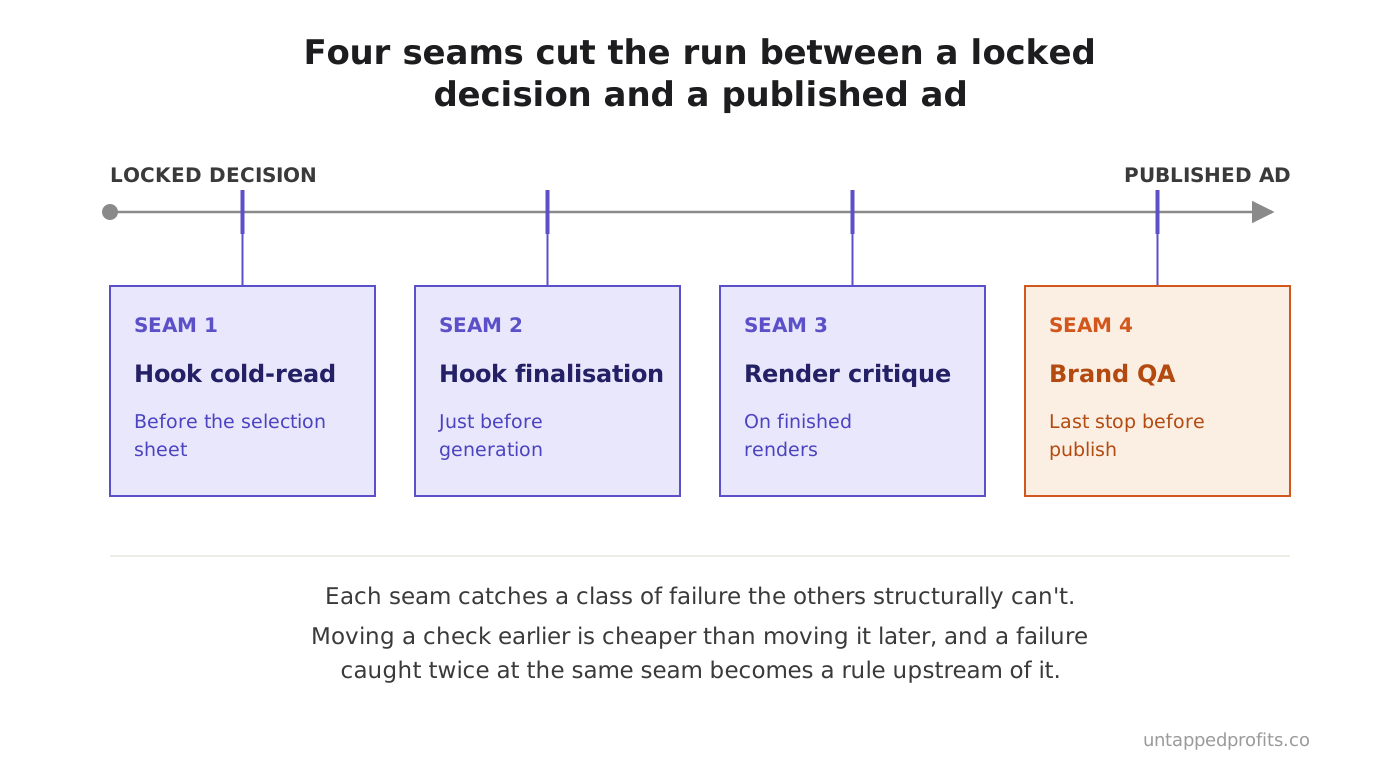
Two rules run through all four seams. The machines do the checking, and the Operator's approvals are the only gates that matter, so the reviewing machinery exists to make sure that ruling is only ever a choice between strong options. And every catch feeds the Ratchet: a failure caught twice at a seam becomes written law upstream, so the seam that caught it stops needing to.
| Seam | When | What it catches |
|---|---|---|
| Hook cold-read | Before the selection sheet | Stalls, ambiguous referents, lines only their writer loves |
| Hook finalisation | Just before generation | Words that stopped working when the context became real |
| Render critique | On finished renders | Work below the Ship Threshold, meaning the polished-but-weak |
| Brand QA | Last stop before publish | Text-fidelity failures, missing codes, unbanked claims, safe-zone breaches |
In practice
Check locked strings against the source text mechanically, character by character, and never by reading. Reading is exactly the wrong tool: a fluent reader auto-corrects a wrong character without noticing, which is why typos survive four sets of eyes and then greet ten thousand strangers.
What should you measure at the seams?
Whether the bar holds and whether the checks are real. Ads shipped below the Ship Threshold tell you if the number is a floor or a suggestion. Text-fidelity failures found live, out in the world where customers see them, tell you the character-level check isn't happening. Seam catches converted to upstream law tell you the seams teach as well as filter.
| Measure | What it tells you | Target |
|---|---|---|
| Ads shipped below the Ship Threshold | Whether the numeric bar is a floor or a suggestion | Zero, because the bar doesn't negotiate |
| Text-fidelity failures caught at QA against those found live | Whether the character-level check is real | All caught at the seam, and zero live |
| Ads with a full QA pass on record | Whether the checklist governs or decorates | Every shipped ad, with no exceptions |
| Seam catches converted to upstream law | Whether the seams teach or just filter | Every repeat failure becomes a rule via the Ratchet |
Watch for
The seam that catches the same thing forever. A checkpoint reliably killing the same failure every month is doing its job and reporting a missing rule upstream. Left alone, the team starts treating that catch as routine, and routine catches are the ones that eventually get waved through on a busy day.
What does skipping the seams cost?
The live typo in a locked string, which reads as carelessness to every prospect who sees it, at production speed and media prices. The polished-but-weak ad that shipped because nobody had a number to point at. The brand code quietly missing from a month of ads before anyone noticed the drift.
On NASA's curve, every one of these is an operations-phase defect: the most expensive possible place to learn what a seam would have caught for the price of a read. And each one arrives looking like bad luck rather than a missing checkpoint, which is why ungated pipelines rarely diagnose themselves. Small automated checks find revenue leaks that grand dashboards miss — The Safety Setting That Was Costing You Leads is one such leak, found for the price of a read.
Frequently asked questions
Isn't four reviews on every ad overkill?
Each seam catches a class of failure the others structurally can't. A cold-read can't see a render drift, and brand QA can't judge whether a line stalls. The full set costs minutes per ad, while one live failure of any class costs more than every seam applied to a year of production. This is the cheapest insurance in the method.
AI reviewing AI, isn't that circular?
Different machines, different jobs, different incentives. The generator proposes and the critics score against written law, meaning the codes, the bank and the threshold, with numeric outputs the Operator can audit. The circle is broken at the top, because the machines never approve anything. They rank, flag and fail, and the Operator rules.
Can you really reduce creative quality to a number?
The number isn't the definition of quality, it is the floor under it. Everything above the Ship Threshold is still judged, chosen and ruled by a human. What the number prevents is the very human failure of shipping weak work because it's late, it's Friday, and someone's fond of it.
Who does the cold-read if the team wrote the hooks?
Anyone who hasn't seen them, and that requirement is the whole point. A machine primed with no context works, a colleague from another project works, and the writer never does. The moment the cold-read becomes the same person who chose the line, the seam has closed and nobody has noticed.
What happens when a seam and the Operator disagree?
The Operator rules and the disagreement gets recorded. A critic scoring below threshold on work the Operator ships anyway is either a miscalibrated critic or an Operator about to learn something, and only the record settles which. Over enough instances the pattern is visible, and the fix goes to whichever side keeps being wrong.
The bottom line
Creative rarely fails at the moment of decision. It fails in the gaps afterwards, where a line meets an image, a string gets regenerated, and nobody is specifically responsible for looking. The Review Seams put a named checkpoint in each of those gaps, with a number that can't be argued past and a character-level check that admits no debate about materiality. Catch it at the seam, or pay for it at CPM.
Where this connects
The seams enforce every law made upstream. The cold-read is The Hook Law's enforcement arm, brand QA checks The Brand Codes Register and The Proof Bank per ad, and render critique guards what The Five Gates locked and the Production Module rendered. The propose-then-rule pattern is The Operator's Laws, and the catch-to-law mechanism is The Return Arrow's Ratchet. Back to the One Brain Method hub.
Part 5 · Creative Production · Chapter 19 of the One Brain Guide
Previous: The Hook Law ·
Next: Static Ads: the Production Module ·
All chapters
Sources
- Bill Haskins, Jonette Stecklein and others, "Error Cost Escalation Through the Project Life Cycle", INCOSE International Symposium 2004, held in the NASA Technical Reports Server. Taking a requirements error found at the requirements phase as 1 unit, the cost to fix rises to 3 to 8 units at design, 7 to 16 at manufacturing and build, 21 to 78 at integration and test, and 29 to more than 1,500 in operations. The study covers hardware and software systems of spacecraft or military aircraft complexity. The application to advertising production is this method's analogy, not NASA's finding.
- Atul Gawande, The Checklist Manifesto: How to Get Things Right (2009), chapter "The End of the Master Builder". Source punctuation preserved.
Every statistic and quotation on this page has been checked against its primary source. Last verified 24 August 2026.
Free guide
Take the method with you. The complete One Brain Method as one PDF: every chapter, the diagrams, and every named framework, ready to hand to whoever runs your marketing. Enter your email and it's yours.
Want nothing weak, off-brand or wrong to survive to publish?
Book a 30-minute call → See what it takes to have this installed