
The Operator's Laws are the three standing laws that govern how the One Brain Method is run: Findings Are Not Decisions, Complete Replacement, and Model Routing by Layer. AI proposes. The Operator decides.
Key takeaways
- Findings Are Not Decisions. Everything the system produces is a finding. It becomes an action only when the Operator rules on it, with the content in front of them.
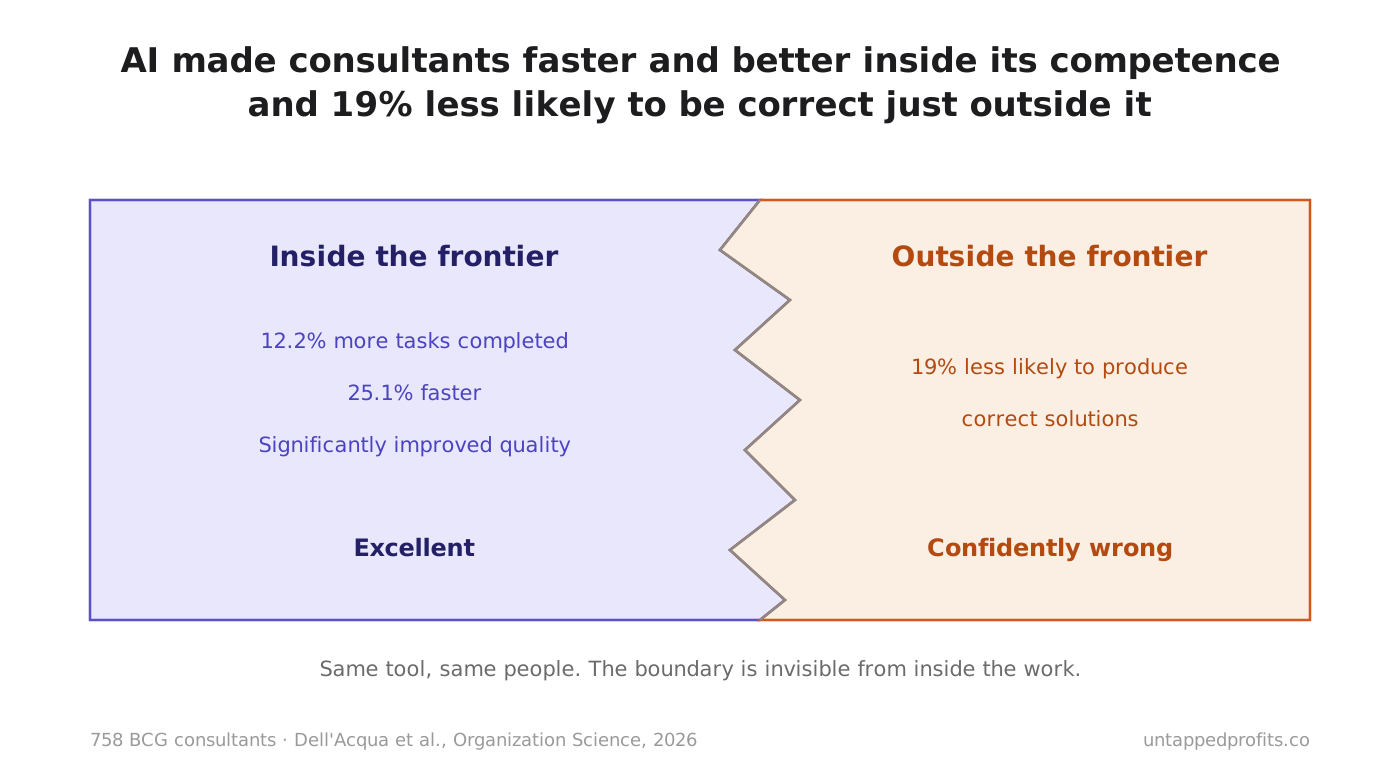
- The law exists because AI's competence has an invisible edge: in a field experiment with 758 BCG consultants, AI lifted performance markedly inside its competence and made consultants 19% less likely to be correct just outside it.1
- Complete Replacement. Governing artefacts are reissued whole and the old version archives, so current truth is always one document long.
- Model Routing by Layer. Judgment-adjacent work gets the strongest reasoning available, mechanical work gets fast execution, and steps that must be exact are made deterministic instead.
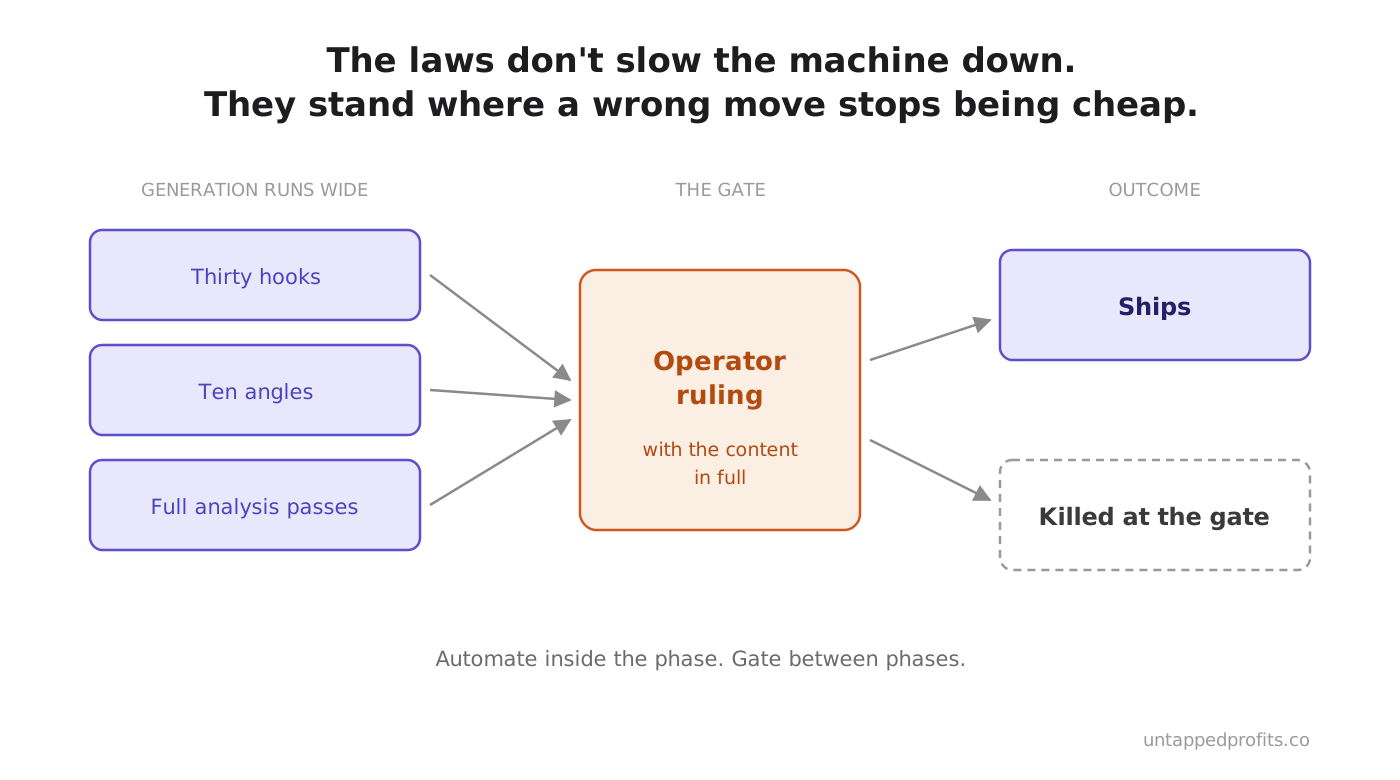
- The laws sit at the boundaries, not inside the work. Generation runs as wide as it likes. The gate is where a wrong move stops being cheap.
Why does AI-run marketing fail without an Operator?
Because current AI has a shape, and the shape is jagged. It is excellent inside its competence and confidently wrong just outside it, and the boundary is invisible from inside the work. A system that ships whatever the machine produced is betting the quarter on which side of that line each task happened to fall.
A preregistered field experiment with 758 BCG consultants put numbers on it. The study, published in Organization Science, found that on tasks inside the technology's competence, consultants using AI completed 12.2% more of them, 25.1% faster, at markedly higher quality. On one task deliberately chosen to sit just outside that competence, consultants using AI were 19% less likely to produce correct solutions.1 Same tool, same people, opposite outcomes, and no reliable way to feel which side of the line you are on while you're working.
That is the machine half. The human half is older. As Daniel Kahneman put it in Thinking, Fast and Slow, "we can be blind to the obvious, and we are also blind to our blindness."2 Put overconfident machines in front of overconfident humans with no governing structure and you get marketing that ships whatever survived nobody's judgment, at scale, faster than ever. The risk is sharpest when a decision-maker asks a machine for a context-free second opinion — The Most Dangerous AI User in Your Business is that failure, named. The answer is law rather than less machinery: fixed rules about what machines may do alone, what requires a ruling, and how those rulings are recorded.
How do the Operator's Laws work?
Three laws, each aimed at a different failure. Findings Are Not Decisions keeps machine output from becoming strategy on its own. Complete Replacement keeps the record readable. Model Routing by Layer keeps the class of machine matched to the stakes of the work. Together they decide what may happen without a human, and what may not.
- Findings Are Not Decisions. Everything the system produces, from research and analysis to drafts and recommendations, is a finding. A finding becomes an action only when the Operator rules on it, with the actual content in front of them, in plain words. The machine can propose all day, and nothing ships, spends or changes strategy on a proposal alone. This is the law that makes the jagged frontier survivable, because the confidently wrong output dies at the ruling instead of in the market.
- Complete Replacement. When any governing artefact changes, whether a plan, a rule set or a brief, it is reissued whole as a complete file, and the superseded version archives. No patches, no diffs, no "updated per my last message". Current truth is always one document long, which is what makes the record in The Build Ledger possible at all.
- Model Routing by Layer. Different layers of the work get the class of machine their stakes deserve. Judgment-adjacent work, meaning strategy, analysis and creative that will face customers, routes to the strongest reasoning available. Mechanical work routes to fast, cheap execution. Steps that must be exact are not given to a model at all, and are made deterministic instead. The discipline runs in both directions: never trust light machinery with heavy calls, and never pay heavy prices for light work.
| Law | What it prevents | What it looks like in practice |
|---|---|---|
| Findings Are Not Decisions | Machine-made strategy, and confidently wrong output reaching customers | Every proposal shown in full, and a dated ruling before anything acts on it |
| Complete Replacement | Version archaeology, and nobody knowing which edit is current | Whole-file reissues, with superseded versions archived and never overwritten |
| Model Routing by Layer | Heavy calls on light machinery, and premium costs on trivial work | Each layer assigned its model class, with exact steps kept deterministic |
Notice what the laws don't do. They don't slow the machine down inside its lane. Generation runs as wide as it likes: thirty hooks, ten angles, full analysis passes. The laws sit at the boundaries, where a wrong move stops being cheap, which is the same principle argued in Stop Automating Across Phases. Start Automating Inside Them. Automate inside the phase, gate between phases, and gate hardest where a wrong move is most expensive and least reversible.
In practice
A ruling means the Operator saw the actual thing. Not a summary of thirty hooks, not a confidence score, not a recommendation with the reasoning folded away. If what reached the Operator was a description of the work, the work wasn't ruled on, and the law only looks like it held.
What should you measure to know the laws are holding?
Whether each law is holding, and whether the gate has turned into a queue. Assets living without a ruling behind them tell you the first law has slipped. Governing artefacts existing as patch-chains tell you the second has. And time from proposal to ruling tells you whether the Operator is a gate or a bottleneck, which is the failure mode nobody admits to.
| Measure | What it tells you | Target |
|---|---|---|
| Assets live without a ruling behind them | Whether Findings Are Not Decisions is holding | Zero |
| Rulings recorded with a date and the content ruled on | Whether the paper trail is real | All of them |
| Governing artefacts existing as patch-chains | Whether Complete Replacement is holding | Zero, with one current file per artefact |
| Time from proposal to ruling | Whether the Operator is a gate or a bottleneck | Hours, because rulings are looked at and decided, never committee'd |
Watch for
The rubber-stamp ruling. When proposals are approved in batches, at speed, without the Operator having read the thing itself, the law has become a formality with a timestamp. The tell is a run of approvals with no rejections in it, because a gate that never stops anything isn't a gate.
What does running without the laws cost?
Two opposite bills, and the same root cause. The autonomous version costs you the morning you find forty polished assets built on an angle you would have killed in ten seconds: fast, impressive, pointed the wrong way. The committee version costs you decisions so diffused across vendors and stakeholders that nobody actually ruled, and nobody is accountable when the quarter disappoints.
Both failures come from the same absence: no single, senior, accountable human whose judgment the system must pass through. Calling the laws bureaucracy misses what they are, which is the difference between an AI-powered system and an unsupervised one, and they are what lets the machinery run at full speed everywhere it is safe to.
Frequently asked questions
Isn't the human bottleneck the thing AI was supposed to remove?
AI never promised to remove judgment. What it removes is the grind around judgment. A ruling costs the Operator seconds: look at the angle, kill it or lock it. Skipping that ruling costs forty variants on a dead idea. Gating the machine doesn't cost you its speed, it aims it.
Why one Operator instead of a team?
Because accountability doesn't average. Five specialists each ruling on their own slice is how the fragmented model failed in the first place, with everyone responsible for a channel and nobody responsible for the whole. One senior Operator who has done the work across every discipline can hear when one section is flat against the rest, and owns the result. That argument in full: Your Marketing Conductor Can't Hear the Flat Note.
What happens when the Operator is wrong?
They will be, because blindness to blindness spares nobody. The system's answer is that corrections compound: every Operator correction becomes permanent law the same day, so a mistake made once is a mistake the system can't quietly repeat. That mechanism, the Ratchet, lives in The Return Arrow.
Doesn't Model Routing go stale as models change?
The routing changes constantly and the law doesn't. What is fixed is the principle that stakes decide the class of machine, and that anything requiring exactness is made deterministic rather than trusted to a model. Which model sits in which layer is a maintenance job, reviewed as the frontier moves.
How is this different from a normal approval process?
Approval processes route work to whoever has authority over that slice, which is how five approvers each say yes to their own piece of a campaign nobody approved as a whole. Here, one person rules on the thing itself, the ruling is dated and recorded, and the correction becomes law. It is closer to a judge than a sign-off chain.
The bottom line
Capable machinery without law produces plausible mediocrity at volume, and the boundary where AI stops being reliable is invisible from inside the work. The Operator's Laws answer that with three fixed rules: nothing acts until a human rules on it, governing files are replaced whole, and the class of machine matches the stakes of the layer. Keep those and the machine can run flat out, because every place it could do real damage has a human standing in it.
Where this connects
The laws govern the layer described in The Memory, and Complete Replacement is the discipline that makes The Build Ledger trustworthy. Downstream, the same propose-then-rule pattern reappears wherever the stakes spike: The Five Gates apply it to creative, and The Review Seams place the human checkpoints inside production. The compounding payoff of every ruling is The Return Arrow's subject. Back to the One Brain Method hub.
Part 2 · The Memory · Chapter 5 of the One Brain Guide
Previous: The Memory ·
Next: The Campaign Plan ·
All chapters
Sources
- Fabrizio Dell'Acqua and others, "Navigating the Jagged Technological Frontier". The source of record is the published version in Organization Science, Vol. 37, No. 2 (2026), pp. 403–423, doi 10.1287/orsc.2025.21838; the SSRN link above is the earlier Harvard Business School working paper 24-013 (2023). The preregistered experiment involved 758 BCG consultants. Inside the frontier, subjects using AI completed 12.2% more tasks, 25.1% faster, at significantly improved quality. On a task selected to sit outside the frontier, subjects using AI were "19% less likely to produce correct solutions".
- Daniel Kahneman, Thinking, Fast and Slow (2011). The full sentence reads: "The gorilla study illustrates two important facts about our minds: we can be blind to the obvious, and we are also blind to our blindness."
Every statistic and quotation on this page has been checked against its primary source. Last verified 24 August 2026.
Free guide
Take the method with you. The complete One Brain Method as one PDF: every chapter, the diagrams, and every named framework, ready to hand to whoever runs your marketing. Enter your email and it's yours.
Want AI doing the work and a senior human doing the deciding?
Book a 30-minute call → See what it takes to have this installed