
Open the dashboard on a fragmented account and every channel is reporting a win while the business grows no faster than last year. Paid acquisition is where that contradiction shows first, because the ad account is the one place a marketing system either feeds itself or simply spends.
Key takeaways
- Paid acquisition runs on The Four Channel Jobs: capture, reach, recover, convert. A channel is judged on the job it was given, never on the account average.
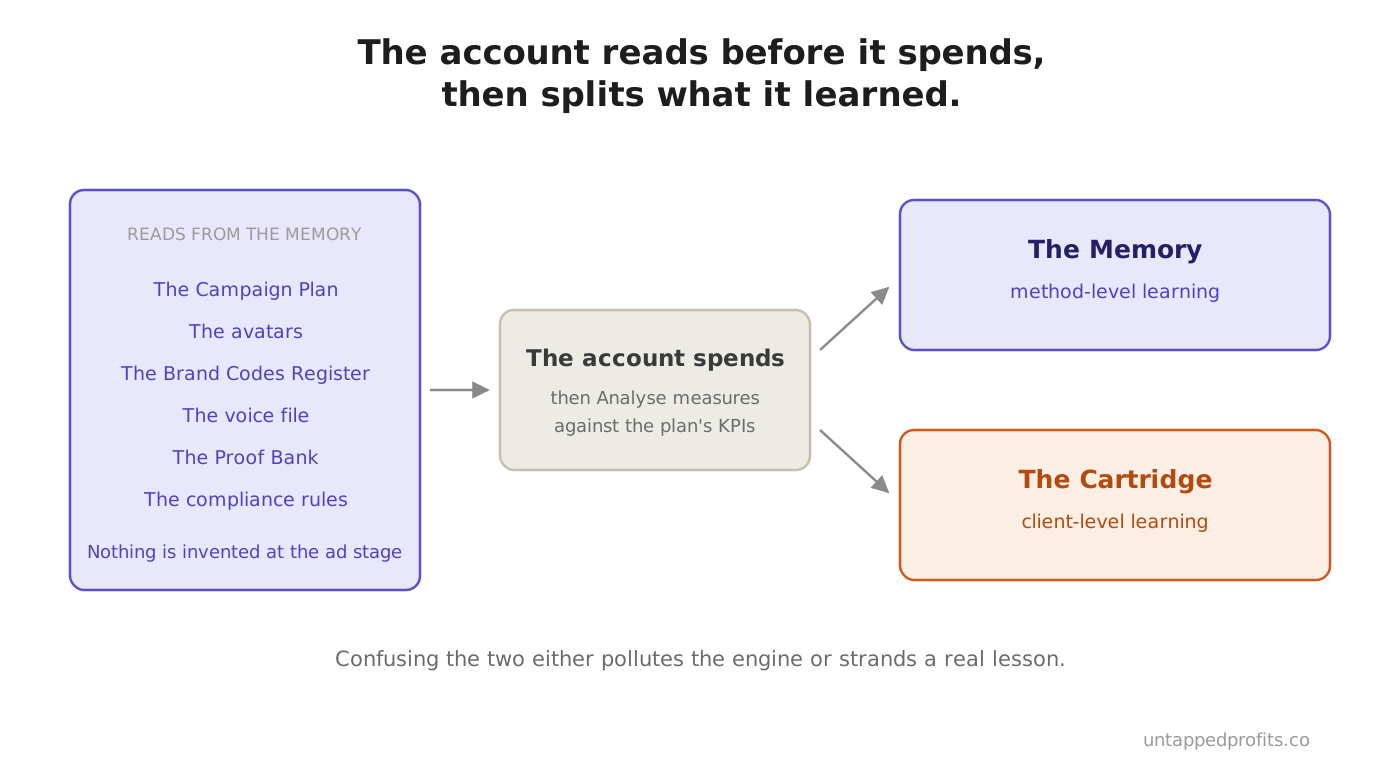
- The ad account reads from the Memory before it spends, taking its plan, its avatars, its brand law and its proof from rulings already made upstream.
- Up to 95% of business clients are not in the market at any one time.1 A channel plan that assumes everyone is shopping is aimed at the wrong 5%.
- It writes back after it spends, and the split is fixed: what the method learns and what one client learns never go to the same place.
- The standard funnel is leads, then marketing-qualified leads (MQLs), then sales, with email list growth tracked separately as audience build instead of being counted as a lead. Counting audience build as demand is how an account flatters itself.
Why does paid media stop compounding?
Because the account's learning has nowhere to go. A campaign ends, the results get reported, and what the spend proved about the market stays inside the platform that hosted it. Three months later the next campaign begins from the same starting assumptions it began from last time, and the business pays a second time for a lesson it has already bought once.
This is rarely a competence problem. The buyer running the account can be excellent and the reporting can be honest, and the outcome is still a business that owns invoices instead of knowledge. Whose Brain Is Your Ad Spend Training? asks the ownership question straight: the accumulated learning is the asset, and in most arrangements the client is renting it back.
The reporting layer conceals the problem it should be exposing. Every channel is measured against the number it chose for itself, so every channel passes. Nobody is measured on the space between channels, which is where a fragmented account spends twice on the same buyer. Your Marketing Partners Aren't Hiding Anything walks that gap end to end — it survives full transparency, because the numbers being shared are true.
What is paid acquisition's job inside the loop?
To buy attention against a written plan, in a defined role, and to return what it learns. Paid is a Build discipline. It reads the Campaign Plan that Plan produced, it turns budget into assets and impressions, and its results go to Analyse to be measured against the plan's KPIs, never against whichever metric the platform would prefer to be judged on.
The named framework is The Four Channel Jobs. Every paid channel on an account is funded to do exactly one of four things, and the job is written down before a budget is set.
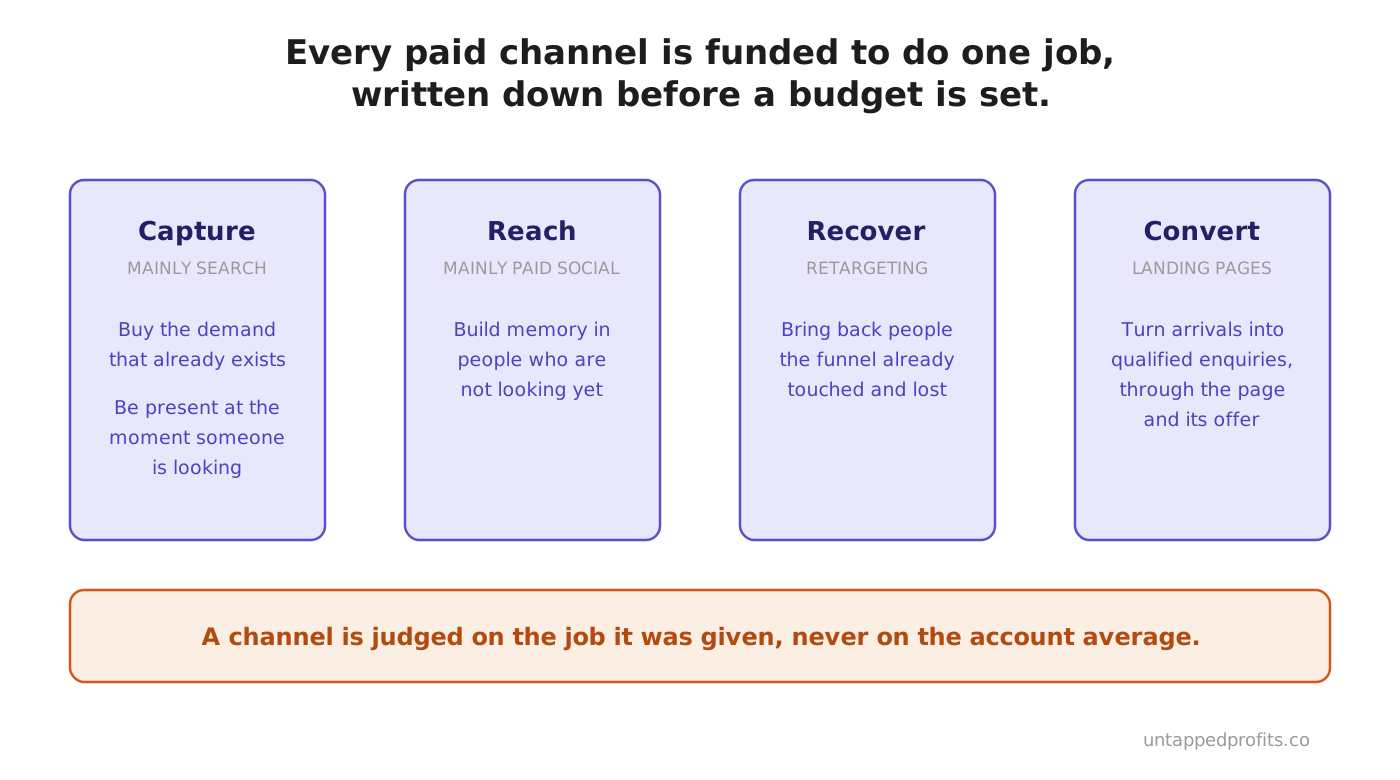
- Capture. Buy the demand that already exists, mainly through search. The job is to be present at the moment someone is looking, and to stay honest about how much of that demand the rest of the marketing created.
- Reach. Build memory in people who are not looking yet, mainly through paid social. This is the job the 95:5 finding argues for, and Dawes puts the mechanism plainly: "advertising mostly hits people who aren't going to buy anytime soon. And in turn, that tells us about how advertising works: it mainly works by building and refreshing memory links to the brand."2
- Recover. Bring back people the funnel already touched and lost, through retargeting. The job has a natural ceiling, and an account leaning hard on it is usually short of reach.
- Convert. Turn arrivals into qualified enquiries, through landing pages and the offer they carry. Paid buys the visit, and this job decides whether the visit was worth buying.
The fourth job carries a rule the method names. Funnel-First Buying settles the destination before it buys the traffic: paid media can only deliver a visit, and whether that visit was worth buying is decided by the page and the offer waiting for it. A click sent somewhere that cannot keep the ad's promise was wasted the moment it was bought, which is why a weak result is read at the funnel before it is blamed on the ad, and why a keyword theme with no page to land on ends in a page brief rather than a campaign build.
Assigning the jobs before the budget is what stops the account being scored on a single blended number. A reach campaign judged on last-click cost will always look like a failure, and killing it is how businesses talk themselves into harvesting demand they have stopped creating.
| Job | Reads from the Memory | Writes back |
|---|---|---|
| Capture | The offer, the Proof Bank, the segments in market | Which claims survive contact with high-intent buyers |
| Reach | Avatars, the Brand Codes Register, the voice file | Which angles hold attention in an audience with no intent |
| Recover | Where the funnel loses people, and at which step | Which objection was actually blocking the sale |
| Convert | The Campaign Plan's KPIs and the qualification rules | Which traffic sources produce leads that settle |
How does an ad account draw from the Memory?
By reading a fixed set of inputs before anything is built or funded. The Build phase reads the Campaign Plan, the avatars, the Brand Codes Register, the voice file, the Proof Bank and the compliance rules. Nothing in an ad gets invented at the ad stage, because the ad assembles decisions that were already ruled on upstream.
The return leg is governed just as tightly. Analyse reads performance against the plan's KPIs, runs loss-driver analysis and a competitive read, then writes the learning back on a fixed split: method-level learning goes to the Memory, client-level learning goes to that client's Cartridge. A finding about how a category of buyer responds is method. A finding about this business's price sensitivity is Cartridge. Confusing the two either pollutes the engine with one client's quirks or strands a real lesson where no future account will ever see it.
In practice
Write the job beside the channel in the Campaign Plan, before the budget column is filled in. "Meta, reach" and "Search, capture" take four words and settle a quarter of the arguments that would otherwise happen in month two, when someone asks why the reach campaign has a worse cost per lead than the branded search campaign.
Watch for
An account where the cheapest conversions and the biggest budget are both sitting in Capture. That account has usually stopped doing Reach, and is spending its way through demand the business built in some earlier period. The numbers look their best in the quarter before the pipeline thins.
What does running paid beside the system cost?
It costs the second campaign, and every campaign after it. The first one is priced correctly, because you pay for the media and you also pay for the learning. From then on the learning should be free. In a fragmented account it gets bought again every time, since nothing persistent was standing there to receive it.
The costs stack in a particular order. Duplicate spend comes first, because two channels chasing the same buyer with no shared view is arithmetic, not bad luck. Message drift follows, since each channel writes its own version of the offer. Then comes the failure that is hardest to see: an account that looks healthier as it gets weaker, tuning itself toward the cheapest conversions until the only thing left is harvesting. That specific illusion is named and diagnosed in The Crusty Table Problem, and the reporting windows that conceal it are audited in Your Ad Platform Is Hiding 60% of Your Returns by Design.
Frequently asked questions
Isn't this just having a strategy before you run ads?
A strategy tells the account what to do once. The Four Channel Jobs tell it what each channel is for, permanently, and give Analyse a defensible basis for judging each one. The difference shows up at the review, when a strategy has been forgotten and a written job is still on the page.
My agency reports every week and the numbers are good. What am I missing?
Probably nothing in the numbers. Per-channel reporting can be entirely accurate and still leave nobody accountable for what happens between channels, which is where fragmented accounts lose money. Ask a different question at the next review: what did last quarter's spend teach us, where is that written down, and which campaign inherited it?
Does every account need all four channel jobs running?
No. Most accounts start with two, usually Capture and Convert, because they pay back fastest. The decision worth making deliberately is when to fund Reach, since it is the job with the longest payback and the one most often cut first when a quarter tightens. The ranking of the four jobs by payback period is this method's own position rather than a sourced finding, and the order will move with category and purchase cadence.
Why not judge the whole account on one blended cost per lead?
Because the four jobs pay back over different periods, and a blended number quietly rewards the fastest one. Run that logic for a year and the account converges on branded search and retargeting, both of which harvest demand instead of creating it.
Where do the ad platform's own recommendations fit?
They are findings, not decisions. A platform's recommendation is tuned to that platform's objective, which overlaps with yours without matching it. It enters the account the same way any other proposal does, through a ruling by the Operator, per The Operator's Laws.
The bottom line
An ad account is a channel of a marketing system, and it should be run like one. Give every channel a written job, read the plan and the brand law before spending, measure against the plan rather than the platform, and return what was learned to a layer that keeps it. Do that and the account gets cheaper to run every quarter, because it stops paying for the same lesson. Skip it and you get the dashboard where every channel reports a win and the business grows no faster than it did last year.
Where this connects
Paid acquisition spends against The Campaign Plan and targets the segments built in Customer Intelligence. Every claim an ad makes has to exist in The Proof Bank first. The creative it runs is produced under Creative Production, and what the spend teaches returns through The Return Arrow into The Memory, which is where the next campaign starts reading. Back to the One Brain Method hub.
Part 4 · Paid Acquisition · Chapter 11 of the One Brain Guide
Previous: The Big Idea ·
Next: Meta Ads ·
All chapters
Sources
- Professor John Dawes, Ehrenberg-Bass Institute, in a paper written for the LinkedIn B2B Institute, 2021: "It might surprise you to learn that up to 95% of business clients are not in the market for many goods and services at any one time." Published on the Ehrenberg-Bass Institute site. Dawes has since stated that the 95% figure is a heuristic and not a precise rule, intended to convey that most buyers are out of market in any given period. The underlying reasoning is category purchase cadence in B2B, so the ratio varies by category. Applying it to small-business channel planning, including B2C categories, is this method's inference.
- John Dawes, The 95:5 Rule, 2021. Source punctuation preserved. Dawes's own site carries the wording "people or firms" where the LinkedIn publication says "business clients".
Every statistic and quotation on this page has been checked against its primary source. Last verified 24 August 2026.
Free guide
Take the method with you. The complete One Brain Method as one PDF: every chapter, the diagrams, and every named framework, ready to hand to whoever runs your marketing. Enter your email and it's yours.
Want an ad account that gets cheaper to run every quarter?
Book a 30-minute call → See what it takes to have this installed