
The Proof Bank is the register of every verifiable fact a brand may use in its marketing, each banked with its source and an ID, so any claim in any asset can be traced to its evidence in seconds.
Key takeaways
- Every banked fact carries five things: an ID, the exact statement, the source, its dates, and where it's used.
- The enforcement arm is Evidence-to-Verify, which makes the bank a gate rather than a reference shelf: proof is a precondition of shipping, not a defence assembled afterwards.
- 57% of the businesses in the ACCC's sweep of Australian websites were making concerning environmental claims.1 Unsubstantiated claims are an enforcement target, not just a trust problem.
- Facts expire. Every banked fact carries a review date, and passing it suspends the claim until someone re-checks the source, because "was true in 2023" is not a licence in 2026.
- The bank replaces memory rather than doubting anyone's honesty, because provenance dies with vendor churn and rounded-up numbers long before anyone intends to mislead.
Why do marketing claims drift into fiction?
Rarely by lying. Claims drift the way rumours do, through retelling. A real result gets rounded up in a deck, the rounded version gets quoted in a brief, a new copywriter inherits the brief and sharpens the line, and now the brand triples response rates with no living connection to whatever was once true.
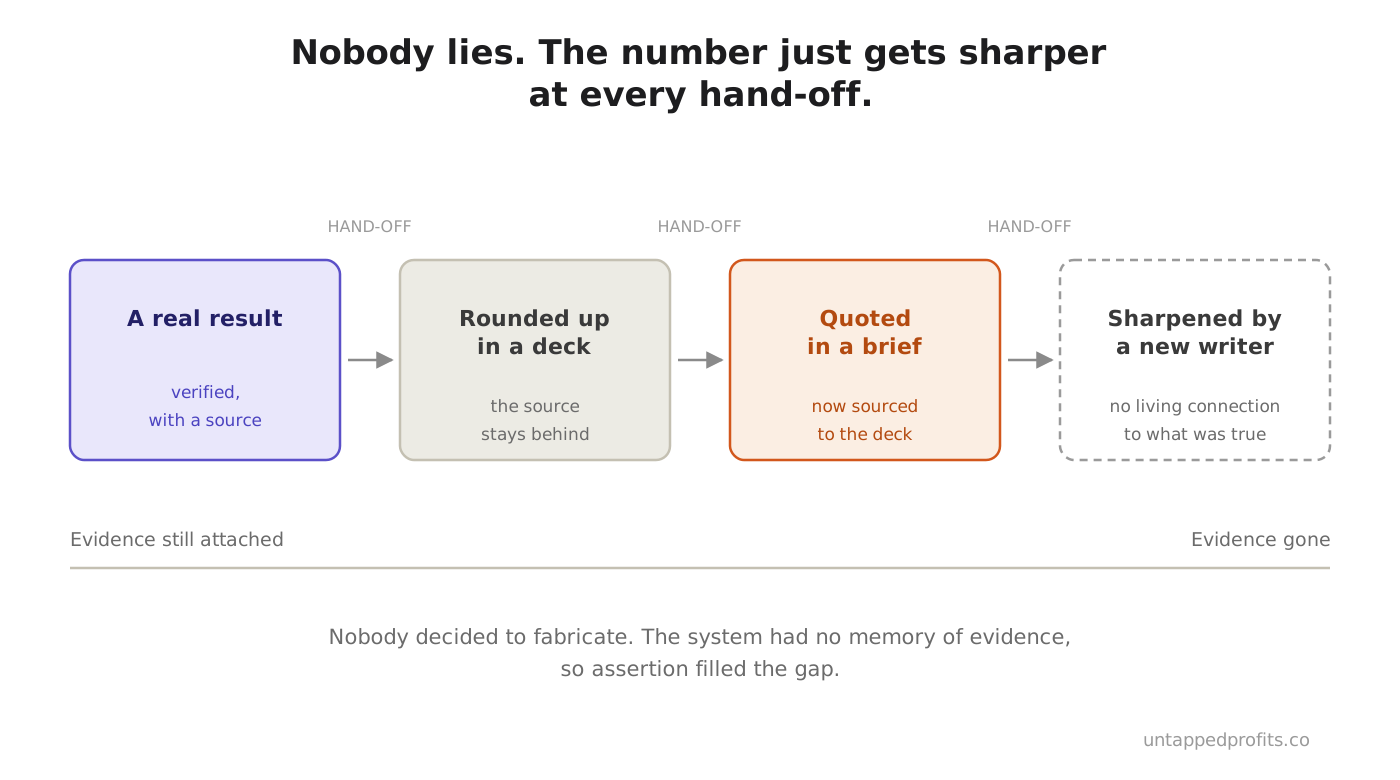
Add vendor churn and provenance dies completely, because the person who knew where the number came from left two agencies ago. Nobody decided to fabricate. The system had no memory of evidence, so assertion filled the gap. That gap is also why so much marketing copy hedges: writers who can't verify anything reach for language that can't be wrong. Hedge enough times and it becomes the house style.
The regulator has noticed. When the ACCC swept Australian business websites for environmental claims in October 2022, 57% of the 247 businesses reviewed were identified as having made concerning claims about their environmental credentials.1 That is not a survey of cowboys. It is a majority of ordinary businesses publishing claims a regulator couldn't square with evidence.
Richard Feynman gave the rule its cleanest form in his 1974 Caltech commencement address: "The first principle is that you must not fool yourself—and you are the easiest person to fool."2 The founder is always the person most sincerely convinced of the claim, which is exactly why the claim needs a bank instead of a memory.
How does the Proof Bank work?
By making every claim a lookup. The named discipline is Evidence-to-Verify: no claim ships unless it is in the bank. Each fact is filed with its source and an ID, every asset cites that ID, and anything unbanked is rejected before a human ever reviews it. "Can we say this?" stops being a debate and becomes a search.
- Every fact is banked with its source and an ID. Not "we're the fastest" but a specific, verifiable statement, with where it came from and when it was verified, filed under an ID any asset can cite.
- Assets cite the bank, not the vibe. Every factual claim in every ad, page and email traces to a bank ID.
- Evidence-to-Verify blocks what isn't banked. A claim with no ID doesn't reach the Operator's review, the same way creative that trips an Ejection Trigger never makes it to the desk.
- Facts carry dates and get re-verified. Evidence ages. A banked fact has a review date, and a fact past its date is treated as unproven until someone checks it again.
- The bank compounds. Every loop produces new verifiable facts, from results to milestones to proof of outcomes, and each one banked is a claim the brand can make forever after, with receipts.
| What a banked fact carries | Why it's there |
|---|---|
| ID | So assets can cite it and audits can trace it |
| The exact statement | The claim as it may be made, with no rounding up in transit |
| Source | Where the evidence lives, meaning the primary and never a retelling of it |
| Date verified and review date | Evidence ages, so the bank knows when to stop trusting itself |
| Where it's used | So a retired fact can be pulled from every asset that leaned on it |
You are reading the discipline in operation, including its failures. Every statistic and quotation in this guide is checked against its primary source before publishing, and that check has caught three attribution errors in this guide's own drafts. A workweek statistic was attributed to McKinsey when that figure belonged to a different publisher; the verified McKinsey finding that replaced it now stands in The Memory, source and all. "Plans are worthless, but planning is everything" was presented as Eisenhower's line when the transcript shows him quoting an Army saying he had heard. And the Ogilvy line in Customer Intelligence was drafted in a popular paraphrase rather than his published wording. Every one came from an aggregator instead of a primary. Three errors, all in material that read as authoritative, none written by anyone careless. That is what a bank is for.
In practice
Bank the fact on the day it happens, while the evidence is still in reach. A result that was easy to prove in the week it landed becomes an archaeology project six months later, and that delay is where most of a business's best true stories quietly become unusable.
What should you measure in a Proof Bank?
Whether claims are traceable, whether the filter runs upstream, and whether the bank is still current. Factual claims traceable to a bank ID tell you if Evidence-to-Verify is holding. Claims blocked before review tell you the filter is working where it's cheap. And banked facts past their review date tell you whether the bank is current or curdling.
| Measure | What it tells you | Target |
|---|---|---|
| Factual claims in live assets traceable to a bank ID | Whether Evidence-to-Verify is holding | All of them |
| Claims blocked before review | Whether the filter works upstream, where it's cheap | Every unbanked claim, caught before the Operator sees it |
| Banked facts past their review date | Whether the bank is current or curdling | Zero in live use |
| Time to answer "can we say this?" | Whether proof is an asset or an argument | Seconds, because it's a lookup |
Watch for
The fact whose source is another piece of marketing. A statistic sourced to a blog post that sourced it to a report nobody has opened is not banked, it is laundered. If the source line doesn't point at something a stranger could open and check, the fact isn't in the bank yet.
What does skipping the Proof Bank cost?
At the cheap end, hedged copy. Writers who can't verify claims protect themselves with mush, and mush doesn't convert. At the expensive end, the retraction, the complaint, the regulator's letter, the case study a prospect fact-checked before the sales call.
In between sits a quieter loss. The brand's best true stories go unused because nobody wrote them down when they happened, so the most persuasive facts the business ever earned are exactly the ones it can no longer prove. And the requirement is getting stricter as buyers bring their own machines: when an AI agent is checking a vendor's claims against public evidence before a human reads the page, unverifiable assertions fail earlier than they used to, a shift spelled out in Buyer Agents Don't Compress Funnels, They Audit Them.
Frequently asked questions
Won't this strangle the copy?
Backwards. Unverified claims force hedging, and banked proof licenses boldness. The strongest line a writer can be handed is a specific, sourced, surprising fact, so a bank full of them is a bank full of hooks. AI has made this sharper, because tools will happily generate tone and cannot generate evidence — AI Copy Tools Ask for Your Tone. The Proof Is Still Your Job. takes that apart in full.
Isn't this admin we don't have time for?
Banking a fact costs minutes once. Not banking it costs the same argument about whether you can say it every time the claim comes up, and one bad outcome, whether a pulled campaign or a regulator inquiry or a torched reference, costs more than a decade of the admin. The 57% above weren't businesses that ran out of time to check. They were businesses with no system that made checking automatic.
Aren't our claims obviously true?
To whom, on what evidence, as of when? The three errors this guide caught in its own drafts are the cautionary tale in miniature: claims everyone knows are exactly the ones nobody checks. Obviousness isn't a source. The bank doesn't doubt your claims, it makes them permanent.
What counts as a source?
Something a stranger can open and check, which in practice means the primary. That means the original study instead of the article about it, the regulator's own release instead of the law firm's summary, and the book page instead of the quote site. Every attribution error caught in this guide came from stopping one step short of that.
What about claims that can't be proven?
They can still be made, so long as they are framed as opinions. "We think most marketing fails for structural reasons" is a position, and "we improve response rates by 300%" is a claim. The bank governs the second kind. Confusing the two is how a brand's honest argument ends up sounding like its unverifiable boast.
The bottom line
Marketing claims go wrong through retelling rather than dishonesty, and the businesses that get caught are mostly ordinary ones with no system for checking. The Proof Bank makes checking structural, with every fact filed under its source and an ID, every claim traceable in seconds, and anything unbanked stopped before a human sees it. Do that and the brand can be bold, because everything it says can be shown.
Where this connects
The bank is Plan's second input, beside Customer Intelligence. One holds what the buyer believes, the other holds what the brand can prove, and The Campaign Plan is built where they meet. Downstream, the standing law that no claim may appear absent from the bank is enforced at The Review Seams' brand-QA gate, which makes the bank a boundary every asset in Creative Production must respect. New proof enters through The Return Arrow as results become facts. Back to the One Brain Method hub.
Part 3 · Plan · Chapter 8 of the One Brain Guide
Previous: Customer Intelligence ·
Next: Method-Actor Research ·
All chapters
Sources
- ACCC, "ACCC 'greenwashing' internet sweep unearths widespread concerning claims", March 2023. The sweep ran 4 to 14 October 2022 and reviewed 247 businesses and brands across eight targeted sectors. Of those, 57% were identified as having made concerning claims about their environmental credentials. The ACCC notes some of those claims may be accurate but were not substantiated.
- Richard P. Feynman, "Cargo Cult Science", Caltech commencement address, 1974. Source punctuation preserved.
Every statistic and quotation on this page has been checked against its primary source. Last verified 24 August 2026.
Free guide
Take the method with you. The complete One Brain Method as one PDF: every chapter, the diagrams, and every named framework, ready to hand to whoever runs your marketing. Enter your email and it's yours.
Want marketing that can show receipts for every claim it makes?
Book a 30-minute call → See what it takes to have this installed