
A synthetic presenter is not a production shortcut with a face on it. It is a distinctive brand asset and a claim-bearing entity at the same time, which means it inherits two registers the moment it appears, and most businesses govern it under neither.
Key takeaways
- This chapter's law is imported: the Brand Codes Register, applied to synthetic presenters. A recurring character or spokesperson is one of the code categories, so an avatar is governed as an asset and not commissioned as one.
- Consistency is the entire mechanism, and it applies with unusual force here because a presenter can be regenerated on a whim: a proposed change starts from no and earns its way to yes. That is Romaniuk's rule, carried with its wording and sourcing in The Brand Codes Register.
- Branding pays even at glancing view times,2 which is what makes a recurring presenter worth locking rather than regenerating.
- A synthetic voice or face carries claims, so it answers to the claims discipline. Testimonials are real, attributed and permissioned, so a synthetic performance of a testimonial is not a testimonial.
- The brief stays tool-agnostic, written as performance rather than prompt syntax. Nothing in this medium outlives its current tool, so the brief is built to outlive them all and the translation happens downstream.
What is a synthetic asset governed as?
As a brand code and as a claim at the same time. Those are two different registers with two different owners, and a synthetic presenter sits in both. Treat it only as a production question and it drifts visually. Treat it only as a compliance question and it never becomes an asset worth having.
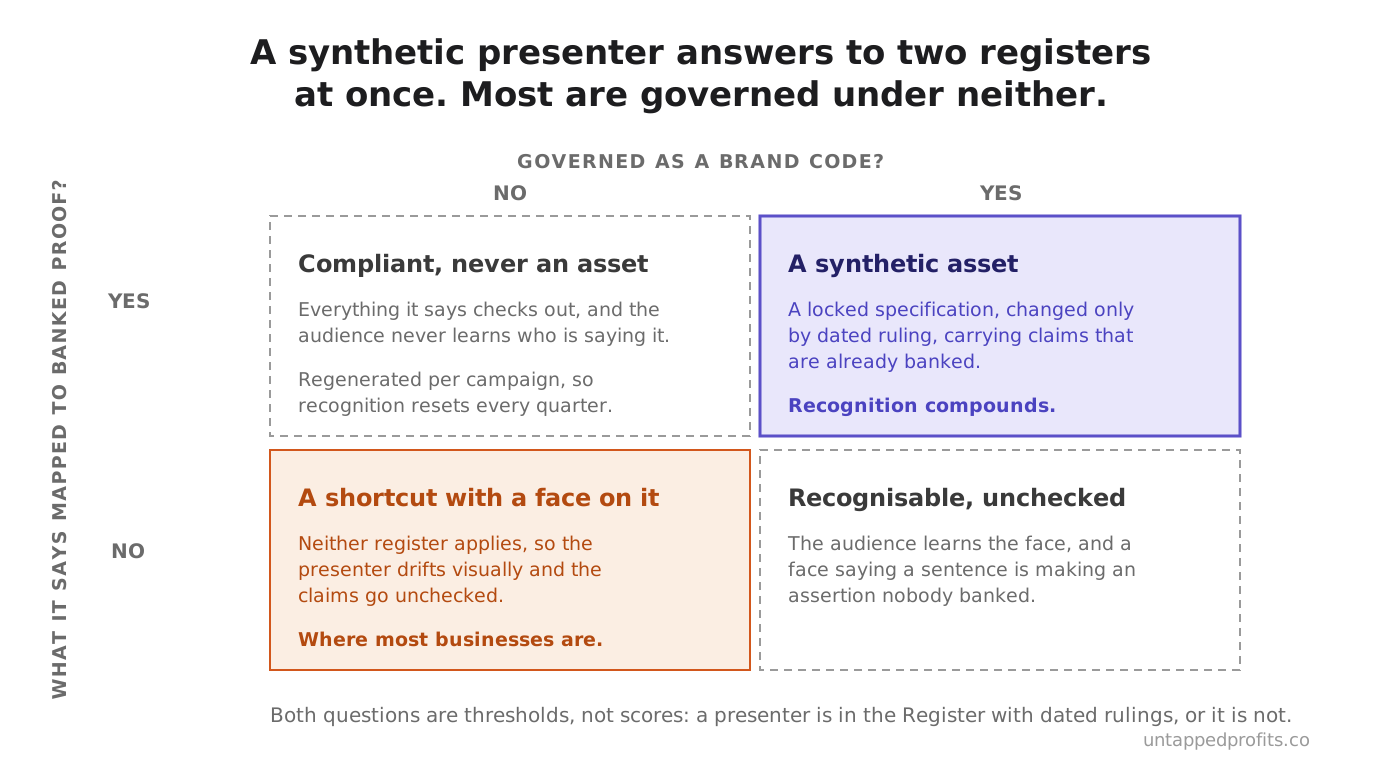
The code side is straightforward once it is named. Mascots, characters and recurring spokespersons are one of the brand-code categories, alongside colour, typography, sonic cues and the verbal assets. A character functions as a shortcut to recognition and can carry brand attribution without other cues present, which is exactly why it is worth building deliberately rather than generating per campaign.
The claim side is where synthetic work gets businesses into trouble. A face saying a sentence is making an assertion, and every factual assertion maps to a banked proof item. Synthetic production does not change that, and it only makes it easier to produce assertions faster than they can be checked.
Why does consistency matter more here than anywhere else?
Because the cost of changing a synthetic presenter is nearly zero, and the cost of having changed it is not. A human spokesperson is expensive to replace, so nobody replaces one casually. An avatar can be regenerated in an afternoon with a slightly different face, a slightly different voice, a slightly warmer grade, and none of those decisions feels like a brand decision at the moment it is made.
Six months of that produces a presenter the audience has never quite met. Romaniuk's discipline is the correction, and it is stated as a default rather than a preference: consistency is crucial, and a proposed change starts from no and has to earn its way to yes.1 Applied here, that means the presenter's appearance, voice and manner are a locked specification governed by dated rulings, exactly like a palette or a wordmark.
The payoff is measurable: well-branded assets outperform weak ones even at very limited view times, and Video carries the finding and its sourcing.2 A recurring presenter is among the cheapest codes a small business can build, and among the easiest to spend without noticing.
| Governed as an asset | Generated per campaign | |
|---|---|---|
| Appearance | Locked specification, changed only by dated ruling | Whatever the tool produced this time |
| Voice | A fixed identity the audience learns | Re-selected per project |
| Recognition | Compounds, and carries attribution without a logo | Resets every quarter |
| What it says | Claims mapped to banked proof | Whatever the script needed |
| Disclosure | A standing rule the client has ruled on | Decided per ad, if at all |
In practice
Write the presenter's specification once, into the Brand Codes Register, and give it dated governance rulings the way a palette gets them. Then the question at production time is not "which avatar should we use" but "has anything changed", and the honest answer is almost always no.
Watch for
A synthetic performance being briefed as a testimonial. The claims discipline is explicit that testimonials are real, attributed and permissioned. A generated person delivering words a customer did not say is not a weaker testimonial. It is a different thing entirely, and treating it as evidence is how a brand loses the trust its Proof Bank exists to protect.
What does the brief contain, and what does it deliberately leave out?
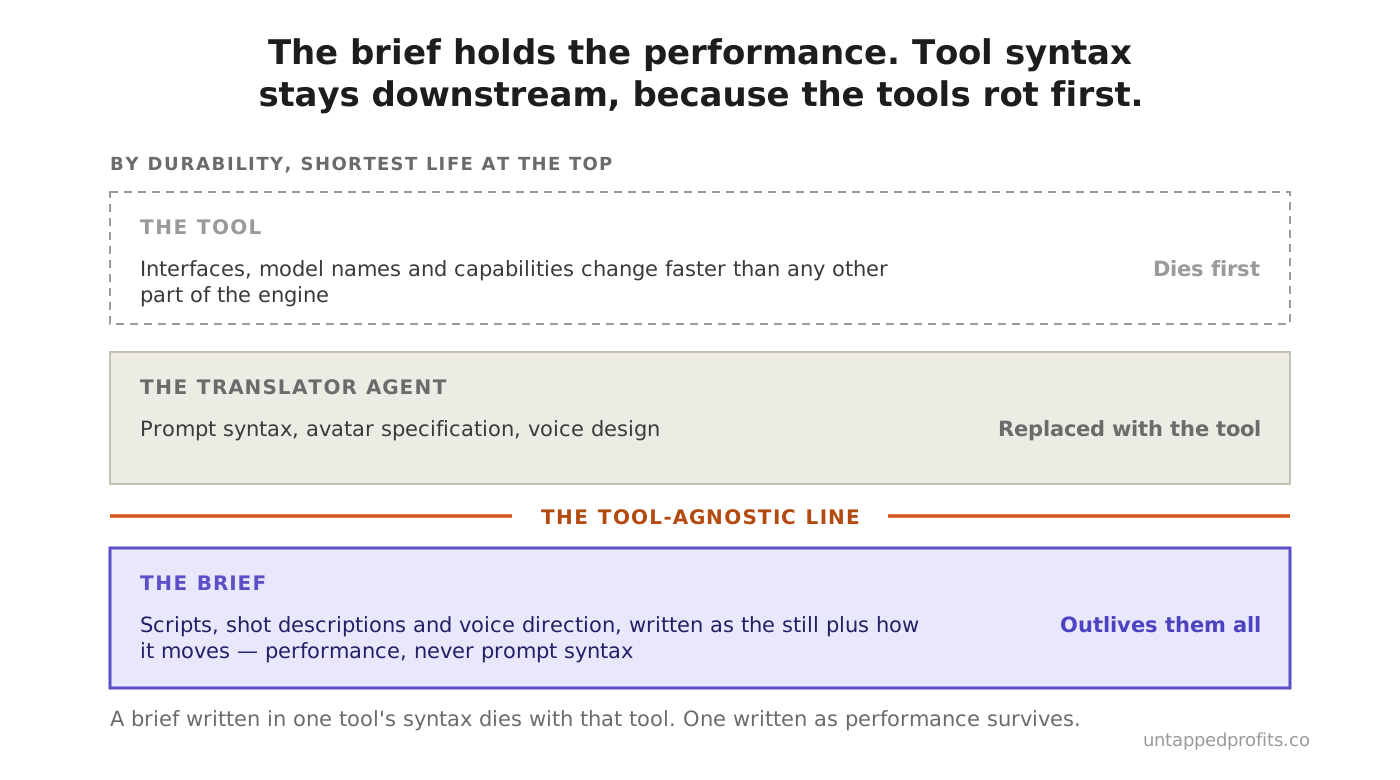
It contains the performance and the specification, and it leaves out the tool. Deliverables are scripts, shot descriptions and voice direction, written as the still plus how it moves. Prompt syntax, avatar specification and voice design happen downstream in translator agents rather than inside the brief.
That separation is a rot decision and not a stylistic one. Synthetic generation tools change their interfaces, their model names and their capabilities faster than any other part of the engine, and a brief written in one tool's syntax dies with that tool. A brief written as performance survives, and the translation step is cheap.
Everything else the medium touches is already governed. The script answers to the video law, meaning the entry rule, the ceilings and the protagonist traced to the Intelligence Pack. The voice answers to the client's voice profile. The claims answer to the Proof Bank. Nothing here is a new body of law, because the chapter's job is to say which existing laws attach and in what order.
Where do the lines sit on disclosure and likeness?
Client's counsel first, standing rules second, per-ad improvisation never. Where an external body regulates what a client may say about their product, their results or their qualifications, the regulator wins immediately and without debate. The method bends, the law does not. That applies to synthetic likeness and voice as much as to any other claim surface.
Outside regulated verticals, the honesty floor still holds. Platform policy is a floor rather than a target, comparative claims stay factual, and caveats travel with the claim they qualify. And the likeness question has one hard edge that is not a matter of taste: a synthetic presenter must not be built on a real person's likeness or voice without that person's permission, and a client's own executives are not an exception to it.
This is the thinnest part of the guide, and the honest thing to say is why. The engine governs claims, codes and production comprehensively. It does not yet carry a dedicated body of law for synthetic likeness, and this chapter is assembled from the adjacent rules that clearly apply rather than from a file written for the purpose. Where a client's situation runs past what those rules cover, that is a conversation and a ruling, not something to route around.
Frequently asked questions
Should a small business use a synthetic presenter at all?
It is a legitimate way to build a recurring character cheaply, and characters are one of the strongest recognition shortcuts available. The condition is that it is treated as an asset from the first use, meaning specified, locked and governed, rather than as a convenience that happens to have a face.
Can a synthetic voice read a real customer's words?
Only with that customer's permission and with the synthesis disclosed. The words being real does not make the delivery real, and an audience that discovers the difference does not draw a fine distinction about which half was authentic.
How does this fit the medium-agnostic law?
Exactly as the other media do. Hooks pass the same tests, claims come from the same bank, brand codes carry, the gates run and the cold read happens. Synthetic production changes the cost and speed of execution, and it changes none of the law that decides what deserves to be executed.
What about avatars used for volume testing rather than brand building?
Then the recognition argument does not apply, and the claims discipline still does. A disposable presenter used to test angles is a production tool. The moment one recurs often enough for an audience to recognise it, it has become a brand code by accident, and it should be governed deliberately from that point and not retroactively.
Why is this chapter shorter than the others in this part?
Because the underlying law is genuinely thinner here than it is for statics, hooks or video, and padding it would misrepresent how developed this part of the method is. Publishing what exists and marking the boundary honestly is the same discipline the guide applies to any claim.
The bottom line
Treat a synthetic presenter as a brand code with a compliance surface, and the decisions become obvious: specify it, lock it, change it only on a dated ruling, map everything it says to banked proof, disclose the synthesis, never build it on a likeness you do not have permission for, and keep the brief tool-agnostic because the tools will not last. Treat it as a cheap way to make a video and it becomes an asset the audience never learns and a claim nobody checked.
Where this connects
Synthetic assets are governed by The Brand Codes Register, inherit the medium-agnostic law in Creative Production, run through The Five Gates, and are scripted under the rules in Video. Everything a presenter says must exist in The Proof Bank, and changes are ruled under The Operator's Laws. The archive argument closest to this chapter is Your AI Marketing Has a CGI Problem, on how almost-right AI output destroys trust faster than obviously generic work. Back to the One Brain Method hub.
Part 5 · Creative Production · Chapter 23 of the One Brain Guide
Previous: Generated Imagery ·
Next: Content & Channel ·
All chapters
Sources
- Professor Jenni Romaniuk, Ehrenberg-Bass Institute, The Four Commandments: future proofing a brand's identity. The rule's exact wording is carried in The Brand Codes Register.
- VCCP Media, Dr Karen Nelson-Field and Amplified, 16 May 2025, published by Amplified. The finding, its exact wording, its sample and the publishers' commercial interest are set out in Video. The research measured digital video ads; applying it to a synthetic presenter is this method's inference.
Every statistic and quotation on this page has been checked against its primary source. Last verified 27 August 2026.
Free guide
Take the method with you. The complete One Brain Method as one PDF: every chapter, the diagrams, and every named framework, ready to hand to whoever runs your marketing. Enter your email and it's yours.
Want a synthetic presenter governed as an asset from day one?
Book a 30-minute call → See what it takes to have this installed