
The Landing Page Build is where the promise made in the ad is kept or broken. Every gate upstream can pass and the money still disappears if the page nobody assessed is doing the receiving.
Key takeaways
- The offer, the copy, the value propositions and the voice already exist before this work starts. The job is deploying them, never re-deriving them.
- The conversion step is where the money leaks: Baymard's fourteen years of tracking put cart abandonment at 70.19 percent, with the design and flow of that step frequently the only cause, and the average benchmarked site carrying 32 improvements still to make.1
- Friction comes in four kinds, and naming the kind is what makes the fix specific instead of a note saying the page feels cluttered.
- Every finding is written as a hypothesis with the replacement copy included, and impacts are directional rather than invented percentages.
What already exists before the page does?
Almost everything that matters. The offer, the copy, the unique selling points, the value propositions and the voice come from the client's own layer or arrive in the brief, and they are treated as the source of truth. The page work does not re-derive the offer, invent new selling points or quietly reposition the business. It deploys what exists onto a surface that converts.
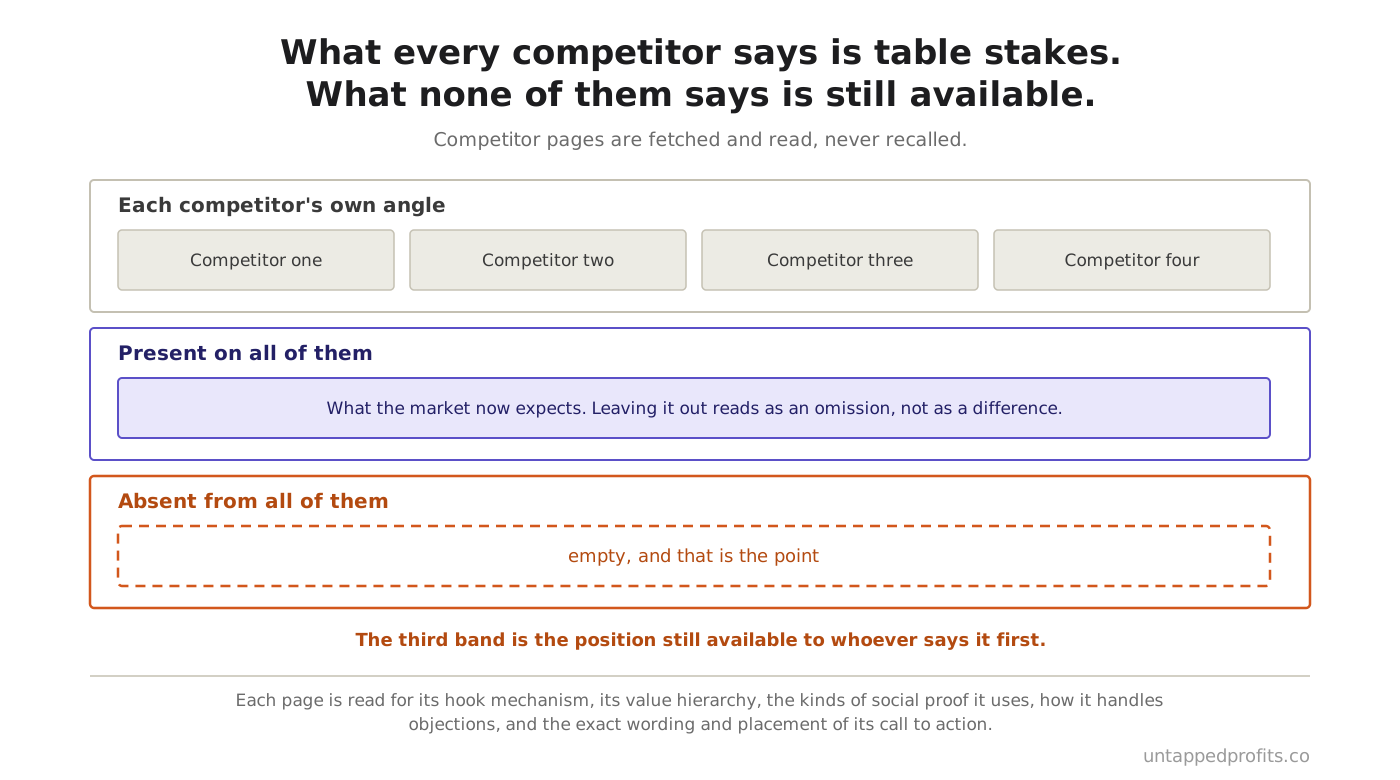
One live research task survives that rule, and it is competitor page review. Those pages are fetched rather than recalled, and each is read for its hook mechanism, its value hierarchy, the kinds of social proof it uses, how it handles objections, and the exact wording and placement of its call to action. Across the set, three things matter: each competitor's unique angle, what appears on all of them, and what is missing from all of them.
That last one is where the opportunity sits. What every competitor includes is what the market now expects, and leaving it out reads as an omission. What none of them says is available to whoever says it first — Stop Trying to Be Different is the claim-it-first case in full.
How does a page get built?
In six steps, and the first is reading. The client's material is mapped onto exact pain phrases, desired outcomes, failed solutions, objections, trigger moments and the language they use to justify a purchase. Verbatim wherever the material provides it. What gets captured alongside is the deeper problem under the surface one and any distinctive metaphor in the customer's own words, because those feed headlines directly.
Value propositions are then selected and sharpened from what the client already has, tested against the competitor gaps, and narrowed to a recommendation with a reason. The hero section follows: a headline mirroring the customer's own problem language, a subheadline promising a specific outcome ideally framed as the result without the objection, a visual described precisely enough to brief, and a call to action that continues the visitor's thought instead of interrupting it.
Fourteen years of testing led Baymard to a blunt conclusion about where the losses happen. They found the design and flow of the conversion step to "frequently be the sole cause for users abandoning their purchase", either because people become angry enough to leave or because they cannot work out how to complete a field.1 The page is not the last thing to look at when performance disappoints. It is frequently the only thing that mattered.
The trust sequence is the step most often built backwards. Proof is not scattered decoratively down the page. Each objection from step one gets an element that answers it, in the order scepticism actually arises, in whichever format is most believable for that specific doubt. Third-party evidence carries further than anything the business says about itself — Sammy Davis Jr Told 25 Lies About Me got the proof secondhand, which is exactly why it worked.
In practice
Note what you deliberately left off the page, and why, at the moment you leave it off. Six weeks later nobody remembers whether the guarantee was omitted for a reason or forgotten, and the difference decides whether adding it is a test or a correction. One line per omission is enough.
How is an existing page diagnosed?
In five layers, and only two of them need data. Analytics interpretation and heatmaps are used where they are supplied and never waited for, turning drop-off points and engagement patterns into named hypotheses that direct where to dig next. The other three always run: the friction finder, the check of page copy against the market's own language, and a checklist audit that reports real gaps and never a box-ticking transcript of everything present.
| Friction | What it looks like | The question that finds it |
|---|---|---|
| Cognitive | Jargon, unclear terms, sentences that need re-reading | Where did I have to go back and read that again? |
| Emotional | Claims that feel exaggerated, missing reassurance | Where did I stop believing this? |
| Decision | Unclear next step, too many choices, missing information | What do I still not know that I need to know? |
| Visual | Competing focal points, broken hierarchy, clutter | Where did my eye go, and was that the right place? |
The copy-market fit layer catches the failure that looks like a writing problem and is not. A page trying to satisfy readers who arrived needing different things will compromise on every line, and that is a segmentation failure. That belongs upstream in the funnel arrangement, and the diagnosis says so alongside the page fixes.
Beauty is not on any of these lists on purpose. A page can be well designed and still fail to sell, because nobody measured the design against an outcome. A page is accountable to the result, not to taste.
What does a finding have to look like?
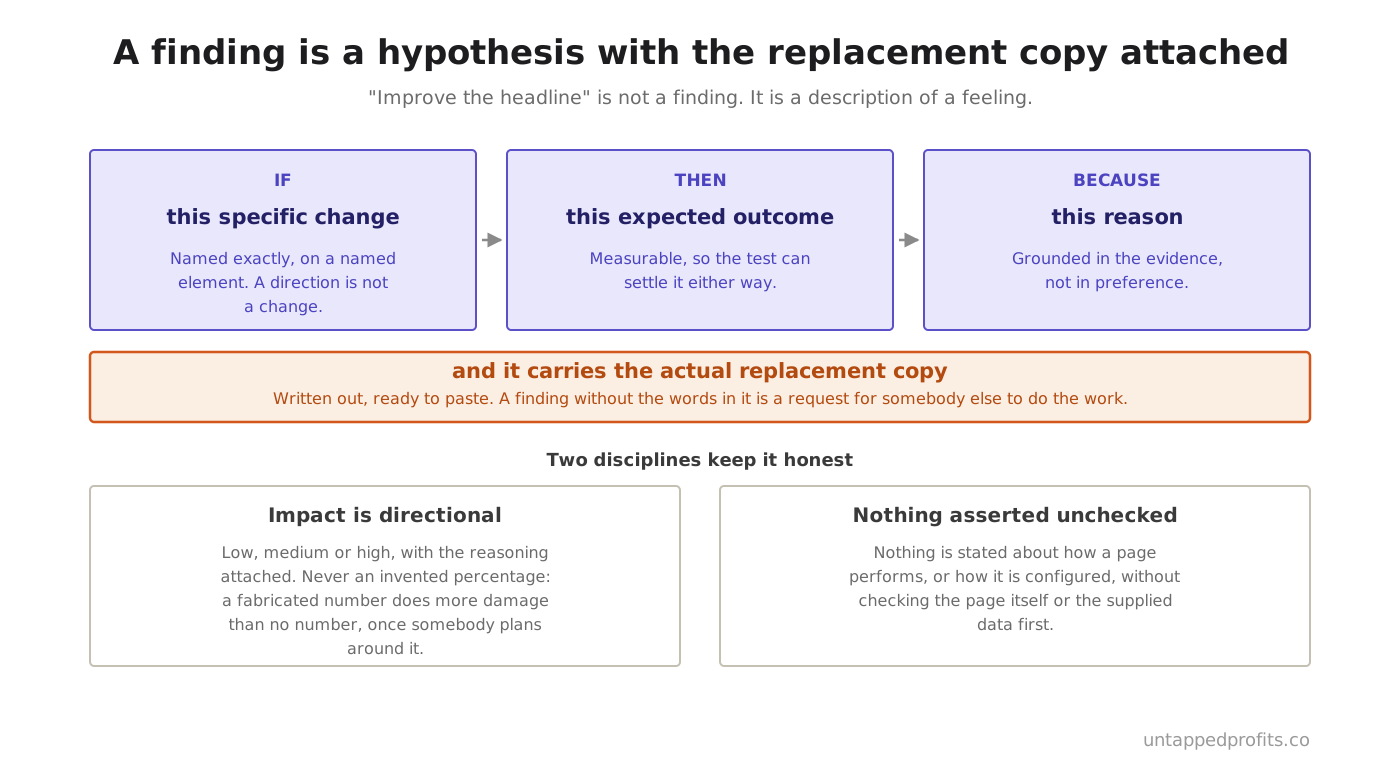
A hypothesis with the fix written out. If this specific change, then this expected measurable outcome, because of this reason grounded in the evidence. Findings are split into quick wins that can happen this week and structural changes that need a rebuild or a test. Every one carries actual replacement copy, because "improve the headline" is not a finding, it is a description of a feeling.
Two disciplines keep that honest. Impacts are directional, meaning low, medium or high with the reasoning attached, and never an invented percentage, because a fabricated number is more damaging than no number at all once somebody plans around it. And nothing is stated about how a page performs or is configured without checking the page or the supplied data first.
The claims on the page answer to the same evidence discipline as claims anywhere else in the system. A specific believable number beats a superlative, an unbanked claim does not ship regardless of how well it reads, and the page is not the place where the business finally gets to say the thing it cannot support.
Watch for
The dark pattern that arrives disguised as urgency. A countdown that resets, a stock figure nobody counted, a discount that never expires. They lift the number this week and cost the trust the page was built to earn. If the scarcity is real, say it plainly. If it is not, the page has to work without it.
Frequently asked questions
Do I need analytics before a page can be diagnosed?
No. Analytics and heatmaps are layers used when supplied and never waited for. Three of the five diagnostic layers run on the page itself, and a page can be improved substantially before the first useful week of data arrives.
How many value propositions should a page test?
Up to five candidates get developed and one gets recommended with a reason. The page runs one. The others are not wasted, because a candidate that loses on this page is often the right angle for a segment-specific advertorial in front of it.
Should the page be rebuilt or improved in place?
Improve it in place, unless the diagnosis says the page is failing because of what it is being asked to carry. That is a funnel problem, not a page problem, and rebuilding the page will not fix it. Where both apply, the recommendation says which to test first.
What about long pages against short ones?
Neither is right in the abstract. The correct length depends on how much the ads in front of the page have already done, and a page inherits that decision instead of making it. Judging page length on its own is judging half a sequence.
Who writes the final copy?
The page work delivers full final copy in the client's voice, section by section, in page order, with layout and visual direction beside it. It does not hand over notes. Every word then passes the same sentence law and the same cold review as anything else the system publishes.
The bottom line
The page is the point where all the upstream discipline either pays off or evaporates, and it is the step most often left to whoever built the website. Deploy what already exists rather than reinventing it, answer objections in the order they arise, name the friction precisely enough to fix it, and write every finding as a hypothesis with the replacement copy attached. A page assessed properly is the cheapest performance gain most accounts have available.
Where this connects
The Landing Page Build sits under Funnel Engineering, which decides how much this page is being asked to carry. The offer and the argument arrive from The Campaign Plan and The Big Idea, the objections it answers come from Customer Intelligence, and every claim on it answers to The Proof Bank. Headlines face The Hook Law and every sentence answers to Writing for Clarity.
Part 7 · Funnel Engineering · Chapter 34 of the One Brain Guide
Previous: Funnel Engineering ·
Next: Lead Nurture ·
All chapters
Sources
- Baymard Institute, Cart & Checkout Usability Research, accessed 25 August 2026. Baymard states that it has tracked the global average cart abandonment rate for 14 years and that it currently sits at 70.19 per cent, drawn from a reference list of 49 abandonment statistics. Its benchmark covers 344 top-grossing United States and European e-commerce sites scored against more than 110 cart and checkout guidelines, finding 65 per cent mediocre or worse, 35 per cent decent or better, two per cent good and none reaching state of the art, with the average site carrying 32 unique improvements to make. The quoted words are Baymard's own description of its testing findings. One currency note: Baymard maintains its cart-abandonment aggregate as a separate list, which was updated in September 2025 to 70.22 per cent across 50 studies. The 70.19 per cent figure above is the one carried on the checkout usability research page read for this chapter, so a reader checking Baymard's site may find either depending on which page they land on. Baymard sells UX research subscriptions and audit services, so it has a commercial interest in the finding that most sites need improvement. The research covers e-commerce checkout rather than lead-generation pages. Applying it to a service business's enquiry page is this method's inference.
Every statistic and quotation on this page has been checked against its primary source. Last verified 27 August 2026.
Free guide
Take the method with you. The complete One Brain Method as one PDF: every chapter, the diagrams, and every named framework, ready to hand to whoever runs your marketing. Enter your email and it's yours.
The cheapest performance gain in most accounts is the page nobody has assessed.
Book a 30-minute call → See what it takes to have this installed