
Most Meta accounts cannot answer the question "what did we learn last quarter", because nothing in the account records what each ad was actually testing. The structure exists to fix that, by making the creative pipeline readable in Ads Manager.
Key takeaways
- The named framework is The Concept Ad Set: one avatar, one concept, and the ads inside it are that concept's executions. The same word means the same thing at the creative gate, in the tracker and in the account.
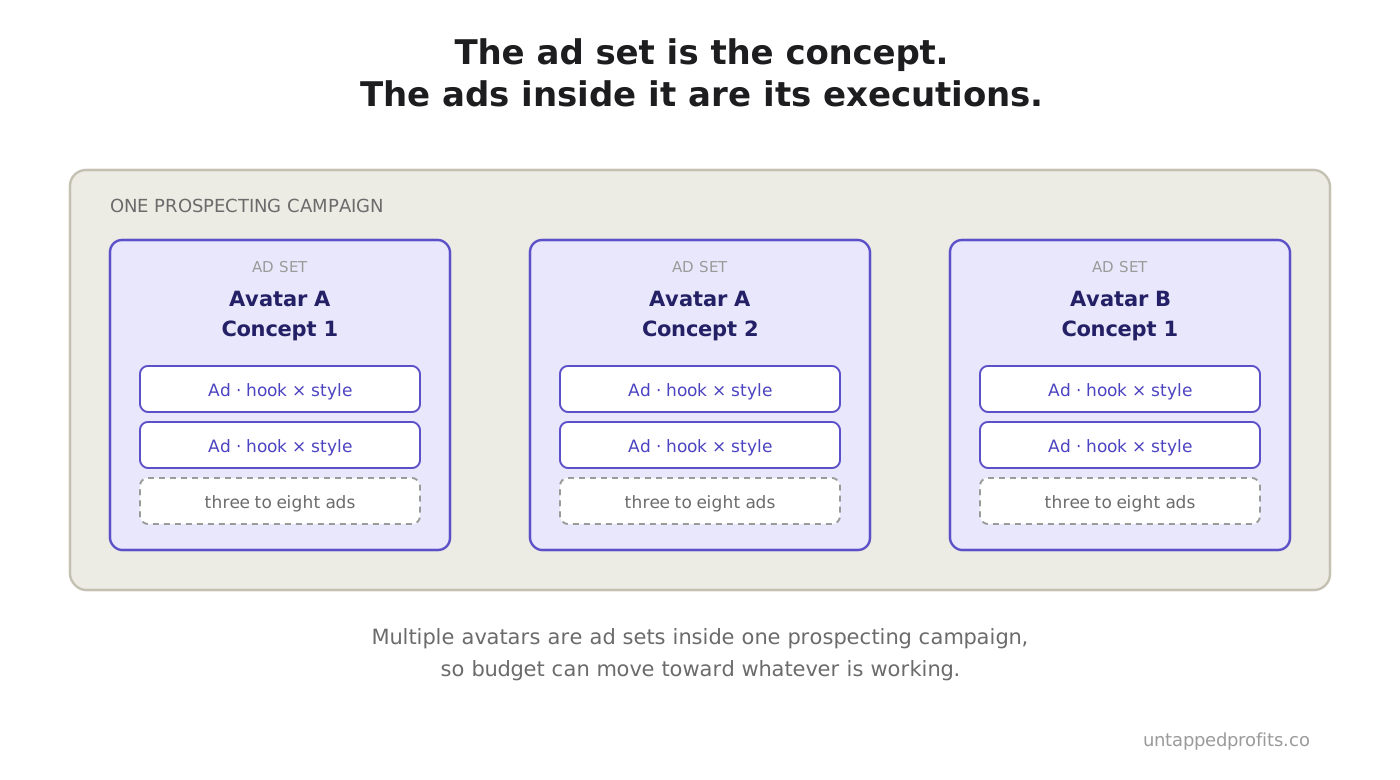
- Multiple avatars do not get multiple campaigns. They are ad sets inside one prospecting campaign, so budget can move toward whichever avatar and angle is actually working instead of being fragmented across campaigns.
- Meta is the demand-creating role. Most of the market is not shopping at any one time — Paid Acquisition carries the 95:5 finding and its sourcing — and this channel is funded to build memory in the people who are not yet looking.
- The creative does the targeting: broad audiences, broad placements, and the angle calls out the identity. The brand codes stay fixed while the ideas move, and Romaniuk's rule for changing a distinctive asset — default to no until strong evidence arrives — applies directly to an ad account.1
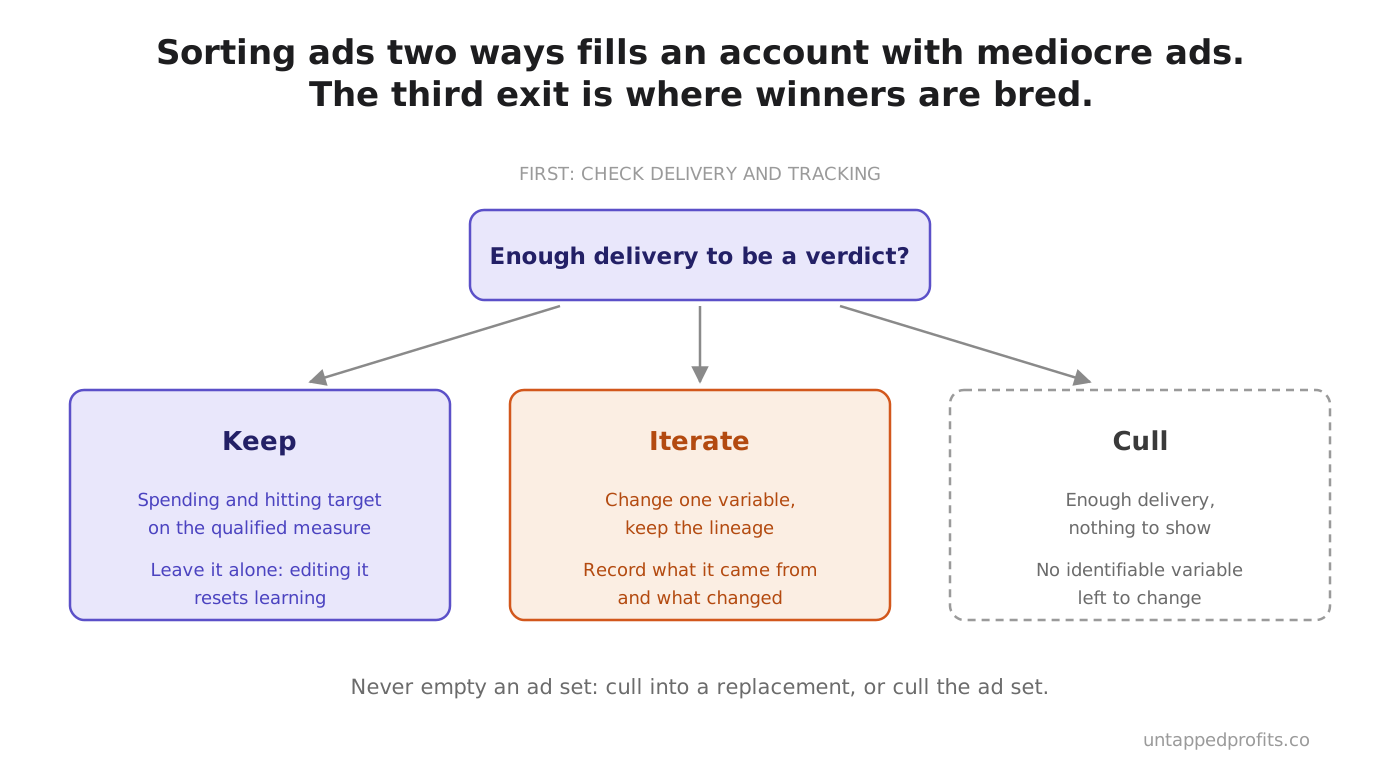
- Ads inside a concept are sorted three ways, keep, iterate or cull, and the middle category is the one most accounts skip, which is why most accounts fill up with mediocre ads.
Why can't most Meta accounts tell you what they learned?
Because the account did not record what each ad was testing. An ad is locked upstream as a concept, an angle, a hook, a style and a family tag. If the account carries none of those distinctions, none of them can be read back from performance data, and every scale-or-pause decision becomes a guess about what a campaign name once meant.
The symptom is familiar. A quarter ends, the numbers are reported, and the honest answer to "which idea worked" is a shrug dressed as a screenshot. Nobody was careless. The account simply had no place to put the distinction. Structure is what turns spend into evidence, and an account without it produces invoices and no knowledge.
Meta's automation makes this more urgent rather than less. Delivery decisions have moved to a machine with more signal than any operator will ever hold, so the remaining advantage sits in what gets made and what is held constant. Meta Automated the Media Buyer argues that shift in full. This chapter is the account-level consequence: if creative is the last real variable, the account has to be built so creative decisions are legible.
How is a Meta account structured?
The ad set is the concept, and the ads inside it are that concept's executions. One avatar, one concept, named so the same word means the same thing at the creative gate, in the production tracker and in Ads Manager. Three to eight ads sit inside, drawn from the ruled angle-by-style fit rather than from whatever happened to get produced.
| Pipeline layer | Lives at | Why there |
|---|---|---|
| Avatar | Ad set | The creative does the targeting, so the avatar has to be isolatable |
| Concept | Ad set | The persuasive idea being tested |
| Hook and style | Ad | The executions inside the concept |
| Family tag | Ad name and tracker | So coverage gaps are visible per ad set rather than discovered later |
Two structural rules follow. Multiple avatars live as ad sets inside one prospecting campaign rather than as separate campaigns, because separate campaigns fragment budget and signal while one campaign lets budget move toward whatever is working. And granularity follows volume: at small budgets an ad set is avatar plus concept, and it splits to avatar plus angle only when there is enough delivery for each ad set to be judged on its own. Splitting early fragments the signal and produces ad sets nobody can read.
Naming carries the whole thing. Every ad name traces back to a locked row in the production record, and an ad whose name cannot be traced is an orphan that should not be running.
What runs in the account, and what has to earn its place?
Prospecting is required, and everything else is optional and gated. The prospecting campaign is the engine of the account, holding the concept ad sets and pushing budget toward the best performers as concepts accumulate. A scale campaign, holding only proven winners, exists to force more spend against what already works.
Retargeting is where accounts quietly waste the most money, so it carries a rule. No retargeting campaign is built without a specific offer and a stated strategy for it. Serving the same ads to the same people again is repetition, and for many service and lead-generation businesses it is a liability: it spends prospecting budget re-showing a message that already failed, against a small audience, at rising frequency.
The test is one question: what does this campaign say that prospecting did not? A business with a single offer often has nothing to retarget with. Legitimate retargeting has its own thing to say: an objection handled, a risk reversed, a deadline, a case study for a specific hesitation, or a smaller commitment to step down to. Only then does the mechanical trigger apply, and it comes from audience-segment reporting showing overspend on engaged audiences inside prospecting.
Two more translations matter for lead generation, because the underlying methodology is shaped for ecommerce. Point the optimisation event at what represents money instead of the easiest thing to record. Aiming it at a form fill when the money is in booked calls is the same error as aiming it at add-to-cart. And paid retention usually has no job, because a service client's past customers rarely re-buy the same service, so that budget belongs in prospecting or in nurture.
In practice
Launch a new concept on a consistent cadence, with roughly one ad set on a forced spend minimum at any time, and cap that minimum at a fifth of the campaign budget. Maximum spend on winners, minimum on tests. The power is cumulative instead of dramatic: no single concept is special, and an account that launches steadily beats one that waits for a great idea.
Watch for
Treating the forced-spend window as a verdict. Releasing a minimum stops a subsidy without deciding anything. After the subsidy stops, the ad set needs enough unsubsidised delivery to be read at all, and at small budgets that commonly takes weeks rather than days.
What stays fixed while the creative varies?
The brand codes stay fixed and the ideas move. Meta rewards a wide field of genuinely different concepts, while memory rewards a narrow field of repeated brand assets. Those pull against each other only if concept and code are treated as the same layer, and the Brand Codes Register is what keeps them separate.
Romaniuk's discipline for distinctive assets transfers directly to account management. "Consistency is crucial," and when a change is proposed, "switch your default answer to 'no'" and demand strong evidence before modifying anything.1 That single sentence settles most of the arguments that arrive in month three, when creative feels exhausted to the team that has lived with it for a month and is still new to most of the people it reaches.
The same logic governs platform enhancements, and the rule is short: if it alters your media, off. If it only adds around it, on. Anything that crops, recolours, brightens, animates or generates background breaks the brand codes and the safe zones the briefs specify. Copy variants follow the distinctness rule too, meaning genuinely different messages instead of numbered versions of one message, which is the same standard applied at the angles gate.
How is an individual ad judged?
Three ways, keep, iterate or cull, and the sort happens only after the failure has been located. Two-way sorting is what fills an account with mediocre ads, because anything not obviously dead survives by default. The third category is the one that does the work: it forces a verdict on the middle, which is where winners are actually bred.
A keeper is spending and hitting target on the qualified measure over enough delivery to be a verdict, and the correct action is to leave it alone. Editing it to improve it resets learning and destroys the record. An iteration changes one variable and keeps its lineage, recording which ad it came from and what changed, because an iteration that changes hook, image and copy at once teaches nothing. A cull needs enough delivery, nothing to show, and no identifiable variable left to change. Culling is the cost of taking swings. An account that culls nothing is an account testing nothing.
Before any verdict, the failure gets located, because most bad ads are not bad ads.
| Symptom | Where the failure actually is | What to do |
|---|---|---|
| Weak hold at the open | The hook | Iterate the hook |
| Stops them, but no click | The promise | Keep the hook and iterate the payoff |
| Leads fine, qualified leads poor | The callout, not the craft | The ad is attracting the wrong person, so change who it calls out |
| Clicks well, converts poorly | Usually the page, not the ad | Leave the ad alone, because killing it removes the traffic that was working |
The last row is the one that costs the most money. It is Funnel-First Buying operating at the level of a single decision: the page earns the verdict before the ad does.
Two safeguards sit around the sort. Check delivery and tracking first, because an ad running while tracking was broken has no verdict and at small budgets a broken tag looks identical to a failing ad. And never empty an ad set: culling every ad restarts its learning, so you cull into a replacement or you cull the ad set.
Frequently asked questions
How many ads should be running in a concept?
Three to eight, chosen from the ruled angle-by-style fit instead of produced to fill a slot. Two ads carrying the same hook and style inside one ad set are one ad and a subsidy. The count that matters is genuinely distinct concepts, not the ad total — You Haven't Tested 20 Ads runs that arithmetic.
Should targeting be broad or should we build audiences?
Broad, with the creative doing the targeting, so the angle calls out the identity and delivery follows. That is a structural position and not a platform tactic, and it is why the avatar has to be isolatable at ad-set level: the account needs to know which identity was being called out when a result arrives.
When is an ad set ready to be judged?
When delivery is stable and there is enough of it to be a verdict rather than a spike. Below roughly ten conversions on an item, judge one level up, at the ad set rather than the ad. A single week is weather. When the honest answer is that there is not enough delivery yet, that is the answer, with a date to look again.
Why not run separate campaigns per audience?
Because it fragments budget and signal, and it removes the mechanism that makes the account improve on its own. One prospecting campaign lets budget move toward whichever avatar and angle is working. Separate campaigns force you to make that judgement manually, on thinner data, more often.
What happens when a concept wins?
The winning angle is re-expressed across the awareness spectrum instead of copied as more versions of the winning ad, and statics prove the angle before video spends on it. Expansion executions inherit the winner's lineage so the record shows which winners bred what. That mechanism is The Return Arrow operating inside a single channel.
The bottom line
A Meta account is a record of what the business tested, or it is a pile of spend nobody can interrogate. Name the ad set for the concept, keep avatars as ad sets inside one prospecting campaign, let the creative do the targeting while the brand codes hold still, make retargeting say something prospecting did not, and sort ads three ways after locating the failure, never before. Build it that way and the account answers the question most accounts cannot: what did we learn, and how do we know.
Where this connects
Meta runs the demand-creating role set out in Paid Acquisition, against the KPIs in The Campaign Plan and the avatars built in Customer Intelligence. Its creative is produced under Creative Production, gated by The Five Gates, tested by The Hook Law and held constant by The Brand Codes Register. Every claim it makes must exist in The Proof Bank first. The related archive arguments are Meta's Algorithm Wants a Thousand Ads and The Brand That Learns Fastest Wins. Back to the One Brain Method hub.
Part 4 · Paid Acquisition · Chapter 12 of the One Brain Guide
Previous: Paid Acquisition ·
Next: Google Ads ·
All chapters
Sources
- Professor Jenni Romaniuk, Ehrenberg-Bass Institute, The Four Commandments: future proofing a brand's identity: "Consistency is crucial", and "switch your default answer to 'no'". The Institute also holds that "one strong asset is worth ten average ones".
Every statistic and quotation on this page has been checked against its primary source. Last verified 24 August 2026.
Free guide
Take the method with you. The complete One Brain Method as one PDF: every chapter, the diagrams, and every named framework, ready to hand to whoever runs your marketing. Enter your email and it's yours.
Want a Meta account that can tell you which idea worked?
Book a 30-minute call → See what it takes to have this installed