
The Big Idea is the single thought a whole quarter of creative expresses. It is found in the market and the product, not invented at a desk, and it is the last decision Plan makes before Build starts.
Key takeaways
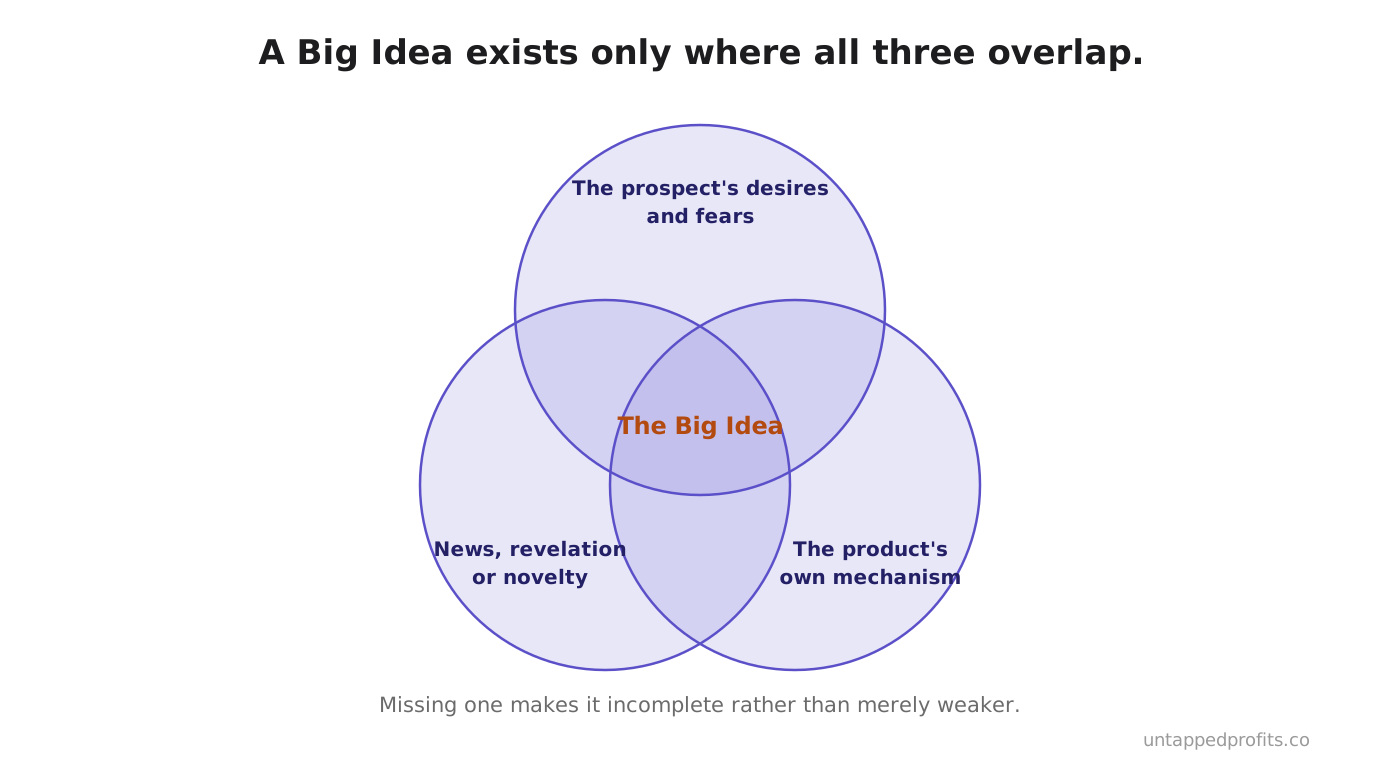
- A Big Idea needs all three circles: the prospect's desires and fears, an element of news or revelation, and the product's own mechanism. Missing one makes it incomplete rather than merely weaker.
- The stakes are measured: across nearly 500 campaigns, Nielsen found creative the biggest driver of sales, and found the lift attributed primarily to media wherever the creative was weak.1
- The idea sits at campaign altitude. Content-level angles are a different job, and confusing the two produces a quarter built on a blog post's insight.
- Scoring ranks candidates and never selects one. The sheet goes to the Operator with the actual lines and a recommendation.
- A named mechanism is a distinctive asset, ruled into the Brand Codes Register once adopted and used verbatim from then on.
What is a Big Idea, and at what altitude?
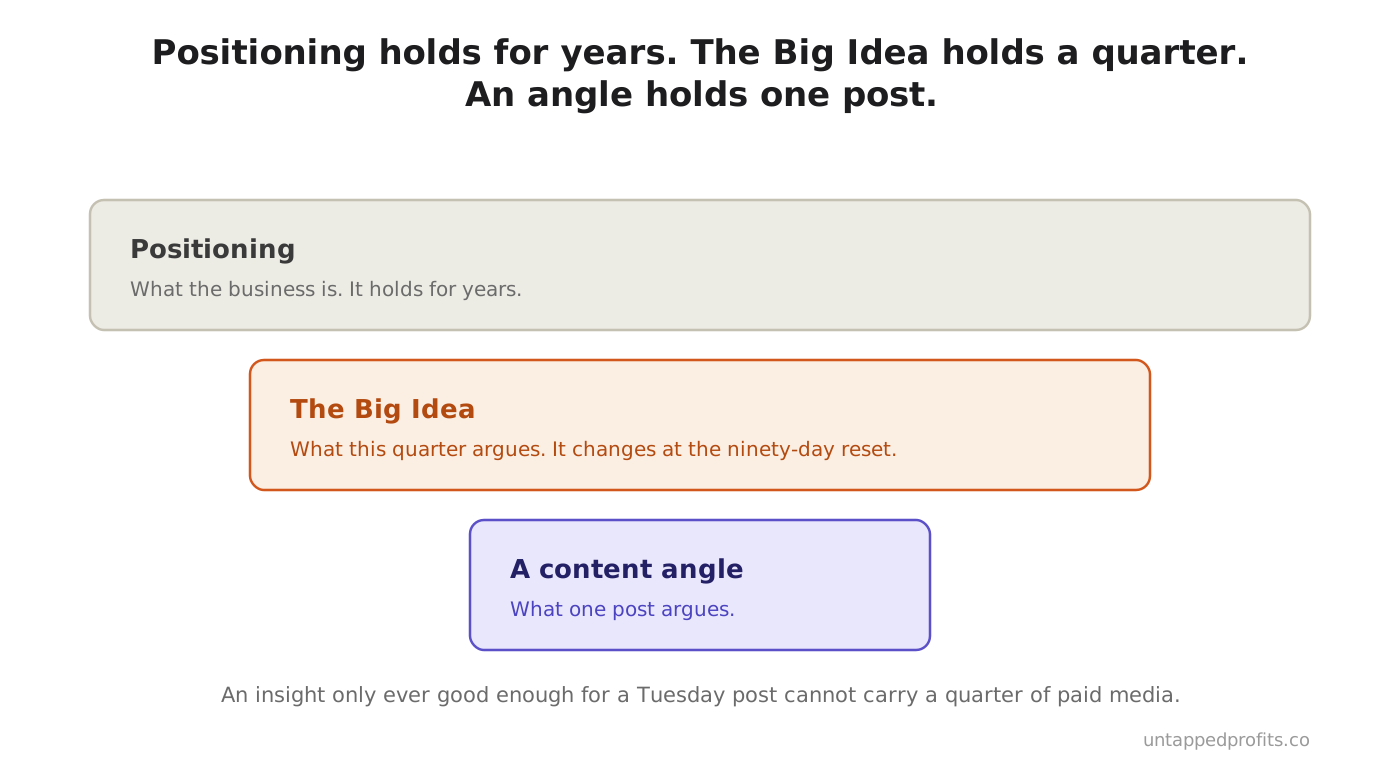
Campaign level. It is the thought every ad, page and email in a quarter expresses differently, and it survives many executions without wearing out. Content-level angles are generated separately and answer to a different chapter. An organisation that treats them as the same thing ends up building a quarter of paid media on an insight that was only ever good enough for a Tuesday post.
Three things have to be present at once for a candidate to be complete. It has to touch what the prospect already wants or fears. It has to carry something that reads as new, whether that is a revelation, a piece of news or a genuine novelty. And it has to run through the product's own mechanism, the specific reason this thing works. A candidate missing any one of them is not a weaker idea, it is an unfinished one.
The most common failure is an idea that only speaks to people already shopping. A Big Idea should recruit the ones who have not started looking — Your Big Idea Isn't Big Enough draws that line between an idea and a reworded hook.
The stakes are measured. Nielsen's analysis of nearly 500 campaigns called creative "the undisputed champ in terms of sales drivers", and found that where creative is weak the sales lift is attributed primarily to media, while strong creative produces higher lift that depends less on it. Over the preceding eleven years the effect of media on sales had risen to 36 per cent from 15.1 A weak idea does not just underperform. It moves the burden onto media spend, which is the one input that bills you every time it runs.
Where does a Big Idea come from?
From the research, not the writer. Eugene Schwartz built Breakthrough Advertising on the point that copy cannot create desire for a product, only take the hopes, dreams, fears and desires that already exist and focus them onto that product, which is why the creativity sits in the market and the product and the job is joining the two.2
That is the operating assumption here. The work is extraction and connection: what this market already believes, what it has already been promised too many times, what the product actually does differently, and where those meet.
Most of the raw material already exists. The avatars, the wounds, the beliefs, the exhausted promises and the competitor gap list are all in the client's own layer by this point, so the phase is a read and not a fresh research project. What gets added is what has changed recently: data that challenges the conventional explanation, a trend not yet mainstream, an analogy from another industry.
Connection hunting then asks four things. What does everyone in this market believe that the evidence does not support. What is the traditional explanation of the problem, and what better one does this research support. Which single piece of proof is the most compelling available. And what is the dominant emotion here, including the thing the prospect most wants to believe is possible.
How is a candidate judged?
Against ten criteria and never fewer than five candidates. Gasp factor, uniqueness in this market, importance to the customer, believability, mechanism strength, emotional power, proof support, headline potential, legs across a campaign, and fit to the market's awareness and sophistication. Scoring ranks the field and produces a recommendation. The Operator picks, because Findings Are Not Decisions anywhere in this system.
Awareness and sophistication set the form more than anything else on that list. An unaware market needs the revelation and will not respond to an offer, while a most-aware market wants the offer and finds the revelation tedious. In an exhausted market, where every promise has been made repeatedly, the mechanism stops being supporting detail and becomes the idea itself, because it is the only part a competitor has not already claimed.
Every claim inside a candidate is anchored before the idea ships, with its measure, subject, date, publisher and primary source recorded. An unanchored Big Idea is a hypothesis and gets labelled one. A quarter built on a number that turns out to be wrong costs more than a quarter that never ran, and generated copy will produce the confident version of that number without blinking — the exact failure AI Copy Tools Ask for Your Tone warns about.
In practice
Write the two-sentence version you could say to a friend without notes, before anything else. If it takes a paragraph of setup to land, the idea is not finished. That test kills more weak candidates in ten minutes than a scoring sheet does in an hour, and it is the same test the idea will face when a prospect meets it cold.
What gets a candidate returned?
Six things, and any one of them returns the idea to be rebuilt instead of softened. The point of naming them is that each one is invisible while you are still excited about the candidate and obvious a fortnight later, when the campaign is already running. A named list is what lets somebody catch the problem on the day the sheet is written.
| Red flag | What it looks like |
|---|---|
| It could be signed by a competitor | Swap the logo and nothing changes. The only-us test failed |
| It rests on an unverifiable claim | The number that makes it work has no primary source behind it |
| It needs three sentences of setup | Nobody in a feed will give it that, and the idea dies in the run-up |
| It is a feature dressed as an insight | A product detail wearing the language of a revelation |
| It makes the prospect feel stupid | The ego lands on the reader instead of on the structure |
| It has no legs past the first execution | One brilliant ad and nothing to say in week three |
The mechanism name deserves separate treatment, because it is the part most likely to be treated as a flourish. A coined name for the mechanism is a verbal asset with compounding value, so once the Operator adopts it, it enters the Brand Codes Register and is used word for word from then on. It is never re-minted for the next campaign and never quietly varied. Specificity is what makes it stick, which is the same reason a precise number outperforms a vague one, as The Claim Nobody Believes sets out.
Watch for
The idea that is brilliant for a different objective. It happens most often when a candidate arrives late and everyone is tired of the ones already on the sheet. An idea that would be excellent for an awareness quarter is not rescued by the fact that this quarter needs leads. Beaten on timing is worth logging and re-reading at the next reset. Beaten on fit is not.
Frequently asked questions
How is this different from a positioning statement?
Positioning is what the business is, and it holds for years. A Big Idea is what this quarter argues, and it expresses the positioning without replacing it. A business that changes its positioning every quarter has no positioning, and one that never changes its campaign idea runs out of things to say.
How often should it change?
At the ninety-day reset, and only if the evidence says so. An idea with legs earns another quarter. What kills ideas early is not fatigue on the business's side but saturation on the market's, and those two feel identical from the inside while being entirely different problems.
Can a small business really have a Big Idea?
It is a small business's cheapest advantage, because it costs thinking and not budget. The three circles do not require scale. A trades business with one genuinely different method and the evidence to back it has more to work with than a national brand that has run out of things to say.
What if none of the candidates are good enough?
Then the honest output is that none are, and the answer is usually upstream. Weak candidates almost always mean thin research: no mechanism worth naming, no proof worth anchoring, or a market whose actual beliefs were assumed and never mapped. Generating another five will not fix any of those.
Who owns the decision?
The Operator, from a ranked sheet with the actual lines on it. The scoring exists to make the comparison honest and to stop the loudest candidate winning on enthusiasm. It does not exist to make the choice, and a sheet that selects has quietly become a decision-maker.
The bottom line
A quarter of creative built on a good idea outperforms a quarter of competent work built on nothing in particular, and the difference is decided before a single ad is written. Read the market properly, find the connection that already exists between what these people want and what this product genuinely does, name the mechanism, anchor the proof, and rule on one candidate. Everything downstream then has something to express instead of something to fill.
Where this connects
The Big Idea closes Part 3 and consumes everything in it. The market reading comes from Customer Intelligence and Method-Actor Research, the anchoring comes from The Proof Bank, and the objective it serves is set in The Campaign Plan. Downstream it becomes the spine of the concepts stage in The Five Gates, its headline seeds face The Hook Law like any other candidate, and an adopted mechanism name is ruled into The Brand Codes Register.
Part 3 · Plan · Chapter 10 of the One Brain Guide
Previous: Method-Actor Research ·
Next: Paid Acquisition ·
All chapters
Sources
- Nielsen, When it comes to advertising effectiveness, what is key?, October 2017, reporting research by NCSolutions. The quoted words appear on that page. Nielsen states that creative remains the largest driver of sales, that the effect of media on sales rose to 36 per cent from 15 per cent over the preceding 11 years, and that where creative is weak the sales lift is attributed primarily to media while strong creative produces higher lift that depends less on media. Methodology: nearly 500 fast-moving consumer goods campaigns running in 2016 and the first quarter of 2017 across linear and addressable television, online digital and video, mobile, magazines and radio. Nielsen sells advertising measurement, so it has a commercial interest in the finding. The widely quoted figure of 47 per cent for creative appears in the charts and in NCSolutions' own report rather than in the text of this page, so it is not cited here. The same page notes that Project Apollo put creative at 65 per cent of sales lift in 2006, which is the earlier study this guide cites separately and not an alternative figure for the same sample. NCSolutions reissued the research in August 2023 with creative at 49 per cent across nearly 450 studies. The study covers consumer packaged goods in mass media. Applying it to a small business campaign is this method's inference.
- Eugene M. Schwartz, Breakthrough Advertising (1966), chapter 1. Schwartz's formulation is that copy cannot create desire for a product, and can only take the hopes, dreams, fears and desires that already exist in the hearts of millions of people and focus those already existing desires onto a particular product.
Every statistic and quotation on this page has been checked against its primary source. Last verified 25 August 2026.
Free guide
Take the method with you. The complete One Brain Method as one PDF: every chapter, the diagrams, and every named framework, ready to hand to whoever runs your marketing. Enter your email and it's yours.
One idea worth a quarter beats twelve months of competent work about nothing.
Book a 30-minute call → See what it takes to have this installed