
Content Repurposing takes one properly made source and produces its whole asset package, under a cap that stops the method turning into the volume machine it was built to replace.
Key takeaways
- Thesis Lock comes before production. The source's own argument is the hero of every asset in the package, and scoring never promotes a consequence over the argument.
- The case for repurposing was settled in a laboratory: across 317 pooled experiments, spacing beat massed exposure in all but a handful of comparisons, and the long-retention studies averaged a 15 percent benefit.1
- One idea met several times beats the same idea met once, even when the total exposure is identical. That is why a package ships as a sequence rather than as a dump.
- Most formats are produced once per source. Secondary ideas produce short video and images only, capped at two of each per run.
- Visual assets are delivered as briefs, not prompts, so the work survives the tool being replaced.
What does a repurposing run actually produce?
A full package from one source: a newsletter edition, a long-form text post, an X long-form post and a tweet pack, an email snippet, a carousel, a document carousel, statics, data graphics, short video, and the publishing sequence that says what goes out when. How many assets a pillar yields is set by the campaign plan and the budget, not by a fixed count. A pillar that yields very little was too thin to have been worth making, and that is a verdict on the pillar rather than on the production.
The run has one pause in it and only one. Before anything is produced, Thesis Lock applies: the source's thesis is confirmed and approved. That gate exists because an earlier version of this method scored several candidate ideas and built the package around the highest scorer, which let a consequence of the argument outrank the argument itself, drifted the package away from the published headline, and cost a full rebuild.
Scoring still happens. What changed is what scoring is allowed to do. It gates individual assets at a quality threshold and ranks whatever is left over, and it selects nothing. Locking three to five things and varying everything else around them is the same discipline the paid side runs — Meta's Algorithm Wants a Thousand Ads, Your Buyer's Brain Wants One Brand runs it across a whole account.
Why does one idea repeated beat several published once?
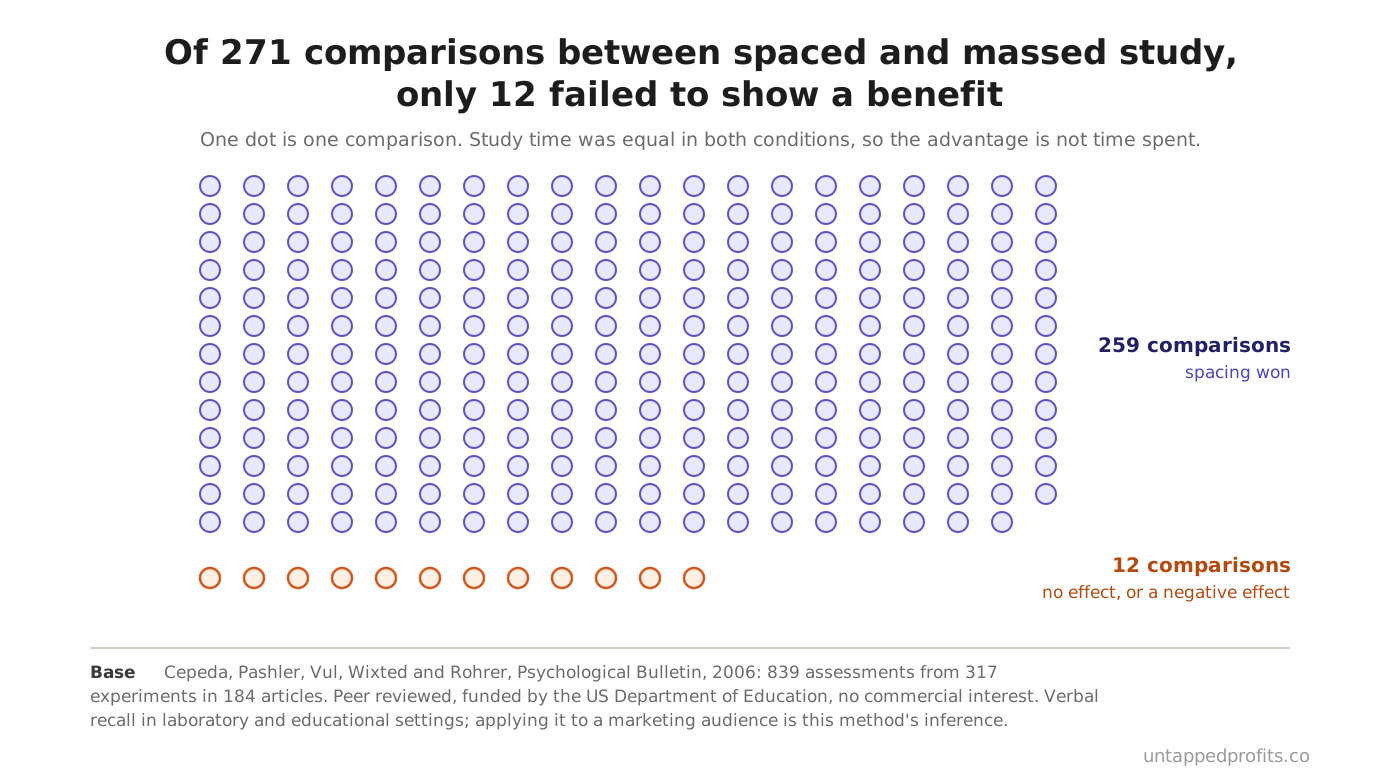
Because spacing is how memory works, and it has a century of evidence behind it. Cepeda and colleagues pooled 839 assessments from 317 experiments and found the effect almost never fails. Of 271 comparisons between massed and spaced presentation, only 12 showed no benefit. Study time was equal in both conditions, so the advantage comes from the spacing and not from time spent.
The finding that matters most for a content calendar is the second one. The best gap between exposures grows with how long you need the memory to last. For retention measured in minutes, gaps of minutes were enough. For retention measured in six months or more, the best gaps ran to a month or longer.1 A business that needs to be remembered at a purchase decision months away is looking at spaced exposures over months, and that is exactly what a package cut from one source and released on a sequence produces.
Their own summary of a century of this work is that "learning is powerfully affected by the temporal distribution of study time", and a content calendar is a distribution of study time whether anyone designed it as one.1
This also settles an argument that comes up on every content plan. Publishing the same argument in nine formats over six weeks is not repetition to be embarrassed about. It is the mechanism. What would be repetition without benefit is the same asset posted twice to the same platform, which the cross-asset routing rule forbids outright.
What stops a waterfall becoming a volume machine?
A hard ceiling written into the method. Each format is produced once per source, from the main article. Secondary ideas go to a ranked register and produce short video and image assets only, capped at two videos and two images per run. Without that cap the waterfall reproduces exactly what the positioning argues against, which is a business publishing a great deal and saying very little.
| Asset | How often | Why the limit |
|---|---|---|
| Newsletter edition, long-form post, carousel | Once per source | A second one competes with the first for the same argument |
| Short-form video from a secondary idea | Two per run, maximum | Video is the most expensive asset to make badly |
| Image assets from a secondary idea | Two per run, maximum | Cheap to produce, which is exactly why it needs a ceiling |
| The ranked register of leftovers | Kept, not published | It feeds the next ideation pass instead of the calendar |
Four standing constraints travel with every asset. No offers, because derivatives teach and the promotional share of the calendar is served by originated posts. Every number comes from the source, never sharpened on the way down, with hedges travelling and hypotheticals staying hypothetical. Video opens on action with the presenter arriving no earlier than the second scene. And every piece has to work with the sound off.
In practice
Apply the standalone test to every static before it ships. Cover the caption and look at the image on its own. If it stops making sense, the asset was never finished, it was a caption with a picture attached. The same test on a carousel means every slide has to hold up if somebody swipes into the middle of it.
How does a visual asset get briefed?
As a brief and never as tool syntax. Each shot is described the way a director would describe it, as the still and then the motion: what is in frame, how it is lit, what moves, how the camera moves. Enough texture that a person or a downstream tool can turn it into the actual generation prompt. No tool names appear anywhere inside a shot description.
The reason is model lock, and the ad lane learned it the expensive way. A library of prompts written for one image tool is worthless the week that tool changes its behaviour or a better one arrives. A library of shot descriptions is not, because it describes the shot instead of the vendor. All video runs image to video, so a still is made first and then animated, and the brief has to work whichever engine ends up doing it.
Briefing this way also forces the thinking to happen before the generating. Describing a scene properly means deciding what the scene argues, which is the demonstration principle old direct response understood — The 160-Year-Old Secret Behind History's Greatest Marketing Campaigns goes back to where it started. One Operator can hold a whole package in view this way, which is the case What a Dead Carpenter's Toolbox Taught Me About Marketing makes for carrying every tool.
Watch for
The package that quietly changes the argument. It happens when a striking secondary idea produces the best-looking assets, and by the tenth piece the run is about something the source never claimed. The check is thesis fidelity, asked once per asset: does this serve the argument the source actually made, or the one that was easier to illustrate?
Frequently asked questions
Isn't publishing the same idea everywhere just spam?
Spam is the same asset posted twice to one platform, and the routing rule forbids it. Spacing one argument across formats and weeks is how people come to remember anything, and the research behind that is a century old. The difference is whether each piece is built for where it lands.
What makes a source worth repurposing?
Enough argument to survive being cut many different ways. The yield is the honest test and it is applied afterwards: a source that produces only a handful of usable assets was thin, and no amount of production skill fixes that downstream.
Can any of this be automated?
Production can be assisted heavily and the decisions cannot. Thesis Lock needs approval, the cap needs enforcing, and every claim answers to the Proof Bank. A run where nobody confirmed the thesis produces twenty assets arguing something nobody chose.
Why no offers in the derivatives?
Because authority is demonstrated by the quality of the teaching, and a derivative that asks for the sale spends attention the source earned. The calls to action stay plain and fixed: follow, save, share, or end on the question the piece raised. The selling happens where the plan says it happens.
Who reviews the package?
A reader who did not write it, then the mechanical checks. Thesis fidelity, data integrity, format singularity, no offers, brand alignment and platform fit all get checked before the sequence is delivered, and the copy gate runs on every word of it.
The bottom line
Repurposing has a reputation problem because most of it is recycling with a schedule. Done properly it is the opposite: one argument worth making, cut into the formats where it will actually be met, and released over enough time for anyone to remember it. Cap the output, keep the source's argument in charge, brief the visuals so they outlive the tools, and a single Operator can produce what used to take a department.
Where this connects
Content Repurposing runs the waterfall that Content Architecture specifies, using ideas ranked in Content Ideation and sentences written under Writing for Clarity. Every claim in every derivative answers to The Proof Bank, openers to The Hook Law, and visual assets to the law in Creative Production. What the package earns feeds back through The Return Arrow.
Part 6 · Content & Channel · Chapter 29 of the One Brain Guide
Previous: Writing for Clarity ·
Next: Infotainment ·
All chapters
Sources
- Nicholas J. Cepeda, Harold Pashler, Edward Vul, John T. Wixted and Doug Rohrer, Distributed Practice in Verbal Recall Tasks: A Review and Quantitative Synthesis, Psychological Bulletin, vol. 132 no. 3, 2006, pages 354 to 380. The meta-analysis drew 839 assessments of distributed practice from 317 experiments in 184 articles. Of 271 comparisons between massed and spaced presentation, 12 showed no effect or a negative effect. The 15 percent figure is the average benefit reported across the studies with retention intervals longer than one month. Study time was equal in the massed and spaced conditions, so the benefit is not explained by time spent. Peer reviewed and funded by the US Department of Education, with no commercial interest in the finding. The research concerns verbal recall in laboratory and educational settings. Applying it to how a marketing audience encounters a repeated argument is this method's inference.
Every statistic and quotation on this page has been checked against its primary source. Last verified 27 August 2026.
Free guide
Take the method with you. The complete One Brain Method as one PDF: every chapter, the diagrams, and every named framework, ready to hand to whoever runs your marketing. Enter your email and it's yours.
One argument, cut properly, will outwork a month of unrelated posts.
Book a 30-minute call → See what it takes to have this installed