
Creative Production is where the method turns decisions into assets. The law here is medium-agnostic: a video script, a static ad and a synthetic presenter all answer to the same gates, the same hook standard and the same brand codes.
Key takeaways
- The law is medium-agnostic. Only the Production Module is static-specific. Everything else applies to every asset the system makes.
- Creative is generated wide and gated hard. The machine produces the field, and a human decides what survives to production.
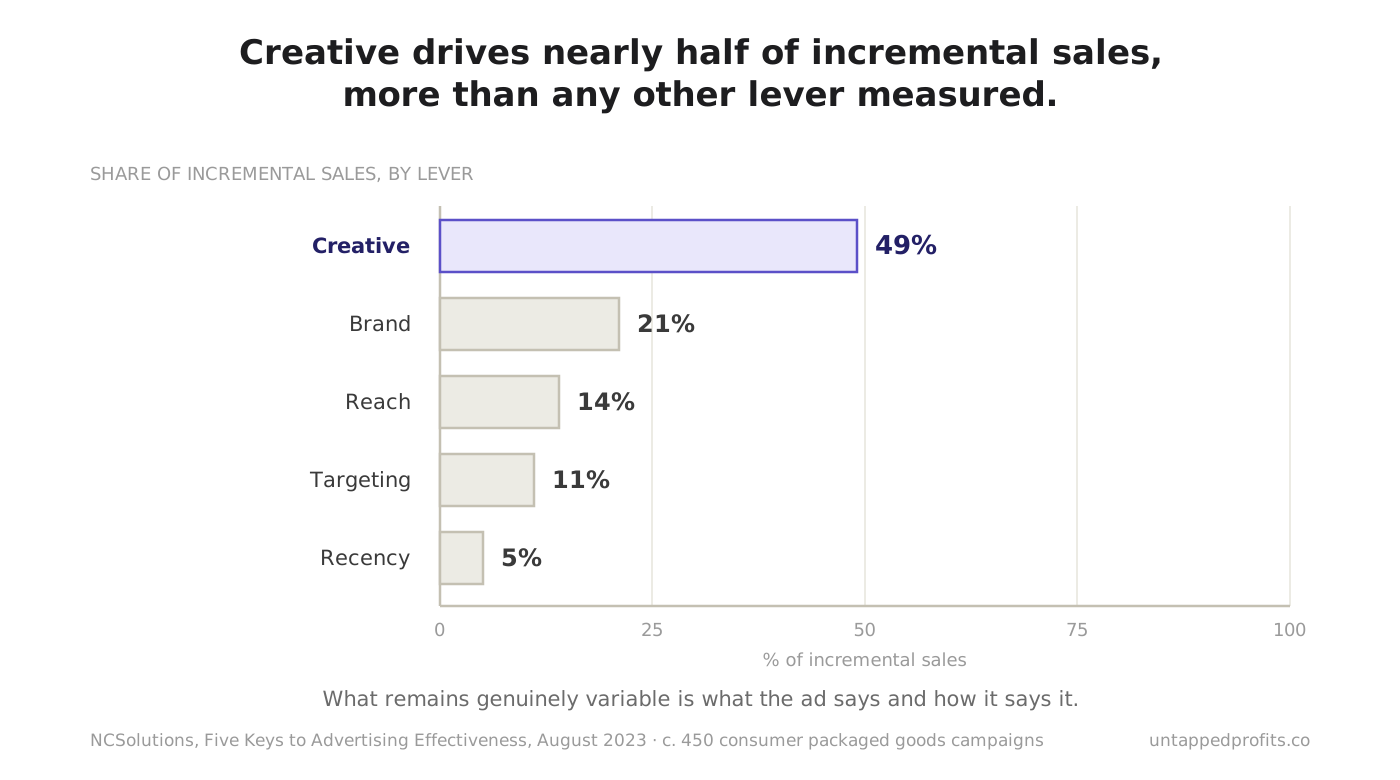
- NCSolutions' analysis of around 450 campaigns puts creative at 49% of incremental sales — nearly half, and more than any other lever measured.1
- Every asset carries the brand codes, every claim traces to the Proof Bank, and every hook passes five tests before a human reads it.
- Constraints are the engine of the work rather than a tax on it, which is why the law is written before the first idea is generated.
Why does creative decide the result?
Because it is the largest single lever in the campaign and the one most often left to whoever was available. Media buying has been handed to the machines, targeting has converged on broad, and what remains genuinely variable is what the ad says and how it says it.
NCSolutions put a number on it. Their 2023 analysis of roughly 450 consumer packaged goods campaigns puts creative at 49% of incremental sales, against 21% for brand, 14% for reach, 11% for targeting and 5% for recency.1 That figure is worth holding next to how most businesses allocate attention, where the media plan gets a meeting and the creative gets a deadline.
Igor Stravinsky described why constraint helps rather than hinders: "The more constraints one imposes, the more one frees oneself of the chains that shackle the spirit."2 The gates, the codes and the laws in this part are that principle applied to advertising, and the freedom they buy is the freedom to stop arguing about taste.
What governs every medium?
Five bodies of law, and none of them care what format the asset ends up in. The Brand Codes Register decides what every asset must carry. The Five Gates decide what gets made. The Hook Law decides which lines may exist. The Review Seams decide what ships. And the Proof Bank decides what may be claimed.
| Law | What it governs | Applies to |
|---|---|---|
| The Brand Codes Register | What every asset must carry to be recognisable | Every medium |
| The Five Gates | Which ideas survive to production | Every medium |
| The Hook Law | Which lines may exist at all | Every medium |
| The Review Seams | What passes from locked decision to published ad | Every medium |
| The Production Module | How a static ad is physically made | Statics only |
In practice
Write the law before generating the first idea. A brand code decided halfway through a batch applies to half the batch, and the half already made becomes a set of exceptions somebody has to remember. Law first, generation second, and the sequence is not negotiable because reversing it costs a rebuild.
How does the work actually get made?
Wide generation, hard gating, and a human ruling at every lock. The machine produces the field because producing a field is now nearly free, and the Operator decides what continues because deciding is the part that was always scarce. Nothing is written to file until something has been locked.
That order matters more than any individual rule in this part. A pipeline that generates narrow and approves everything produces a small amount of mediocre work. A pipeline that generates wide and approves nothing produces nothing. The method runs wide generation into hard selection, which is the only combination that produces a genuinely good ad on a schedule.
Each medium then adds its own production grammar on top. Statics get the Production Module. Video gets the entry law and the scripting ceilings. Generated imagery gets the four-prompt chain. Synthetic assets get governed as brand codes with a compliance surface. What none of them get is a different quality bar.
Watch for
The medium that quietly exempts itself. It usually starts with a deadline and a reasonable-sounding argument that this one is different. A system with a different standard per format does not have a standard, and the exemption is never reversed later because by then it is precedent.
Frequently asked questions
Isn't this a lot of process for making ads?
It is less process than the alternative, which is revision rounds, stakeholder opinion and post-hoc rationalisation of work nobody consciously chose. The law is read once and applied at machine speed. What it removes is the argument, and arguments are the expensive part of creative production.
Does the law apply to organic content too?
Yes. Hooks pass the same tests, claims come from the same bank, and codes carry. The lane changes the format and the length, not the standard, which is the point of writing the law once rather than per channel.
Where does taste fit?
Above the floor. The law sets a minimum and prevents specific failures, and everything above that line is judged, chosen and ruled by a human with an opinion. What the law prevents is taste being the only thing standing between a weak idea and a media budget.
What if a client's brand law conflicts with the method's?
The client's brand law wins, and it gets recorded in their Cartridge as a ruling. The method supplies the structure for making brand decisions rather than the decisions themselves, and a business that has already made those decisions deliberately is ahead, not in conflict.
Which chapter should I read first?
The Five Gates, because it explains the sequence everything else sits inside. The Hook Law next, since hooks are where most advertising fails, and then the Brand Codes Register for what every asset has to carry regardless of what it says.
The bottom line
Creative is the biggest lever in the campaign, and most businesses leave it to whoever had time. This part of the method writes the law first, generates wide, gates hard, and lets a human rule at every lock. The law does not change by medium, because a standard that bends per format was never a standard. Get this part right and the media plan starts looking like the easy half.
Where this connects
Creative Production builds what The Campaign Plan decided, for the buyers described in Customer Intelligence, claiming only what sits in The Proof Bank. Its assets run in Paid Acquisition, and what they teach returns through The Return Arrow into The Memory. The archive arguments closest to this part are You Haven't Tested 20 Ads and Your Designer Has Never Asked What Happened After the Ad Ran. Back to the One Brain Method hub.
Part 5 · Creative Production · Chapter 15 of the One Brain Guide
Previous: Account Analysis ·
Next: The Brand Codes Register ·
All chapters
Sources
- NCSolutions (formerly Nielsen Catalina Solutions), Five Keys to Advertising Effectiveness, August 2023, analysing approximately 450 consumer packaged goods campaigns across digital and television. The report states that creative "drives nearly half (49%) of incremental sales", with brand at 21%, reach at 14%, targeting at 11% and recency at 5%. This edition updates the third edition of August 2017, which analysed around 500 campaigns and put creative at 47%; the later figures are the ones cited here. An earlier Nielsen study, Project Apollo in 2006, put creative at 65%; that is a separate analysis of a different sample and is not interchangeable. NCSolutions sells advertising measurement, so a finding that creative quality is the dominant driver supports its own services. The study covers consumer packaged goods in mass media; applying it to a small-business campaign is this method's inference.
- Igor Stravinsky, Poetics of Music in the Form of Six Lessons, trans. Knodel and Dahl (Harvard University Press, 1947), Lesson Three.
Every statistic and quotation on this page has been checked against its primary source. Last verified 26 August 2026.
Free guide
Take the method with you. The complete One Brain Method as one PDF: every chapter, the diagrams, and every named framework, ready to hand to whoever runs your marketing. Enter your email and it's yours.
Want creative made under law instead of under deadline?
Book a 30-minute call → See what it takes to have this installed