
The Hook Law is the five tests every hook must pass to exist. A hook that fails any test doesn't get workshopped, softened, or granted a second read. It dies before it reaches a selection sheet.
Key takeaways
- Five tests, all mandatory: name the reader, be concrete, assert something falsifiable, say what no competitor could sign, and score on the 4 U's.
- The law was written the hard way. This method's first run produced hooks that passed every prohibition and grabbed nobody, which proved that a hook can't be defined by what it avoids.
- The stakes are measured: Amplified Intelligence puts the attention-memory threshold at 2.5 seconds, and around 85% of paid ads never reach it.1 Most of the spend buys impressions that never cross it.
- Four clauses sit around the tests, each legislated the day a real failure taught it, including the Referent Test: every reference must resolve instantly, because a stall is a scroll.
- Ogilvy priced the headline at eighty cents of the advertising dollar. Sixty years and every format change later, the ratio has only got crueller.
Why do clever hooks fail?
Because the reader grants you half a second, and cleverness spends it badly. Most advertising doesn't get argued with, disliked or rejected. It gets scrolled, unprocessed, having briefly occupied a rectangle nobody looked at for long enough to remember.
The attention research is unforgiving. Amplified Intelligence sets the attention-memory threshold at 2.5 seconds, the point above which enduring brand impact starts, and finds that around 85% of the ads advertisers pay for don't hit that mark.1 Platforms report on windows that flatter them, so this gap rarely shows up in a dashboard — Your Ad Platform Is Hiding 60% of Your Returns by Design audits exactly those windows.
The hook is the whole fight for that threshold, which is why it gets its own law. David Ogilvy priced it in Confessions of an Advertising Man: "On the average, five times as many people read the headline as read the body copy. When you have written your headline, you have spent eighty cents out of your dollar."2
And the failure mode is rarely hype. It is polish. Review by prohibition alone, meaning no hype, no jargon, no false claims, optimises for lines that offend nothing and move no one: the clever line that makes the writer smile and the reader keep scrolling. Guardrails can only prevent sins. They cannot demand a grab. Beauty isn't the missing ingredient either, since ads sell through accountable selling words — Your Designer Has Never Asked What Happened After the Ad Ran makes that case from the feedback loop's side.
How does the Hook Law work?
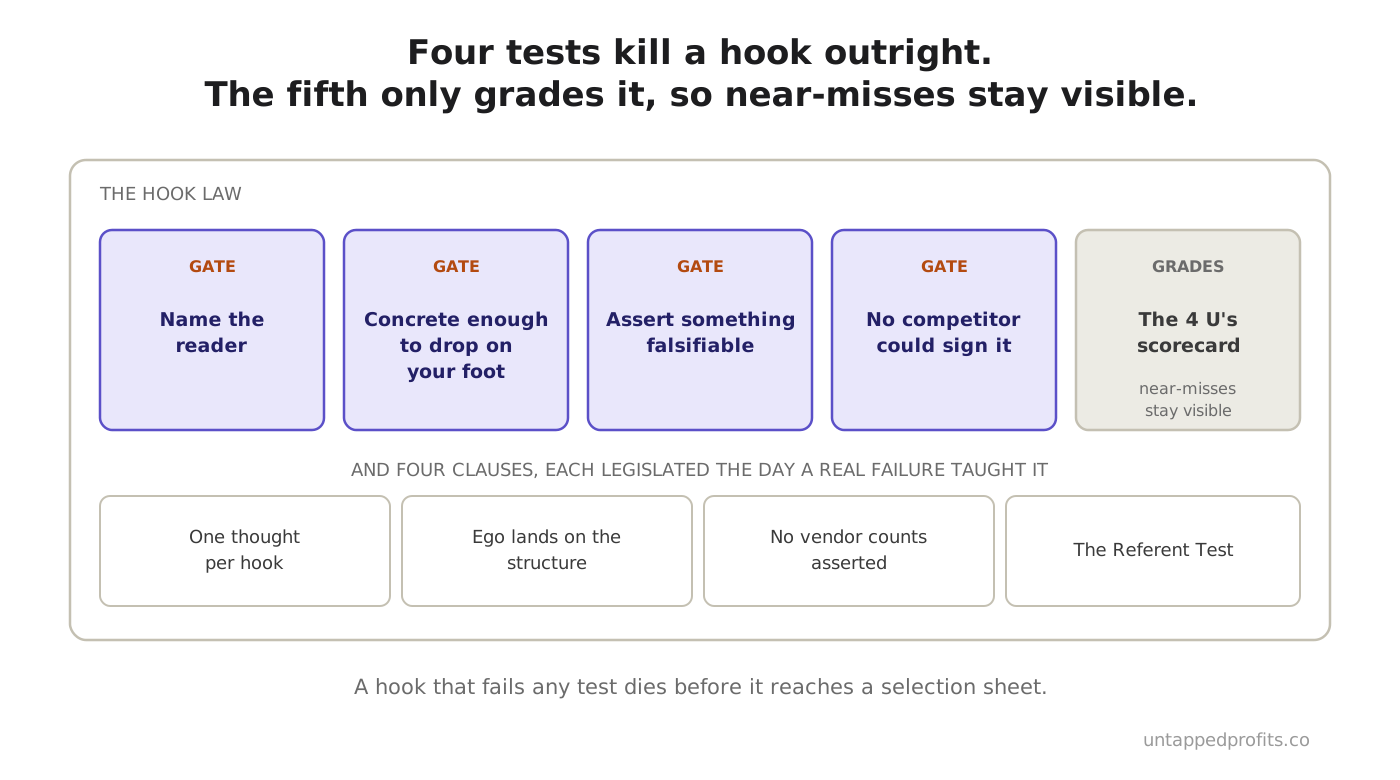
Five tests, and every hook passes all of them or it doesn't exist. Four of the five gate, meaning a failure is fatal. The fifth grades, so near-misses stay visible. Around them sit four clauses, each one legislated live on the day a real failure taught it.
- Name the reader. The person it's for must know it's for them, from the line itself: their situation, on the page, unmistakably.
- Be concrete enough to drop on your foot. Abstractions bounce off and objects land. "Streamline your marketing" is fog. A Monday calendar full of meetings about marketing is a thing.
- Assert something falsifiable. A claim that could be wrong is a claim that means something, and if nobody could dispute it, nobody will notice it. Every falsifiable claim stands on the Proof Bank behind it.
- Say something no competitor could sign. If a rival could run the line unchanged, it is category wallpaper: an ad for everyone's product, billed to you.
- Score on the 4 U's, Michael Masterson's copywriting scorecard of useful, urgent, unique and ultra-specific.3 This is the one test that grades rather than gates, so near-misses are visible.
The clauses:
- One thought per hook. Two ideas in one line is two weak lines sharing a coffin.
- Ego lands on the structure, never the reader. The villain is the setup they're stuck in, and never the person reading.
- No vendor counts asserted as the reader's reality. The line doesn't tell the reader how many agencies they have. It names a situation they recognise.
- The Referent Test. Every reference must resolve instantly. It was born the day a punchline stalled its reader for half a second while they worked out what the last line pointed at, and a stall is a scroll.
When the hook lives on an image, the Headline Rule governs its platform partner: the headline complements the on-image hook and never repeats it, and when in doubt it becomes a clear call to action that agrees with the button and the destination.
| Test | What it kills |
|---|---|
| Name the reader | Lines addressed to everyone, received by no one |
| Concrete enough to drop on your foot | Abstraction, fog, category-speak |
| Assert something falsifiable | Safe claims nobody could dispute or notice |
| No competitor could sign it | Wallpaper, meaning ads that advertise the category |
| The 4 U's scorecard | Near-misses that pass the gates and grade weak |
| The clauses | Double thoughts, reader-blame, asserted realities, half-second stalls |
In practice
Run the competitor test literally. Put a rival's logo on the hook and see whether anything breaks. If the line survives the swap intact, it was never your ad, and you were about to pay to run it anyway.
What should you measure in the Hook Law?
Whether the law reaches the sheet, and whether failures get caught before the feed catches them. Hooks that passed all five tests tell you the law gates rather than decorates. Kills at cold-read matter more than they look, because they are the reader's half-second being simulated before it's bought. Referent stalls caught pre-production tell you every reference resolves.
| Measure | What it tells you | Target |
|---|---|---|
| Hooks on selection sheets that passed all five tests | Whether the law gates or decorates | All of them, because no untested hook reaches the Operator |
| Kills at cold-read | Whether the reader's half-second is simulated before it's bought | Failures caught here, never in the feed |
| Referent stalls caught pre-production | Whether every reference resolves instantly | Zero stalls survive to a locked string |
| New clauses ratcheted from failures | Whether the law is alive | Every repeated failure becomes a written clause |
Watch for
The hook that passes on paper and dies out loud. Read the candidates aloud to someone who hasn't seen the brief, at the speed a phone gets read. Lines that technically satisfy all five tests but need a breath in the middle fail the only exam that counts, and that failure is invisible on a checklist.
What does running without the law cost?
Invisible advertising, which is the most expensive kind because it looks like activity. The media plan delivers the impressions, the dashboard counts them, and the great majority of the creative never crosses the threshold where memory starts. Without a hook law, that outcome isn't bad luck. It is the default, purchased at full CPM.
Everything downstream of the hook, meaning the offer, the landing page and the nurture, plays only to the minority the hook stopped. A weak line doesn't dilute the funnel. It decides its size, and resources spent anywhere the reader's attention never lands are resources spent on nothing — The Sextopus Strategy runs that logic across the whole system. That makes the hook the most consequential sentence anyone in the business writes all quarter.
Frequently asked questions
Don't formulas kill the writing?
The tests don't write the line, they judge it. Voice, wit and craft live entirely inside the law's boundaries, the way sonnets live inside fourteen lines. What the tests actually kill is the illusion that a line which names nobody, asserts nothing and could run under a competitor's logo counts as on-brand restraint.
Aren't falsifiable claims risky?
They are, and that's the point. Unfalsifiable claims are risk-free and worthless in the same motion. The method's answer isn't retreat but the Proof Bank: assert boldly, with the receipt banked and the claim traceable. The genuinely risky position is the safe line that spends the budget without being noticed.
Isn't our audience too professional for hooks?
A hook isn't hype, it's specificity. Naming a professional reader's actual situation, concretely, in one thought, is the most respectful thing an ad can do with their half-second. What professional audiences are actually too professional for is fog.
Who writes the hooks, the machine or the human?
The machine writes them by the dozen and the law kills most of them before a human reads anything. That order matters: an Operator grading forty raw lines is doing the machine's job badly, while an Operator choosing between eight that already passed five tests is doing the only job that needed a person.
Does the law change?
Constantly, and only by ruling. Each clause exists because something failed in a way the five tests didn't catch, and the Referent Test is the clearest example: nothing in the original law forbade a reference that took half a second to resolve, until one did and the reader was gone. A law that never gains clauses has stopped learning.
The bottom line
Most advertising fails before it is understood, because the hook never bought enough attention for anything else to matter. The Hook Law answers that with five tests a line must pass and four clauses written from real failures, applied before any human reviews the work. Prohibitions can only stop bad lines. Only positive tests can demand a good one.
Where this connects
The law is enforced at gate three of The Five Gates, and its cold-read is the first checkpoint of The Review Seams. Falsifiable claims stand on The Proof Bank, and naming the reader stands on the avatars and Ejection Triggers of Customer Intelligence. On static work, Type-First composition makes the hook the design priority, which is Static Ads: the Production Module. The law applies to every medium, and video scripts pass it too, per the Creative Production overview. Back to the One Brain Method hub.
Part 5 · Creative Production · Chapter 18 of the One Brain Guide
Previous: The Five Gates ·
Next: The Review Seams ·
All chapters
Sources
- Amplified Intelligence, "Why does the attention-memory threshold matter?". At a 2.5-second threshold, around 85% of the ads advertisers pay for don't hit the mark. At the looser 3-second viewability framing the figure is around 75%. WARC reported the finding from Cannes Lions 2022 under the headline that over 80% of ads fail to reach the threshold. Amplified Intelligence sells attention measurement, so the finding supports its own product.
- David Ogilvy, Confessions of an Advertising Man (1963), chapter on headlines. Verified against the publisher's excerpt. Source punctuation preserved.
- The 4 U's, useful, urgent, unique and ultra-specific, were formulated by Michael Masterson of American Writers and Artists Institute (AWAI), and are taught through AWAI's copywriting programmes as a scorecard for headlines and subject lines.
Every statistic and quotation on this page has been checked against its primary source. Last verified 24 August 2026.
Free guide
Take the method with you. The complete One Brain Method as one PDF: every chapter, the diagrams, and every named framework, ready to hand to whoever runs your marketing. Enter your email and it's yours.
Want ads that earn the half-second instead of renting the rectangle?
Book a 30-minute call → See what it takes to have this installed