
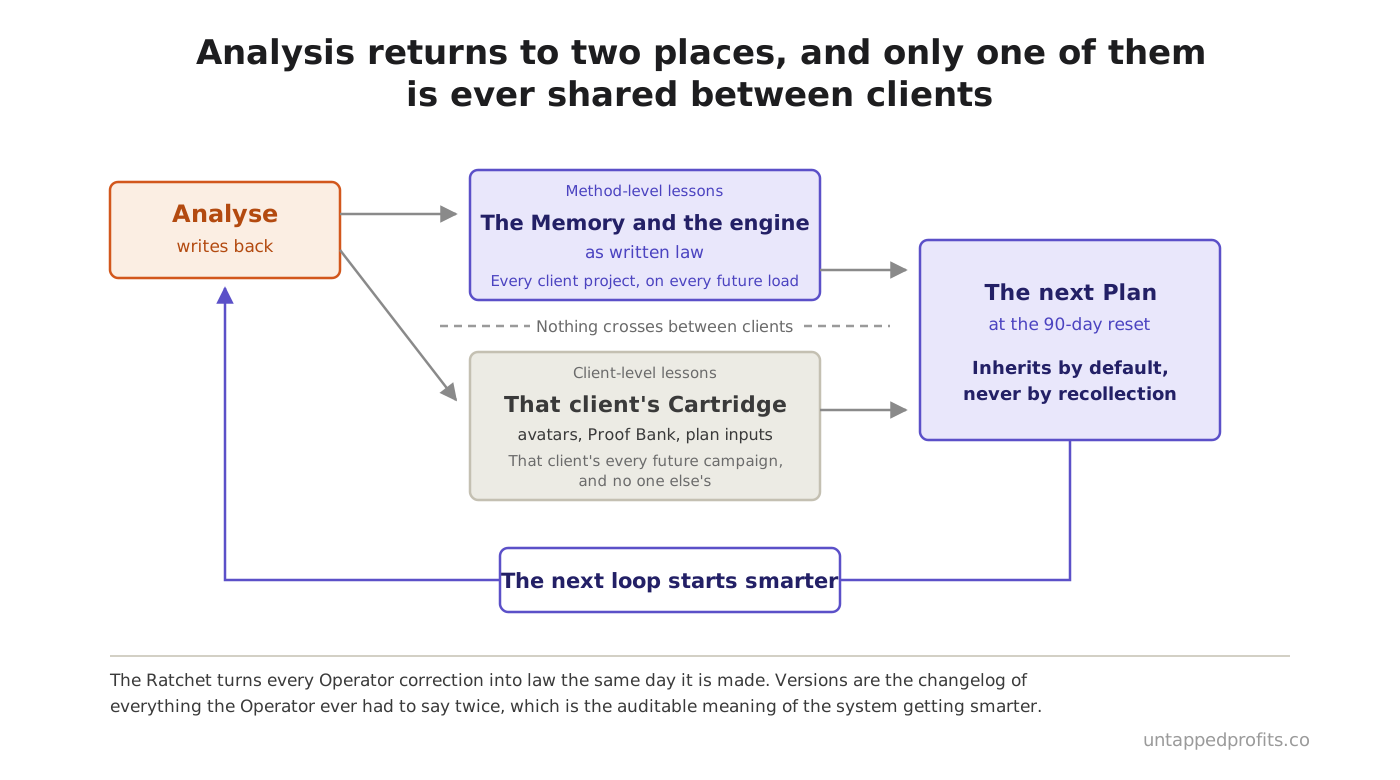
The Return Arrow is Analyse feeding back into the Memory: the step that turns a one-off campaign into a system that compounds. Every other part of the method produces something. This is the part that makes sure none of it has to be produced twice.
Key takeaways
- Learning returns to two different places: method-level lessons to the engine, client-level lessons to that client's Cartridge. Nothing crosses between clients.
- The named habit is the Ratchet: every Operator correction becomes permanent law the same day it's made.
- When Ebbinghaus's 1880 forgetting curve was replicated in 2015, the subject's relearning advantage had collapsed to a few percent after a month.1 That is one brain trying to remember. An organisation does worse.
- Version numbers are the changelog of everything the Operator ever had to say twice, which is the auditable meaning of "the system got smarter."
- The 90-day reset inherits by default, so compounding is structural and never depends on anyone remembering.
Why does most marketing never get smarter?
Because organisations forget the way people do: fast, and without noticing. The lesson lives in a contractor's head, a slide nobody reopens, a chat that scrolled away. By next quarter the organisation is a fresh subject in its own experiment, relearning at full price.
The individual version of this is one of psychology's oldest measured findings. When Ebbinghaus's 1880 forgetting curve was replicated in 2015 in PLOS ONE, most of the loss happened inside the first day, and by 31 days the subject's savings score had fallen to roughly 4%.1 That is a single motivated brain, learning deliberately, with nothing else competing for the material. A marketing operation has none of those advantages and every distraction.
George Santayana wrote the diagnosis in The Life of Reason, and the famous last sentence is less useful than the one before it: "Progress, far from consisting in change, depends on retentiveness. [...] Those who cannot remember the past are condemned to repeat it."2 Most marketing has plenty of change. What it lacks is retentiveness, a mechanism that keeps what was learned so change can accumulate into progress instead of just happening.
AI makes the problem sharper. Sessions end, contexts truncate, and the machine that produced last quarter's insight has no idea it ever did. Speed without retention built 47 Funnels in 5 Minutes, Zero Revenue — all output, no accumulation.
How does the Return Arrow work?
By making the write-back structural rather than optional. Analyse doesn't finish with a report, it finishes by depositing what it learned into the artefacts that persist, and the Ratchet converts every Operator correction into law the same day. Nothing important survives as a memory or a mood.
- Analyse writes back, to the right place. Method-level learnings return to the Memory and the engine, stripped of anything client-identifiable. Client-level learnings sharpen that client's Cartridge: avatars updated, proof banked, dead ends closed. Nothing crosses between clients and everything lands somewhere durable.
- The Ratchet turns corrections into law, same day. This guide's own chapters are the evidence trail, set out below.
- Versions are the changelog. The engine's version numbers record everything the Operator ever had to say twice. Once a rule exists, the correction behind it never needs repeating, which is the precise and auditable meaning of a system getting smarter.
- The reset inherits. The Compounding Brief closes the loop on schedule, so every 90-day reset of The Campaign Plan starts from the current Memory. Everything returned since the last reset is in the next plan by default and never by recollection.
- The next loop starts smarter. That is the whole claim, and the arrow is what makes it structural instead of aspirational: Plan draws from a Memory that Analyse just improved, forever, in a circle.
| What went wrong once | What it became |
|---|---|
| A hook that passed every prohibition and grabbed no one | The Hook Law |
| A punchline that stalled its reader for half a second | The Referent Test |
| A model-drawn logo | The wordmark process in the Production Module |
| A safe-zone miss | Encoded reserves |
This is the chapter the method's name hangs on. The method's own definition — running all of a business's marketing through one accountable Operator and one AI-powered system, so every channel works from the same intelligence and every result feeds back into it — ends on this chapter. That last clause is the Return Arrow. Everything before it describes machinery, and the feedback is what makes the machinery compound.
| What was learned | Where it returns | Who inherits it |
|---|---|---|
| Method-level lessons: a better gate, a sharper test, a new clause | The Memory and the engine, as written law | Every client project, on every future load |
| Client-level lessons: what these buyers actually did | That client's Cartridge, meaning avatars, Proof Bank, plan inputs | That client's every future campaign, and no one else's |
| Operator corrections | Permanent law, same day, which is the Ratchet | The system itself, because the correction never needs saying twice |
In practice
Write the correction into law before the session ends, while you still remember why it mattered. A rule written a week later carries the instruction and loses the reasoning, and a rule whose reasoning is gone is the first one someone overrides when it becomes inconvenient.
What should you measure on the return?
Whether the loop is connected and whether it holds. Corrections ratcheted into law the day they're made tell you whether the Ratchet is a habit or a hope. Lessons the Operator has had to give twice are the system's true error rate. And an Analyse pass that wrote nothing back was a report, never a loop.
| Measure | What it tells you | Target |
|---|---|---|
| Corrections ratcheted into law the day they're made | Whether the Ratchet is a habit or a hope | All of them, same day, with no exceptions |
| Lessons the Operator has had to give twice | The system's true error rate | Zero, because twice means a rule is missing |
| Resets that inherited the current Memory | Whether compounding is structural or manual | Every one, by inheritance and not by effort |
| Analyse passes that wrote nothing back | Whether the arrow is connected | Zero, because an analysis that returns nothing was a report |
Watch for
Law that only accumulates. Retention needs a counterpart, so the rule set gets reviewed on a schedule and stale rules are retired deliberately, the same way the Memory retires stale knowledge. A system that can only add rules eventually forbids everything worth doing, and nobody notices until the work has quietly gone beige.
What does running without the return cost?
The same lessons, purchased annually. The audience insight that dies with the campaign that found it. The correction given in March, forgotten by June, repeated in September with interest. Year three of the marketing running on year one's knowledge, with two years of invoices in between.
On the forgetting curve, that isn't a risk. It is the default trajectory of any operation with no retention mechanism. The Return Arrow is cheap, and amnesia is the most expensive thing in marketing, usually itemised as onboarding. It is also the thing that decides who owns the accumulated learning your budget paid for — Whose Brain Is Your Ad Spend Training? asks that question of every agency arrangement.
Frequently asked questions
Don't post-campaign reviews already do this?
A review describes and the return legislates. The deck that says hooks underperformed with this segment is a memory with a filename, and it governs nothing next quarter. The same finding returned through the arrow updates the avatar's pack, adjusts a law, and is inherited by the next plan automatically. The test: does your review change what the system does when nobody remembers the review?
Won't laws pile up into bureaucracy?
Every law here is born from a real, paid-for failure, because the Ratchet doesn't legislate hypotheticals. And retention has a counterpart, since the system reviews its own rules on a schedule and retires what has gone stale. Living law accumulates judgment and bureaucracy accumulates paper, and the difference is whether each rule can point to the failure that earned it.
Doesn't AI remember everything anyway?
No, and designing as if it does is how learning dies in a scrollback. Sessions end, contexts truncate, models change. Chats are scaffolding and files are the system. The Return Arrow writes learning into artefacts that persist, which is the same discipline that makes The Build Ledger resurrectable.
What if a returned lesson turns out to be wrong?
It gets reversed by the same mechanism that installed it: a dated ruling, with reasons, replacing the old one. That is why the changelog matters more than any individual rule. A system that can only add law is as broken as one that never writes any, and the record is what makes reversal cheap instead of embarrassing.
How long before the compounding shows?
The first visible sign is small and early: a correction you gave once and never had to give again. The larger effect arrives over quarters, as each reset starts from a sharper Memory than the last. What you won't get is a dramatic moment, because compounding never announces itself. It shows up as the year the marketing stopped feeling like it was starting over.
The bottom line
Marketing forgets, because nothing in the ordinary arrangement is responsible for remembering. The Return Arrow makes remembering structural: analysis writes back to the Memory and the Cartridge, every correction becomes law the day it's made, and every reset inherits the lot. It is the last chapter of this method because it is the reason there can't be a last version of it. Learning velocity is the durable advantage — The Brand That Learns Fastest Wins measures it campaign against campaign. The system that returns is the system that keeps getting smarter.
Where this connects
The arrow lands in The Memory, which every loop begins by reading. Its cadence is set by The Campaign Plan's 90-day reset, and its separation discipline, method to the master and client to the Cartridge, is Engine, Cartridge and Connectors and The Seam Rule doing their jobs. The corrections it carries come from every gate and seam in Creative Production, under the authority of The Operator's Laws. Back to the One Brain Method hub, or read the whole method in order from the contents page.
Part 10 · Return · Chapter 38 of the One Brain Guide
Previous: Lead Tracking and Pipeline ·
All chapters
Sources
- Jaap M. J. Murre and Joeri Dros, "Replication and Analysis of Ebbinghaus' Forgetting Curve", PLOS ONE 10(7): e0120644, 2015. One subject spent about 70 hours learning and relearning lists of nonsense syllables, with retention measured as savings at 20 minutes, 1 hour, 9 hours, 1 day, 2 days, 6 days and 31 days. The 31-day savings score was 0.041. The authors note this is markedly lower than Ebbinghaus's own result and other replications, and that correcting for a learning-speed trend across the experiment would put it nearer 0.137. Single subject, nonsense syllables: the study measures individual memory for meaningless material, and the extension to organisational forgetting is this method's analogy.
- George Santayana, The Life of Reason: The Phases of Human Progress, Volume I, Reason in Common Sense (1905), chapter 12, "Flux and Constancy in Human Nature". The bracketed ellipsis omits one sentence between the two quoted. Source punctuation preserved.
Every statistic and quotation on this page has been checked against its primary source. Last verified 27 August 2026.
Free guide
Take the method with you. The complete One Brain Method as one PDF: every chapter, the diagrams, and every named framework, ready to hand to whoever runs your marketing. Enter your email and it's yours.
Want marketing that has to be taught everything exactly once?
Book a 30-minute call → See what it takes to have this installed