
Account waste is not usually discovered. It is prevented, by a routine that runs whether or not anything looks wrong. The accounts that get audited dramatically once a year are the ones that needed reading every week.
Key takeaways
- The named framework is The Weekly Read: a fixed weekly routine across three touchpoints plus a monthly cycle, producing proposals for the Operator to rule on rather than changes.
- The governing principle is discipline and consistency, not heroics. The routine works because it happens on schedule, not because it is clever.
- Conversion tracking is checked first, every week. It is the cheapest check available and the most expensive to skip: a week of broken tracking is a week of blind spend and a month of corrupted learning.
- Analysis reads architecture before performance, because performance data alone conceals substitution. The eBay experiment found a campaign whose traffic the business would have received anyway1 — and nothing in the account's own reporting could have shown it.
- Every analysis carries its figures, and no analysis proceeds on a subset while quietly caveating the conclusion. Missing inputs are named, and the analysis waits.
Why do most account audits find the same shallow problems?
Because they all read the same layer. An audit that opens with performance data finds performance problems: this campaign is expensive, that keyword converts badly, this ad group has drifted. All true, all real, and all downstream of decisions made in the account's architecture months earlier.
Structural waste does not appear in a performance report, because the report has no column for it. A settings choice quietly suppressing delivery, a negative architecture that was never built, an optimisation event pointed at the wrong outcome, a tracking break that has been feeding automated bidding false signals. None of these show up as a bad number. They show up as a mediocre account that everyone agrees is fine.
The eBay experiment, set out in Google Ads, is the clearest published demonstration of the gap. Brand-keyword ads looked highly effective on the account's own attribution numbers, and switching them off cost eBay almost nothing, because natural search absorbed the clicks.1 No performance report contains that finding, because the data needed to see it does not exist inside the account. An audit that only reads what the platform hands over cannot find what the platform never measured.
How does The Weekly Read work?
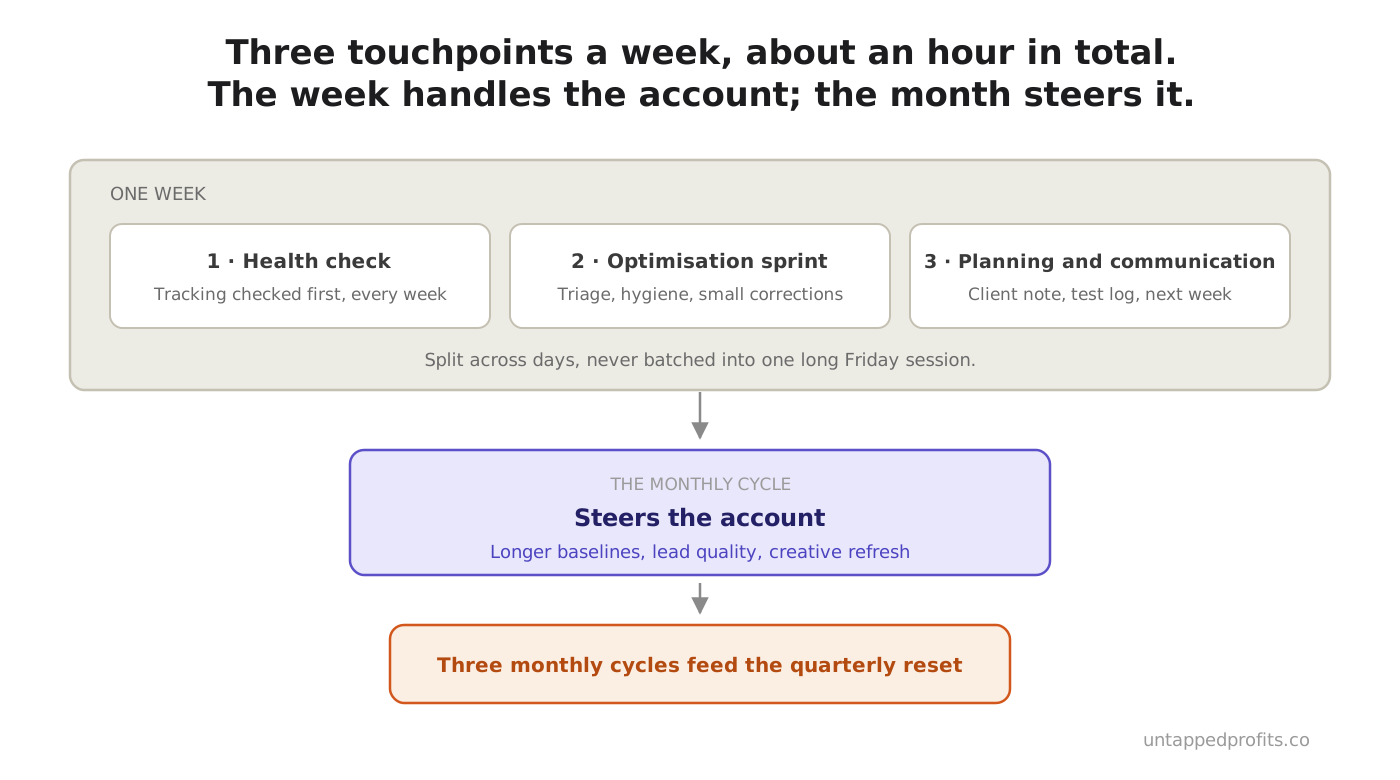
Three touchpoints a week, deliberately split across days rather than batched. One long Friday session is not the same thing: a problem found on Monday gets five days of correction, and the same problem found on Friday gets none. The whole routine costs about an hour, and its value comes from happening on schedule rather than from any single pass being thorough.
| Touchpoint | What gets read | What it catches |
|---|---|---|
| 1 · Health check | Performance against both the prior equivalent period and the four-week average, alerts and disapprovals, confirmation that conversions are still recording, and budget pacing | Blind spend, and a trend being mistaken for a blip |
| 2 · Optimisation sprint | Search-term triage on cost, asset and channel review, small target refinements, and anything spending with nothing to show that is not deliberately in a test | Small problems becoming large ones |
| 3 · Planning and communication | The client note in the Operator's own words, a competitive check, the test log updated, next week's priorities decided now instead of improvised then | A client who wonders what you actually do |
Two comparisons rather than one is the detail that carries the health check. A single comparison cannot separate a trend from a blip, and most weekly reporting runs on exactly one. And the tracking check earns its place at the top of the routine because at small budgets a broken tag and a failing campaign look identical while calling for opposite actions.
The monthly cycle does the steering the weekly routine deliberately does not attempt: period comparisons against both last month and last year, the lead-quality question where outcome data exists, thematic search-term work, a creative refresh plan, and a budget reallocation modelled before it is made. Then implementation, a short course correction, and a report whose job is to explain why instead of listing what.
In practice
Log every test as it launches instead of afterwards, with one row each: the hypothesis, what changed, the dates, the single success metric declared before launch, the result, and the rule it produced. A test that changes no rule was entertainment. The log is also the only defence against re-running an experiment the account already answered.
Watch for
The monthly question nobody asks: did lead quality move? Cost per lead can improve while the leads get worse, and the two are frequently the same event. Where offline outcome data exists, the lead-to-customer rate is the number that separates a paid operator from a button-pusher.
What does an analysis have to prove?
Its figures, its inputs, and the difference between what changed and what we changed. Every finding carries the numbers behind it. "The campaign became much less efficient and needs work" is not a finding. A stated movement, with its figures and its period, is.
Three standing rules sit around that.
- Context before data. No analysis starts without knowing the conversion goal and what a conversion is actually worth, the efficiency target, the business model, the geography, and what the business does and does not sell. An analyst who does not know what a client refuses to sell will optimise toward it.
- Input mandate stated, then honoured. Each analysis names the files and columns it needs. Missing inputs are named and the analysis waits. It does not proceed on a subset and quietly caveat the conclusion, which is how a partial read becomes a confident recommendation.
- Separate what we changed from what changed around us. Seasonality, auction shifts, platform updates and page changes all move numbers. Account changes are correlated with performance shifts before cause is attributed, benchmarks are context rather than justification, and whatever remains unexplained is stated as unexplained.
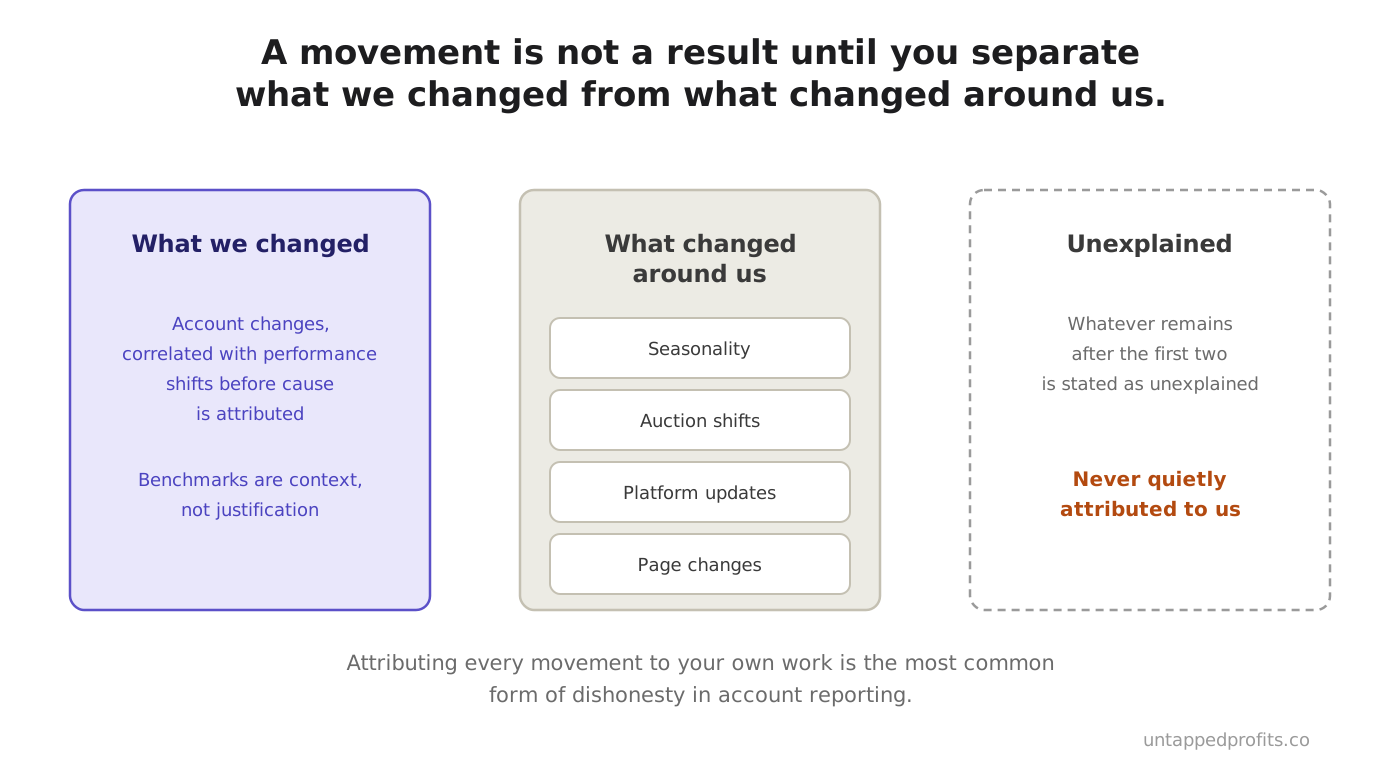
That last rule is what makes a before-and-after analysis worth reading. Attributing every movement to your own work is the most common form of dishonesty in account reporting, and it is usually unintentional, because the alternative requires saying "we cannot fully explain this", which few reports are willing to print.
What does the audit produce?
Proposals, ranked by money at stake and not by ease. Nothing in the account changes because a chart moved. The analysis output is a prioritised set of recommendations, each with its expected impact expressed in the client's own numbers, and each waiting on a ruling before it touches anything.
The library of analyses is a standing set rather than improvisation: the period audit that quantifies waste and constrained performers, the foundational negative build and its recurring maintenance pass, search-term mining that ends in a structure brief, placement quality assessment, asset analysis for campaign types that hide their own workings, the before-and-after impact read, and budget pacing with its reallocation modelled first. The same account read twice by the same method returns the same findings, which is the property that makes an audit checkable.
Findings then leave the account, on the split the method sets everywhere else. Method-level learning goes to the Memory, client-level learning goes to that client's Cartridge, and a result that repeats twice is promoted to standing law. Analysis is The Return Arrow's other lane: creative learning and account learning travel the same road home, which is why a well-read account gets cheaper to run each quarter.
Frequently asked questions
Isn't a weekly routine overkill on a small account?
It matters more on a small account, not less. At low volume a broken tag, a delivery stall and a genuine failure all look the same, and the only thing that separates them is having looked recently enough to know what changed. The routine takes about an hour a week and its purpose is to stop small problems compounding into the kind that need an audit.
What is the difference between the weekly routine and the monthly cycle?
The weekly routine handles the account, and the monthly cycle steers it. Weekly work is triage, hygiene and small corrections. Monthly work is comparison against longer baselines, the lead-quality question, the creative refresh plan and a modelled reallocation. Three monthly cycles then feed the quarterly plan reset, so the small cadence feeds the large one instead of competing with it.
Why not just act on what the analysis finds?
Because reading and acting have different risk profiles. Analysis is reversible and cheap, so it runs wide. An account edit spends real money and a large one can restart automated bidding's learning, destroying the evidence the recommendation was based on. Findings Are Not Decisions, from The Operator's Laws, is the law that separates the two.
What if the client will not connect the CRM?
Then lead quality is unknown. That gets stated plainly, and every judgement made in the period carries the caveat. Connecting it becomes the highest-value tracking fix available and belongs in the plan rather than being quietly worked around. What the analysis cannot do is substitute a platform-reported number that feels close and report it as quality.
How much of an audit can be automated?
The retrieval and the arithmetic, and none of the ruling. Pulling reports, correlating change history with performance shifts and flagging anomalies is read-only work that is safe to run at volume. Deciding what to do about it is not — The Safety Setting That Was Costing You Leads found that line the expensive way.
The bottom line
An audit is what you need when the routine has not been running. Read the account weekly across three short touchpoints, check tracking before anything else, compare against two baselines rather than one, ask monthly whether lead quality moved, log every test with the rule it produced, and rank findings by money at stake. Waste then gets caught while it is small and cheap, and the dramatic annual audit stops being necessary, which is the point of it.
Where this connects
Account Analysis reads accounts run under Paid Acquisition, including Meta Ads and Google Ads, against the KPIs set in The Campaign Plan. Its output is proposals ruled on under The Operator's Laws, and what it learns returns through The Return Arrow into The Memory. Closest in the archive: The 4-Question Diagnostic, The Crusty Table Problem and Five Agencies, Five Wins, One Losing Business. Back to the One Brain Method hub.
Part 4 · Paid Acquisition · Chapter 14 of the One Brain Guide
Previous: Google Ads ·
Next: Creative Production ·
All chapters
Sources
- Thomas Blake, Chris Nosko and Steven Tadelis, "Consumer Heterogeneity and Paid Search Effectiveness: A Large Scale Field Experiment", Econometrica, Vol. 83, No. 1 (January 2015), pp. 155-174. The finding, its exact wording and its scope caveats are set out in Google Ads.
Every statistic and quotation on this page has been checked against its primary source. Last verified 24 August 2026.
Free guide
Take the method with you. The complete One Brain Method as one PDF: every chapter, the diagrams, and every named framework, ready to hand to whoever runs your marketing. Enter your email and it's yours.
Want an account read every week instead of audited every year?
Book a 30-minute call → See what it takes to have this installed