
Content Ideation is the layer that turns pillars into specific things worth making, and it exists because running out of ideas is almost never the problem. Deciding between them is.
Key takeaways
- Five lenses across each pillar produce 25 ideas per pillar per pass. Four pillars is a hundred ideas, and the constraint has never been supply — it is the scoring, ranking and killing that follow.
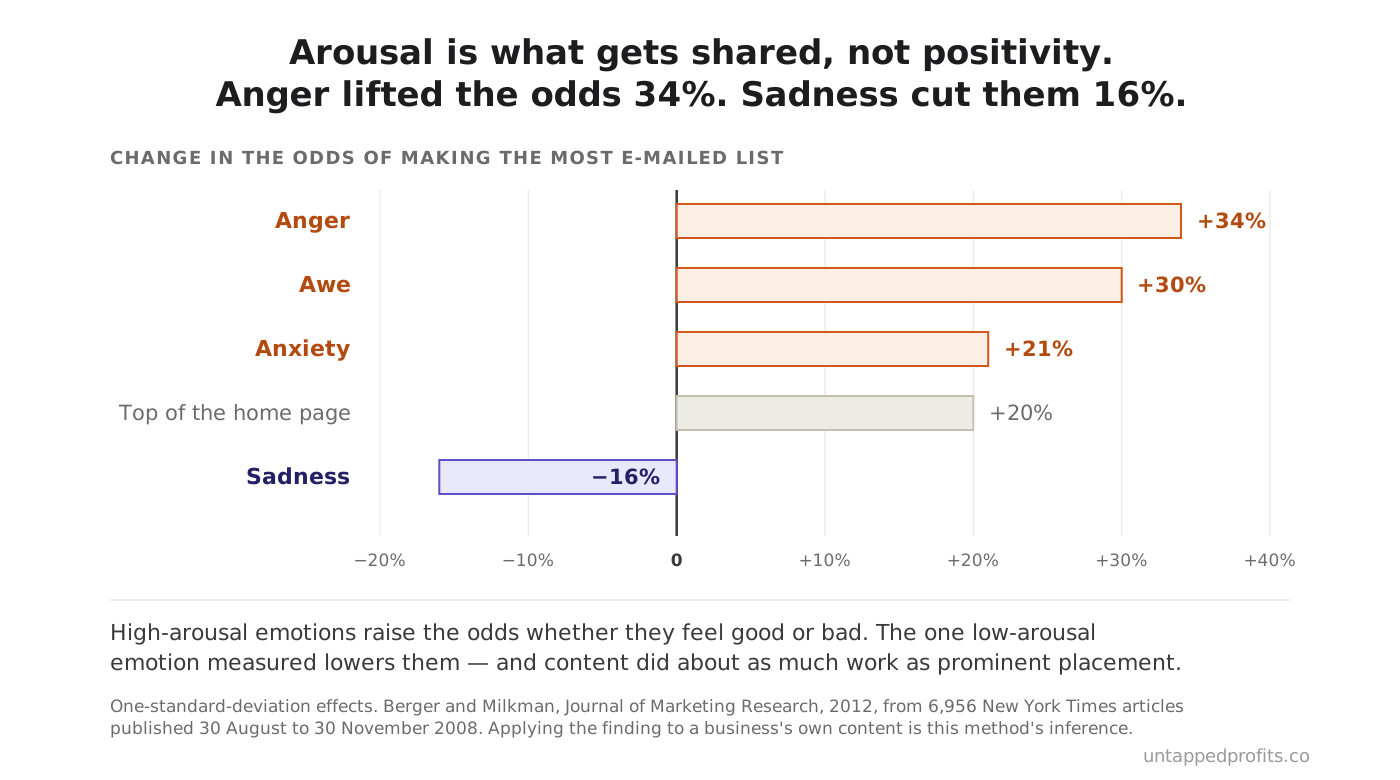
- Berger and Milkman coded 6,956 New York Times articles and found that a one-standard-deviation rise in awe lifted the odds of an article being widely shared by 30 percent, anger by 34, while sadness lowered them by 16.1
- Arousal predicts sharing better than whether something is positive or negative, which makes the emotion an idea carries a scoring criterion instead of a matter of taste.
- Ideas are scored, ranked and queued, and anything sitting unused for 30 days is killed rather than carried, because a stale queue is a queue nobody trusts.
- Every idea still passes the same gate as an ad: claims banked, Ejection Triggers swept, destination named.
Where do content ideas actually come from?
Three standing inputs, the same ones the ad pipeline uses. The Intelligence Packs supply what the buyer already asks and already fears, competitor libraries supply the persuasion jobs being run at them right now, and performance data supplies what has landed before. Ideation working from none of those is intuition wearing a framework, and it produces content that could belong to any business in the category.
The mechanical part is deliberately dull. Each pillar runs through five lenses, educational, inspirational, entertainment, promotional and community, five ideas per lens, which is 25 per pillar in a single pass. Four pillars produce a hundred. Nobody has ever needed a sixth technique for generating more.
What the volume exposes is that the real work is downstream. Execution stopped being the constraint the moment production got cheap, and judgment became the thing in short supply — Why AI Made Creative Strategy the Only Thing That Matters scales that shortage up to the whole campaign. A hundred ideas and no way to rank them is worse than ten and a scoring sheet.
What makes an idea worth making?
Three things, scored one to ten each. Whether it fits the audience profile, which describes what makes these people react and not who they are. Whether it matches a pattern that has already performed here, and whether a live signal is running in the category right now. An idea strong on pattern and signal together is the week's best bet. Signal alone is chasing, and pattern alone is safe and flat.
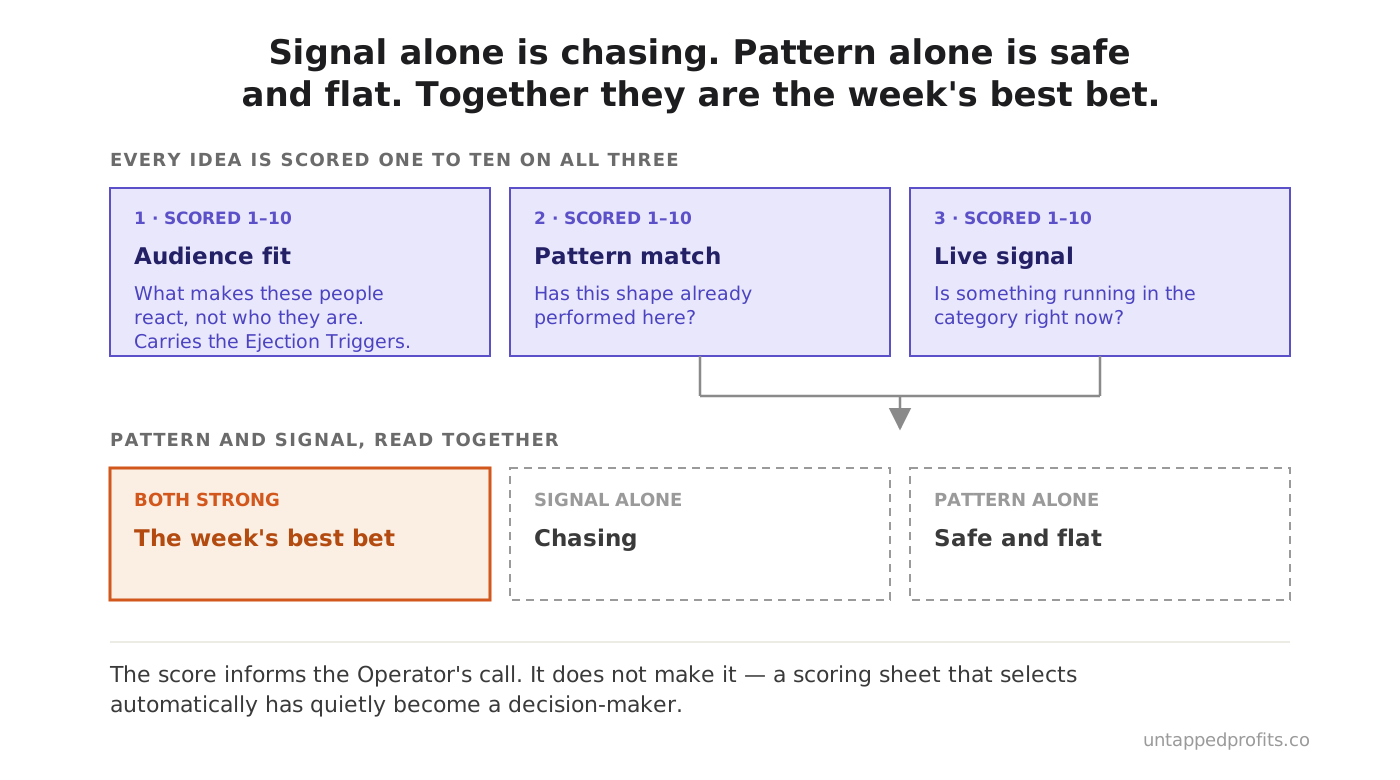
The audience profile is not the avatar, and confusing the two is the common error. Avatars describe who buys. The profile describes what makes them stop: how they see themselves, what they are sophisticated about, what lands, and what makes them leave instantly. That last list is the Ejection Triggers wearing different clothes, and it does the same job here it does in the ad pipeline. Averaging across a segment hides all of it — Your Segmented Campaigns Are Still Talking to Nobody is that average, met in the wild.
Berger and Milkman's data gives the emotional axis some teeth. Their coding of nearly 7,000 articles showed that arousal drives sharing, so awe, anger and anxiety all raised the odds while sadness lowered them, and they found that "content characteristics are of similar importance" to prominent placement.1 What an idea makes someone feel is worth a score, and low-arousal ideas are worth spotting before they are made.
In practice
Keep the queue ranked and visible, and kill anything that has sat in it for 30 days. Parking an idea feels generous and costs nothing on the day. What it actually does is teach everyone that the queue is a graveyard, and once that happens nobody reads it. A short queue people trust beats a long one people scroll past.
How do you get an angle out of a source?
By reading it for what it takes for granted. Read it first for the core claim, the assumptions underneath it, who it does not serve, where the evidence thins, and what has changed since. Then generate deliberately, evaluate honestly, and develop only the survivors into briefs. Skipping to generation is what produces the generic output, and that is the entire reason the sequence is enforced.
| Reframe | The move | When it earns its place |
|---|---|---|
| Belief flip | Most people believe X, the evidence says Y | When you can actually cite the Y |
| Audience pivot | Same topic, a completely different reader | When the original was written for someone else |
| Time shift | What was true before, or will be later | When something in the category has moved |
| Scale shift | Zoom to the micro tactic or the macro implication | When the source sits at one altitude only |
| Stakeholder swap | The view from the competitor, buyer or regulator | When the source has one obvious vested interest |
| Contradiction hunt | The tensions inside accepted wisdom | When two things everyone believes cannot both hold |
Six angles per request is the ceiling. A list of twelve is a list nobody uses, and depth is what makes an angle survive contact with a blank page. Three hard constraints travel with every one of them. No angle that could apply to any business in the category. Every angle carries its evidence or is flagged as needing some, never assumed. And for anything contrarian, the opposing view gets its strongest form written out before it gets taken apart.
What stops everything sounding the same?
Deliberate rotation, tracked rather than trusted to memory. Angle types are a fixed set of ten. Two consecutive pieces sharing a type is a pattern, and three is a fingerprint. The same rule governs the reframing techniques above, because a business that runs belief flips every week has one trick and a publishing schedule.
The ten angle types:
- Contrarian
- How-to
- List
- Question
- Why
- Comparison
- Warning
- Story
- Data-led
- Reveal
Boldness gets rated on the way out, on a visible scale from safe through spicy to provocative, so the risk in a piece is chosen up front and not found out at publication. That single line prevents most of the arguments that happen after something goes out sharper than anyone expected.
One thing this layer deliberately does not do is invent a hook standard. Angle types supply the shape of an argument. Hooks answer to the Hook Law, blog openings answer to their own tactics, and no third framework operates anywhere in the system. Ideas about what people actually want also come from watching what they research at midnight rather than from asking them, which is the method How to Visualise Your Prospect lays out.
Watch for
The pattern library that never changes. It gets built once from the best-performing posts, ranked, and then quietly treated as permanent. Six months later it is a guess with a filing system attached. Rebuild the rankings every 30 days against real numbers, flag what is declining, and name what is emerging.
Frequently asked questions
How is this different from a content brainstorm?
A brainstorm generates and stops. This generates against locked pillars, scores every idea on three named axes, ranks the survivors into a queue and kills the rest on a clock. The generating part is the least valuable half hour in the process.
What if there is no performance data yet?
Build the pattern library from the niche, mark it provisional, and say so out loud. Then update it every 30 days against whatever real numbers have arrived. A provisional library that gets corrected monthly beats waiting six months for certainty that never quite comes.
Should we jump on trends?
Only where the business has a credible angle, the trend maps to a pillar, it survives the Ejection Triggers, and there is time to ship before it dies. Anything older than about a month gets a dated assessment framing instead of a reaction framing. The reactive share of the calendar is a budget, and trends compete for it.
Does emotional content mean being dramatic?
No, and the research is specific about why. What predicts sharing is arousal, not volume. A precise finding that makes someone sit up produces awe. A manufactured outrage that the audience can see through produces nothing except a credibility problem, and it fails the Ejection Trigger sweep before it reaches the queue.
Who decides which ideas get made?
The Operator, from the ranked queue, and the score informs the call without making it. A scoring sheet that selects automatically has quietly become a decision-maker, and Findings Are Not Decisions anywhere in this system.
The bottom line
Businesses that struggle with content almost never have an idea problem. They have a selection problem, and it shows up as a calendar full of things nobody chose so much as accepted. Generate in volume, because generating is the cheap part now. The real effort belongs downstream, in the scoring, the ranking and the killing, and the output improves the moment somebody is willing to throw away 90 good ideas to make the ten that were worth making.
Where this connects
Content Ideation takes its pillars and its calendar slots from Content Architecture and sits inside Content & Channel. The audience profile it scores against is built from Customer Intelligence, and every claim inside an idea answers to The Proof Bank before it reaches a draft. Hooks belong to The Hook Law, and what the published work teaches goes back through The Return Arrow to seed the next pass.
Part 6 · Content & Channel · Chapter 27 of the One Brain Guide
Previous: Content Architecture ·
Next: Writing for Clarity ·
All chapters
Sources
- Jonah Berger and Katherine L. Milkman, What Makes Online Content Viral?, Journal of Marketing Research, vol. 49 no. 2, 2012, pages 192 to 205. The field study covered 6,956 New York Times articles published between 30 August and 30 November 2008, of which 20 percent reached the paper's most e-mailed list. The odds figures are one-standard-deviation effects from the paper's own chart: awe 30 percent, anger 34 percent, anxiety 21 percent, sadness minus 16 percent, with time at the top of the home page at 20 percent. Peer reviewed, funded by Wharton research initiatives, with no commercial interest in the finding. The study concerns news articles read in 2008. Applying it to a business's own content is this method's inference.
Every statistic and quotation on this page has been checked against its primary source. Last verified 27 August 2026.
Free guide
Take the method with you. The complete One Brain Method as one PDF: every chapter, the diagrams, and every named framework, ready to hand to whoever runs your marketing. Enter your email and it's yours.
The ideas are not the hard part. Choosing between them is where the money is.
Book a 30-minute call → See what it takes to have this installed