
Community and Governance is the law for everything that happens after publishing: who answers the comment, how fast, on whose authority, and what the business does on the day something goes badly wrong.
Key takeaways
- Four escalation tiers, from routine questions up to a reputation threat, each with a named clock and a named decision-maker agreed before anything happens.
- Replies, community management and anything carrying a claim are never automated, at any volume, for any client.
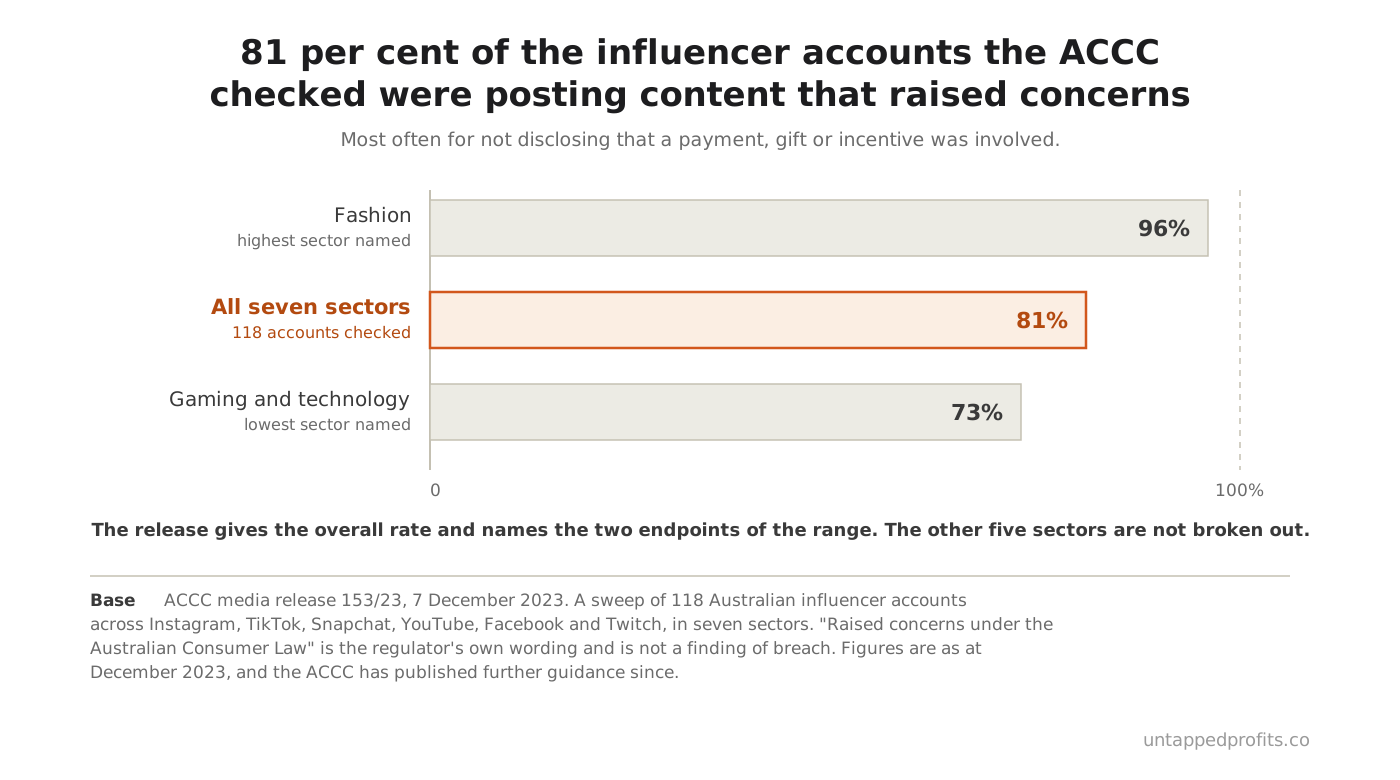
- The regulator has already measured the failure rate: the ACCC's sweeps found 81 percent of 118 influencers raising concerns under the Australian Consumer Law, mostly undisclosed brand relationships, and 37 percent of 137 businesses in concerning conduct around online reviews.1
- Every incident ends with a post-mortem that changes the policy. A crisis that teaches nothing was just an expensive week.
Why does a public inbox need written law?
Because inconsistent replies cost more than inconsistent posts, and consistency under pressure only happens when the answer was written down beforehand. The policy covers the voice used in replies, the response-time standard, who approves what, what employees may say, and the industry rules that apply. It is agreed at onboarding while nothing is on fire, which is the only time anyone thinks clearly about it.
The policy is a plan input, not an afterthought. Response times and approval workflow are commitments the business is making, and a marketing plan that promises daily community management the owner cannot sustain has written a cheque against somebody's evenings. The rhythm underneath it is unglamorous: a daily sweep of notifications, replies and direct messages, then a weekly look at response metrics and weekend coverage.
Outbound engagement belongs in that rhythm too, and it is a growth channel and not a chore. Meaningful comments on other accounts earn attention that no post of your own can buy. What earns nothing is the generic compliment, and a business leaving a hundred of those a week has automated its own credibility away — the comment-section cousin of Your AI Marketing Has a CGI Problem.
What happens when something goes wrong?
It gets a tier, and the tier decides the clock and who is told. Routine questions are handled at Operator level using approved framings. Complaints and pricing disputes get a considered reply and often move to a private channel. Anything legal, regulatory, viral or safety-related means the client is told immediately and scheduled content pauses. A genuine reputation threat convenes the decision-makers.
| Tier | What it covers | Who acts, and when |
|---|---|---|
| Tier 1 | Routine questions, thanks, basic how-to | Operator, same day, approved framings |
| Tier 2 | Complaints, pricing and policy questions, minor negative sentiment | Operator, considered reply, private channel where it helps |
| Tier 3 | Urgent: viral negatives, legal or regulatory mentions, media, safety | Client notified immediately, routine replies paused |
| Tier 4 | Crisis: reputation threat, legal threat, coordinated attack | Decision-makers convened, all scheduled content stopped |
For anything sold on consideration instead of impulse, one mishandled public comment can cost a sale outright, which is why this matrix is not administrative overhead. The reply is also not written for the person complaining. It is written for everyone reading the exchange afterwards — What a 1920s Gangster Taught Me About Google Reviews learned that watching a bad reviewer get corrected.
In practice
Write the tier-three and tier-four contact list before you need it, with names, mobile numbers and a stated expectation about after-hours contact. The worst moment to find out that the only person authorised to approve a statement is unreachable until Monday is the Saturday morning it matters. Confirm the list every quarter, because people change roles quietly.
What does a crisis look like hour by hour?
Five stages on a clock. Detect within about 15 minutes. Assess in the following hour, establishing the facts, the spread and who is affected. Respond within one to four hours with a holding statement and direct outreach to anyone harmed. Manage with updates and documentation. Resolve with a final communication, a post-mortem and a policy change. Speed matters most at the front of that sequence.
Five things are never done. A legitimate complaint is never deleted. Nobody argues publicly. Blame is never assigned before the facts are in. The business never goes quiet without at least a holding statement, because silence reads as guilt within a few hours. And scheduled promotional content never keeps running through it, which happens far more often than it should because nobody remembers the queue.
Four things always happen. Acknowledge fast, even before there is an answer. Move detail into private channels. Take responsibility where it is warranted rather than where it is comfortable. And document everything as it happens, because the post-mortem is worth nothing if the timeline gets reconstructed from memory a fortnight later.
Which compliance rules catch businesses out?
Disclosure, mostly, and the regulator has already measured how badly. Sponsored content must be obvious. Music and imagery are licensed rather than borrowed. User content is used with permission. Approval records are kept. Industry rules for health, finance, legal and property apply before anything ships, and none of that is optional at any posting volume.
The ACCC's sweep of 118 Australian influencers is the number to sit with. It found 81 percent making posts that raised concerns under the Australian Consumer Law, rising to 96 percent in fashion and falling to 73 percent in gaming and technology, and the most common issue was simply not disclosing that a payment, gift or incentive was involved. Vague markers such as sp in place of sponsored were called out by name, as was formatting that hides the disclosure. Acting Chair Catriona Lowe put the obligation on both sides, saying the ACCC was concerned that influencers, brands and advertisers were "taking advantage of consumers' trust through hidden advertising".1
The reviews finding is the one that should make marketers uncomfortable, because it sits next to advice everyone gives. The same regulator flagged businesses that direct happy customers to post publicly while quietly routing unhappy ones back to the business. Moving a complaint into a private channel to actually resolve it is good practice. Building a system that sends negative experiences somewhere they cannot be seen while positive ones go to the review platform is manipulation, and the line between them is intent. Genuine third-party endorsement is worth more than a curated wall anyway — Sammy Davis Jr Told 25 Lies About Me got twenty-five of them for free.
Watch for
The reply queue quietly becoming automated. It starts with a canned answer to a common question, which is fine, and it ends with a system answering complaints in a voice nobody chose. Anything carrying a claim, an apology or a commitment is written by a person. The saved time was never worth what it costs the first time it goes wrong in public.
Frequently asked questions
How fast does a business actually have to reply?
Fast enough to match what it promised, which is why the standard is written into the policy and never assumed. What matters more than the number is that it holds. An account answering within an hour on Tuesday and three days later on Thursday has trained its audience to expect nothing.
Should negative comments ever be deleted?
Only where they breach the platform's own rules, meaning abuse, spam or something unlawful. A legitimate complaint stays up and gets answered. Deleting it removes one comment and creates a second, angrier one along with a screenshot, and the audience now has a reason to believe the account curates its criticism.
Who decides what gets said in a crisis?
The client, on the facts the Operator brings them, with the tiers deciding when that conversation starts. The Operator's job at tier three and four is to detect, establish what is true, pause anything scheduled, and put a holding statement in front of someone who can approve it. Findings Are Not Decisions here either.
Does a small business really need all this?
It needs the tiers and the contact list, which take less time to write than the first incident takes to unfold. The rest scales with exposure. What no business gets to skip is the disclosure law, because the Consumer Law applies to a business with 200 followers exactly as it applies to one with 200,000.
When does the policy get reviewed?
Quarterly as a light pass, annually in full, and immediately when something fires. A platform changes its rules, a competitor arrives, the business changes what it sells, two quarters of targets get missed, or an incident happens. The post-mortem after an incident is the most valuable review of the four and the one most often skipped.
The bottom line
Everything upstream of this chapter is about what a business says. This one is about what it does when someone answers back, and that is where trust is actually won or lost. Write the tiers, name the people, keep replies human, disclose what the law requires, and treat every incident as a rule waiting to be written. A business that handles its worst day well earns more from it than a month of good posts ever will.
Where this connects
Community and Governance closes Content & Channel and applies to every surface the business publishes on, including the comments under paid ads in Paid Acquisition. The response-time standards and approval workflow are inputs to The Campaign Plan. Claims made in a reply answer to The Proof Bank exactly as claims made in an ad do, and the corrections an incident produces become standing law under The Operator's Laws and land in The Memory.
Part 6 · Content & Channel · Chapter 31 of the One Brain Guide
Previous: Infotainment ·
Next: Funnel Engineering ·
All chapters
Sources
- Australian Competition and Consumer Commission, Scrutiny of influencers and businesses for misleading advertising and online reviews continues, media release 153/23, 7 December 2023. The influencer sweep covered 118 accounts across Instagram, TikTok, Snapchat, YouTube, Facebook and Twitch in seven sectors, finding 81 per cent making posts that raised concerns under the Australian Consumer Law, from 96 per cent in fashion to 73 per cent in gaming and technology. A separate sweep found 37 per cent of 137 businesses engaged in concerning conduct on online reviews. The quoted words are those of ACCC Acting Chair Catriona Lowe, verbatim from the release. Figures are as at December 2023 and the ACCC has published further guidance since.
Every statistic and quotation on this page has been checked against its primary source. Last verified 27 August 2026.
Free guide
Take the method with you. The complete One Brain Method as one PDF: every chapter, the diagrams, and every named framework, ready to hand to whoever runs your marketing. Enter your email and it's yours.
The day something goes wrong is a bad day to start writing the plan for it.
Book a 30-minute call → See what it takes to have this installed