
The Build Ledger is the single artefact that holds the entire state of a build, reissued at every milestone and filed to storage and project knowledge in lockstep. One file, always current, holding every ruling, every version, every open item.
Key takeaways
- The ledger holds four things: dated rulings, the current version of every component, open items awaiting a decision, and what has been superseded. If it isn't in the ledger, it isn't part of the system's state.
- The named test is the Resurrection Test. Can a fresh session with no history rebuild the system from the file alone? Everything about how the ledger is kept exists to keep that answer yes.
- The tax on unwritten state is measurable: Asana's Anatomy of Work Index put around 60% of the working day into "work about work" — chasing updates, hunting documents, reconstructing status.1
- It is reissued as a complete replacement, never patched or appended, so the current truth is always one document long.
- Without it, corrections made in conversation die with the conversation. Anything the record misses is a lesson the system will have to learn again.
Why do marketing systems lose their memory?
Because the state lives everywhere except somewhere authoritative. Ask why the budget is split this way, who approved this audience, which version of the brand rules is current, and watch where the answers hide: an email thread from March, a vendor's folder, the head of the person who left in May. The state exists. It just can't be retrieved by anyone who wasn't there.
AI makes this worse before it makes it better. Real work now happens inside sessions: conversations that end, contexts that fill and truncate, tools that version weekly. Run a marketing system that way without a ledger and its true state lives wherever the last conversation happened — which is to say nowhere at all. Speed without a record is its own failure mode, the one 47 Funnels in 5 Minutes, Zero Revenue documents.
The reconstruction cost is measurable. Asana's Anatomy of Work Index, surveying more than 10,000 knowledge workers, put around 60% of the working day into "work about work", the chasing and searching and status-rebuilding that swells wherever state isn't held anywhere trustworthy.1
David Allen built a whole methodology on the fix: "Your mind is for having ideas, not holding them."2 The same is true of a marketing system. Heads, threads and chat histories are for doing the work. A single trusted artefact is for holding its state, which is the same argument The Memory makes about knowledge that outlives campaigns.
How does the Build Ledger work?
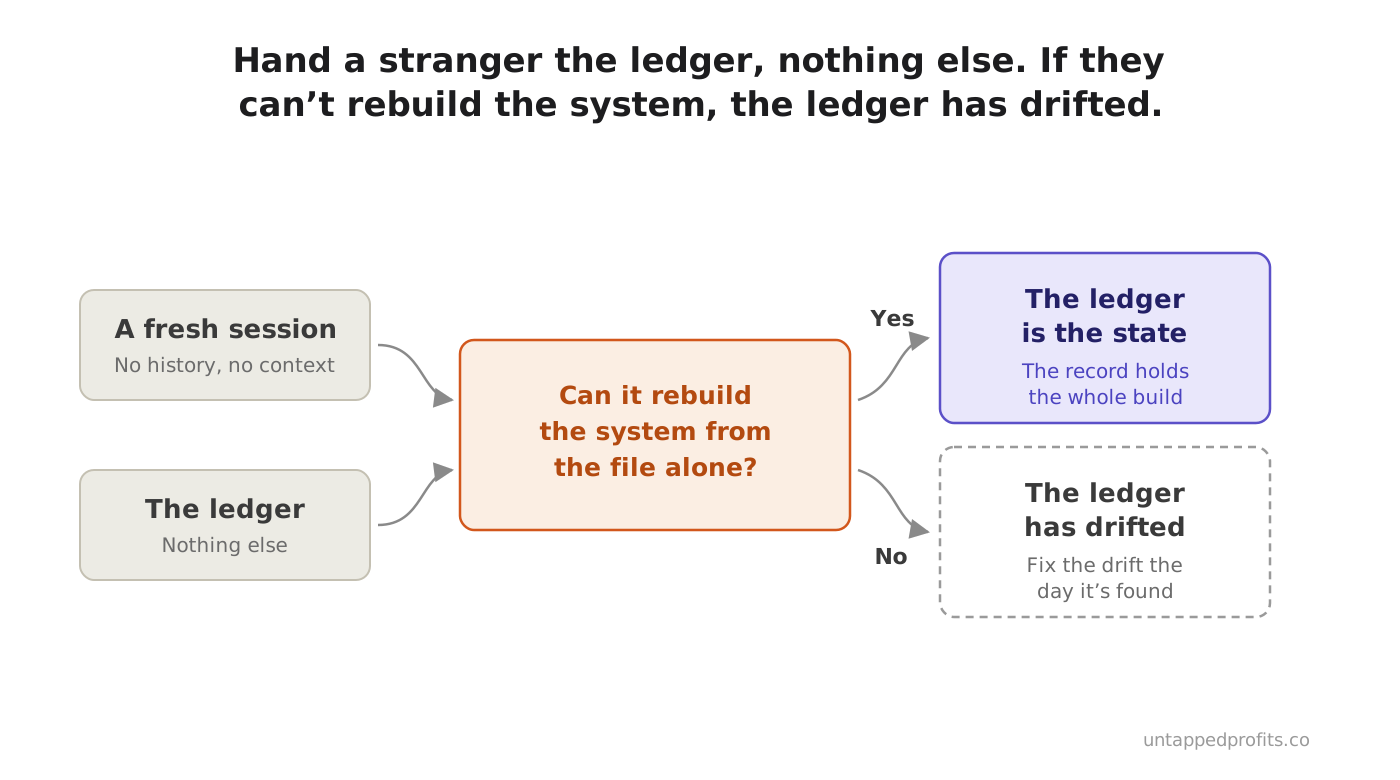
By holding one artefact to one hard test. The Resurrection Test asks whether a fresh session with no history could rebuild the system from the file alone, and every rule about how the ledger is kept exists to keep that answer yes. Nothing lives in a thread, a head or a chat history that the record does not also hold.
- One artefact holds the whole state. Decisions with dates. The current version of every component. Open items awaiting a ruling. What has been superseded and where it went. If it isn't in the ledger, it isn't part of the system's state.
- It is reissued at every milestone, as a complete replacement. Never patched, never appended, never "see edits above". Each reissue is the full current truth in one document, so reading the latest ledger is always sufficient. That is the Complete Replacement law from The Operator's Laws, applied to the record itself.
- It is filed to two homes in lockstep. Storage and project knowledge carry the same version, always. One home makes it durable and the other makes it available where the work happens. Divergence between them is a failure, not a detail.
- Superseded versions archive rather than disappear. The archive is the paper trail, and every ruling stays traceable to the version it changed.
- The Resurrection Test gets run for real. Open a fresh session, hand it the ledger, nothing else. If it can't reconstruct the build, the ledger has drifted from the truth, and the drift gets fixed the day it's found.
| State in institutional memory | State in a Build Ledger | |
|---|---|---|
| Where "current" lives | Scattered across threads, heads, vendor folders and chat history | One file, latest reissue |
| What a decision looks like | A vague memory that everyone agreed on this at some point | A dated ruling in the record |
| What happens when someone leaves | The system partially leaves with them | Nothing, because the state was never in their head |
| Recovering after a break | Days of archaeology and "where were we?" | Read one file, resume |
| Proof it works | None. You find out when it fails | The Resurrection Test, run on demand |
In practice
Run the Resurrection Test on a real gap, not a convenient one. Pick the moment after a fortnight away, when nobody remembers where things stood, and open the ledger cold. That is the exact condition the file exists to survive, and it is the only honest way to find out whether it does.
What should you measure in a Build Ledger?
Whether the file is current and whether it actually works. Time from a fresh start to productive work tells you if the ledger resurrects the build. The gap between the last milestone and the last reissue tells you whether anyone is maintaining it. And rulings without a date and a version are the paper trail's holes.
| Measure | What it tells you | Target |
|---|---|---|
| Time from a fresh start to productive work | Whether the ledger actually resurrects the build | Minutes, on one read of the current ledger |
| Gap between last milestone and last reissue | Whether the ledger is current or decorative | Zero, because reissue is part of the milestone |
| Divergence between the two filing homes | Whether lockstep filing is holding | None, ever |
| Rulings without a date and a version | Whether the paper trail is complete | Zero |
Watch for
The ledger that is written but never read. If nobody opens it to answer "what's current?", it has stopped being the state and started being a report. The tell is a reissue that lags the milestone by a week, because a file people actually rely on gets updated the moment it goes stale.
What does skipping the ledger cost?
The bill arrives at the worst moments. The Operator is unavailable and nobody can safely touch the system. A tool dies and takes its history with it. A dispute about what was agreed becomes opinion against opinion, because no ruling carried a date. A build gets abandoned after three months idle, not because it failed but because restarting felt cheaper than working out where it stood.
Every one of those is the same failure: state that lived somewhere fragile. And there is a compounding cost underneath them. Without a ledger, the system can't learn durably, because a correction made in conversation is a correction made to that conversation, which is why the ledger isn't admin. It is the substrate the whole compounding claim stands on. Only what reaches the record survives to govern the next loop — and what reaches the record is what The Return Arrow carries back.
Frequently asked questions
Isn't this just documentation nobody will read?
Documentation describes a system from the outside. The ledger is the system's state, so nobody has to remember to read it: it is the working answer to "what's current?", consulted because it answers the question people actually have. The Resurrection Test keeps it honest, because a ledger that has drifted into fiction fails the test visibly.
Isn't reissuing the whole file every time wasteful?
The alternative is a trail of diffs, patches and "updated per my last message", where the current truth exists only as the sum of every change ever made, assembled in someone's head. Complete replacement means the current truth is always one document long. The few minutes a reissue costs are bought back the first time anyone asks which version is real and the answer takes one click.
We already have project management tools.
Task boards track what is being done. The ledger holds what has been decided and what is currently true. "Write the landing page" is a task. State is the other thing entirely: the offer was ruled on the 14th, v3 of the brand rules is current, and the audience question is still open. Most teams have somewhere to put the first and nowhere at all to put the second, which is exactly why the second keeps getting lost. The same gap shows up in how the work gets sold, which Most Agency Proposals Are Built to Win Your Signature takes apart.
Who writes it, and when?
The Operator issues it, at the milestone rather than after it. That timing is the whole discipline: a ledger written as homework at the end of the week is a summary, and a ledger issued as the milestone closes is the state. The system drafts the reissue, and the Operator rules on what it says.
What does the client see?
Their own ledger, in full. It is the answer to "what's happening with my marketing?" that doesn't require a status call, and it is the same file that would let anyone else pick the work up. That is deliberate, because a record only you can read is a lock-in mechanism wearing a record's clothes.
The bottom line
Marketing systems lose their memory because the state lives in threads, heads and chat histories, all of which end. The Build Ledger moves it into one artefact that gets reissued whole at every milestone, filed in two places, and tested by asking whether a stranger could rebuild the system from it. Keep that answer yes and nothing important is ever more than one file away, however long the gap and whoever walks in next.
Where this connects
The ledger completes Part 1. Engine, Cartridge and Connectors gives the system its anatomy, The Seam Rule keeps method and client separable, and the ledger keeps the whole build reconstructable. The reissue discipline it runs on is a law from The Operator's Laws, and the durable memory it protects is what The Return Arrow deposits into. Accountability for the whole system is the question worth asking of whoever runs it, and The One Word That Determines Which Agency You Should Hire makes that case at the hiring stage. Next comes The Memory, the persistent layer everything draws from. Back to the One Brain Method hub.
Part 1 · Architecture · Chapter 3 of the One Brain Guide
Previous: The Seam Rule ·
Next: The Memory ·
All chapters
Sources
- Asana, Anatomy of Work Index. The index surveyed over 10,000 knowledge workers and found 60% of a person's time at work goes to work about work instead of skilled work. Asana sells work-management software, so the finding supports its own product.
- David Allen. The phrase is a registered trademark of the David Allen Company and the foundation of the Getting Things Done methodology.
Every statistic and quotation on this page has been checked against its primary source. Last verified 24 August 2026.
Free guide
Take the method with you. The complete One Brain Method as one PDF: every chapter, the diagrams, and every named framework, ready to hand to whoever runs your marketing. Enter your email and it's yours.
Want your marketing to have a memory that doesn't walk out the door?
Book a 30-minute call → See what it takes to have this installed