
The Production Module is the brand module the image advisor must obey: the written law governing how a static ad is physically made, from exact colours and reserved zones to a text budget and the tests every composition must pass before it exists.
Key takeaways
- Image models are approximators and brands are exact, which is the whole reason the module exists.
- The text budget has physics behind it: NNG's reading research gives users time for barely a quarter of the words on a web page,1 and a feed grants less. Every word on an ad has to buy its place.
- Type-First: the hook is the design priority and composition serves it. Text-heavy is permitted, and encouraged when the line demands it.
- The Dramatisation Test: the scene must stage the argument. A nice picture beside a good line, unacquainted, fails.
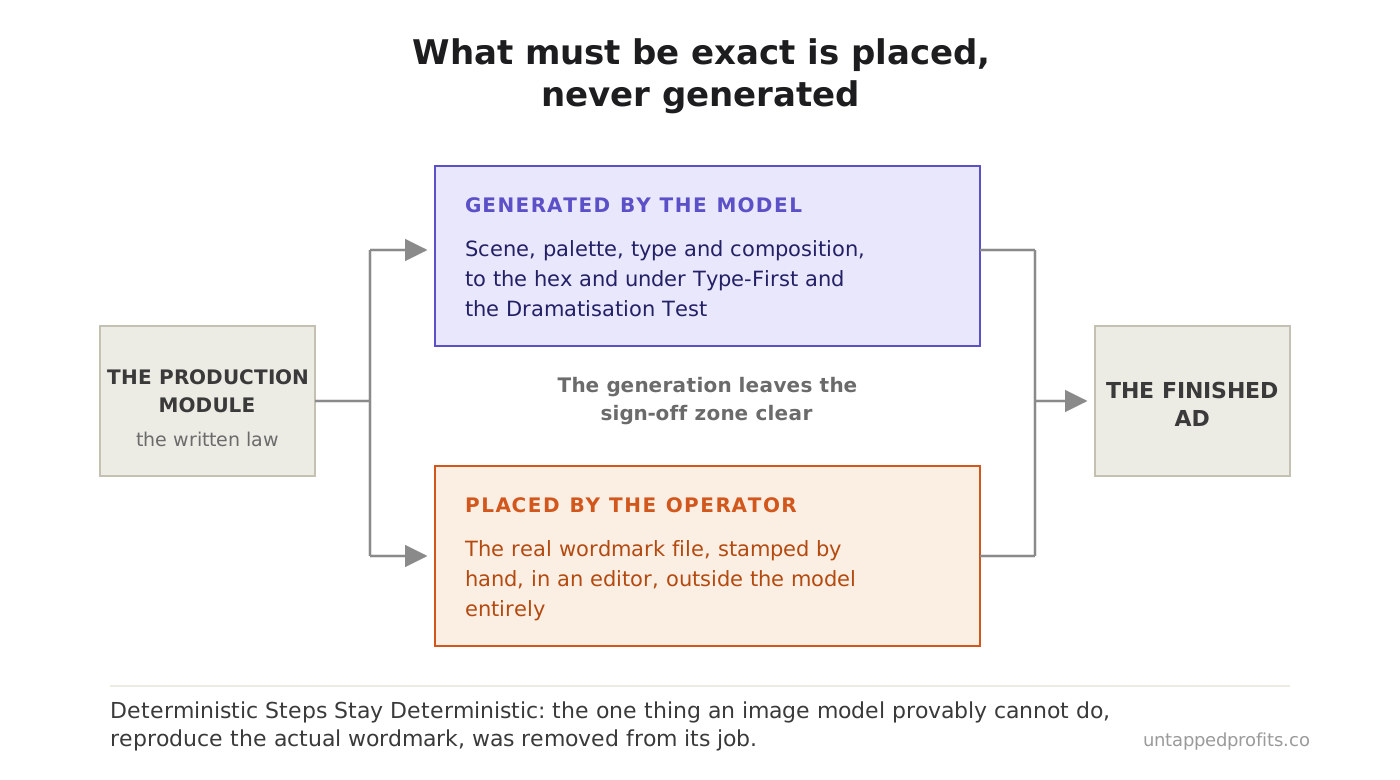
- Deterministic Steps Stay Deterministic. The wordmark is never model-drawn. Generations leave the sign-off zone clear and the real file gets stamped.
Why does AI image generation drift off-brand?
Because image models are approximators, and brands are exact. Ask a model for "our blue" and you'll get a blue: convincing, plausible, and a shade off, differently each time. Ask it to render a logo and it will draw you a confident near-forgery.
Leave composition to taste and a third failure arrives: decoration, meaning a handsome scene sitting politely beside the copy, arguing nothing. None of these are model failures exactly. They are what happens when a system that generates likelihoods is handed a job defined by exactness, with no law in between. The tools produce the surface and never the substance — AI Copy Tools Ask for Your Tone. The Proof Is Still Your Job. meets the identical split in copy.
The text side has its own physics. Nielsen Norman Group's reading research found users have time to read at most 28% of the words on an average web page, with 20% more likely.1 A static ad in a feed gets far less patience than a web page, so whatever the composition carries beyond the hook is mostly freight. That is why the module includes a text budget: words on an ad are spent, never placed.
Dieter Rams wrote the module's aesthetic as the tenth of his ten principles: "Good design is as little design as possible. Less, but better, because it concentrates on the essential aspects, and the products are not burdened with non-essentials."2 The Production Module is that principle with enforcement attached.
How does the Production Module work?
By encoding the brand as specifications a generator can obey and a reviewer can check, then removing from the machine anything it provably can't do reliably. Six elements, and three of them are rulings that do most of the work: Type-First, the Dramatisation Test, and Deterministic Steps Stay Deterministic.
- The brand is encoded exactly. The module carries the Brand Codes Register into production as specifications: the palette by hex, the rendering law, the composition discipline. "Close to the palette" is a fail and never a style.
- Type-First. The hook is the design priority and composition serves it. Text-heavy designs are permitted, and encouraged when the line demands it, because the hook is the ad. A layout that buries its own argument under art direction has the hierarchy exactly backwards.
- The Dramatisation Test. The scene must stage the argument. If the image is decoration sitting beside the copy, meaning a nice picture and a good line that have never met, it fails. Composition either performs the hook's claim or it doesn't ship. The picture is accountable to the line, not to taste.
- Safe zones and the text budget. Platform chrome, meaning buttons, captions and overlays, eats edges on schedule, so the module reserves those zones in advance and nothing critical ever sits under a UI element. The words are rationed by a budget rather than a suggestion, because of what readers actually read.
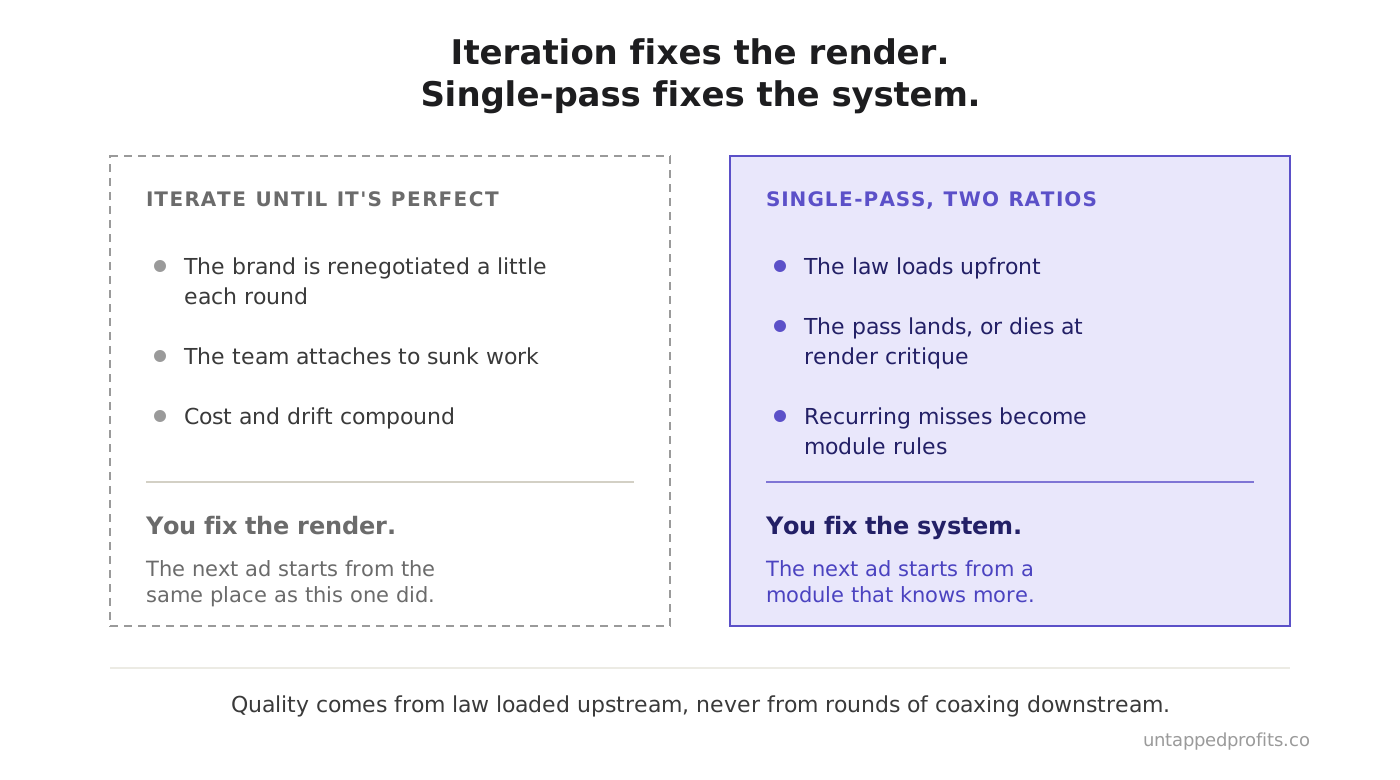
- Single-pass generation, two ratios. Every ad is generated in one pass, in the two ratios the placements demand. The module exists so first-pass-right is the default: quality comes from law upstream and never from forty rounds of coaxing downstream. Renders that miss die at render critique and never get nursed.
- Deterministic Steps Stay Deterministic. The one thing an image model provably cannot do, reproduce the actual wordmark, was removed from its job. Generations leave the sign-off zone clear and the Operator stamps the real wordmark file by hand, in an editor, outside the model entirely. What must be exact is placed, never generated.
| Module element | What it governs | Why it's law |
|---|---|---|
| Exact palette and rendering law | Colour and treatment, to the hex | Approximators drift and brands don't |
| Type-First | Hierarchy, meaning the hook leads and composition serves | The hook is the ad |
| The Dramatisation Test | What the scene must do | Decoration beside the copy argues nothing |
| Safe zones | Where nothing critical may sit | Platform chrome eats edges on schedule |
| Text budget | How many words the ad may spend | Readers read a fraction, so ration accordingly |
| The wordmark process | The real file, stamped, never model-drawn | Deterministic Steps Stay Deterministic |
In practice
Sample the render's colours against the hex values instead of judging them by eye. Monitors lie, ambient light lies, and a shade of drift that looks fine in isolation reads as a different brand next to last month's ad in the same feed. The check takes seconds and catches what confidence can't.
What should you measure in the Production Module?
Whether the law is encoded or just remembered. Renders passing the production gate on first pass tell you the module front-loads quality. Safe-zone breaches reaching QA tell you the reserves live in vigilance and not in the spec. And model-drawn wordmarks anywhere tell you the deterministic step stopped being deterministic.
| Measure | What it tells you | Target |
|---|---|---|
| Renders passing the production gate first pass | Whether the module makes first-pass-right the default | Rising, as misses become module rules via the Ratchet |
| Safe-zone breaches reaching QA | Whether the reserves are encoded or remembered | Zero, because zones live in the module and never in vigilance |
| Model-drawn wordmarks anywhere | Whether the deterministic step stayed deterministic | Zero, forever |
| Ads failing the Dramatisation Test at critique | Whether scenes argue or decorate | Caught at the seam, with none published |
Watch for
The module that grows a rule per render. Each miss is supposed to become law, but a specification bloated with one-off fixes stops being loadable and starts getting ignored. When a new rule only ever applied to one ad, it belongs in the brief and not the module.
What does producing without a module cost?
Brand drift at generation speed: a hundred slightly-wrong blues and a dozen almost-logos, each individually ignorable and collectively a brand nobody can learn. Iteration hell, where every ad is coaxed through revisions the law would have made unnecessary.
The worst of it wears a professional face. The handsome, on-trend, decorative ad passes every taste check and stages no argument at all, so it fails for structural reasons no amount of polish can fix. When production got cheap, this became the default output rather than the exception. The constraint moved from making things to deciding what deserves to be made — The $131 Blog Post Killed the Marketing Specialist watched it happen.
Frequently asked questions
Why single-pass? Iterate until it's perfect.
Iteration is where cost, drift and rationalisation live. Every round of coaxing renegotiates the brand a little and attaches the team to sunk work. The module inverts the effort: the law loads upfront, the pass either lands or dies at critique, and every recurring miss becomes a new module rule. You fix the system, and never the render.
Text-heavy ads? Design best practice says minimal copy.
Type-First isn't a word count, it's a hierarchy. When a hook needs one line the ad carries one line, and when the argument is the typography the ad is text-heavy and proudly so. What the ruling forbids is composition that demotes its own hook. Rams governs the non-essentials, and the hook is never a non-essential.
The model's logo is 95% right. Why the manual step?
Because 95% right is 100% wrong, on the same logic as Text Fidelity. A near-logo is a forgery your most attentive customers notice first. The stamp costs the Operator seconds, and the principle it protects is the module's deepest one: what must be exact is never left to a probability engine.
Doesn't the module need rewriting every time the tools change?
The specifications outlive the generators, because hex values, safe zones, text budgets and the Dramatisation Test describe the ad rather than the machine. What changes with each model release is the prompt layer and the list of what the machine can be trusted with, and that list only ever shortens the deterministic exceptions as the tools improve.
Who writes the module for a new client?
It is derived from that client's Brand Codes Register, which makes it Cartridge material and never engine material. The structure is universal and every value in it belongs to one business, which is the Seam Rule applied to production law.
The bottom line
Image models drift because they approximate, and brands are the one thing in marketing that can't be approximated. The Production Module answers that by encoding the brand as checkable specification, making the hook the design priority, demanding the scene stage the argument, and taking the wordmark away from the machine entirely. Load the law upfront and the first pass is the good one.
Where this connects
The module is the rendering arm of The Brand Codes Register: the codes decide what every ad carries and the module decides how a static ad carries them. It stages hooks that survived The Hook Law and concepts locked at The Five Gates, and its output faces render critique and brand QA at The Review Seams. Its principle of giving machines only what they're reliable at comes from model routing in The Operator's Laws. The other mediums, Video, Generated Imagery and Synthetic Assets, run the shared law with their own production rules. Back to the One Brain Method hub.
Part 5 · Creative Production · Chapter 20 of the One Brain Guide
Previous: The Review Seams ·
Next: Video: Scripting and Shot Selection ·
All chapters
Sources
- Jakob Nielsen, "How Little Do Users Read?", Nielsen Norman Group, May 2008, modelling data from Weinreich and others, "Not Quite the Average: An Empirical Study of Web Use", ACM Transactions on the Web (2008), covering 59,573 page views from 25 instrumented users. The finding concerns web pages, not advertising. The application to static ads is this method's inference, and a feed offers less patience than a web page, never more.
- Dieter Rams, tenth of the ten principles for good design, as published by Vitsoe.
Every statistic and quotation on this page has been checked against its primary source. Last verified 24 August 2026.
Free guide
Take the method with you. The complete One Brain Method as one PDF: every chapter, the diagrams, and every named framework, ready to hand to whoever runs your marketing. Enter your email and it's yours.
Want production-grade creative from a system that can't drift?
Book a 30-minute call → See what it takes to have this installed