
Content Architecture is the layer that decides what gets made and in what proportion, so a calendar is the output of a set of decisions instead of a standing invitation to think of something.
Key takeaways
- Three to five pillars carry everything. Each one sits where audience need, business goal and demonstrable expertise overlap, and each maps to a destination.
- Every pillar publishes across three layers: visibility, connection and conversion. Connection is the one businesses starve, and it is where trust is actually built.
- Binet and Field's analysis of 996 IPA campaigns put the optimum budget balance at 60 percent brand building to 40 percent activation, and later work moved it to 62:38. Most content calendars run the opposite way round.1
- The mix ratio is enforced across the month, not inside each post. Nothing is judged on its own.
- Between a fifth and a third of the calendar stays open for whatever the month brings, which makes reacting a budgeted activity instead of an interruption.
What is a content pillar, and how many should a business have?
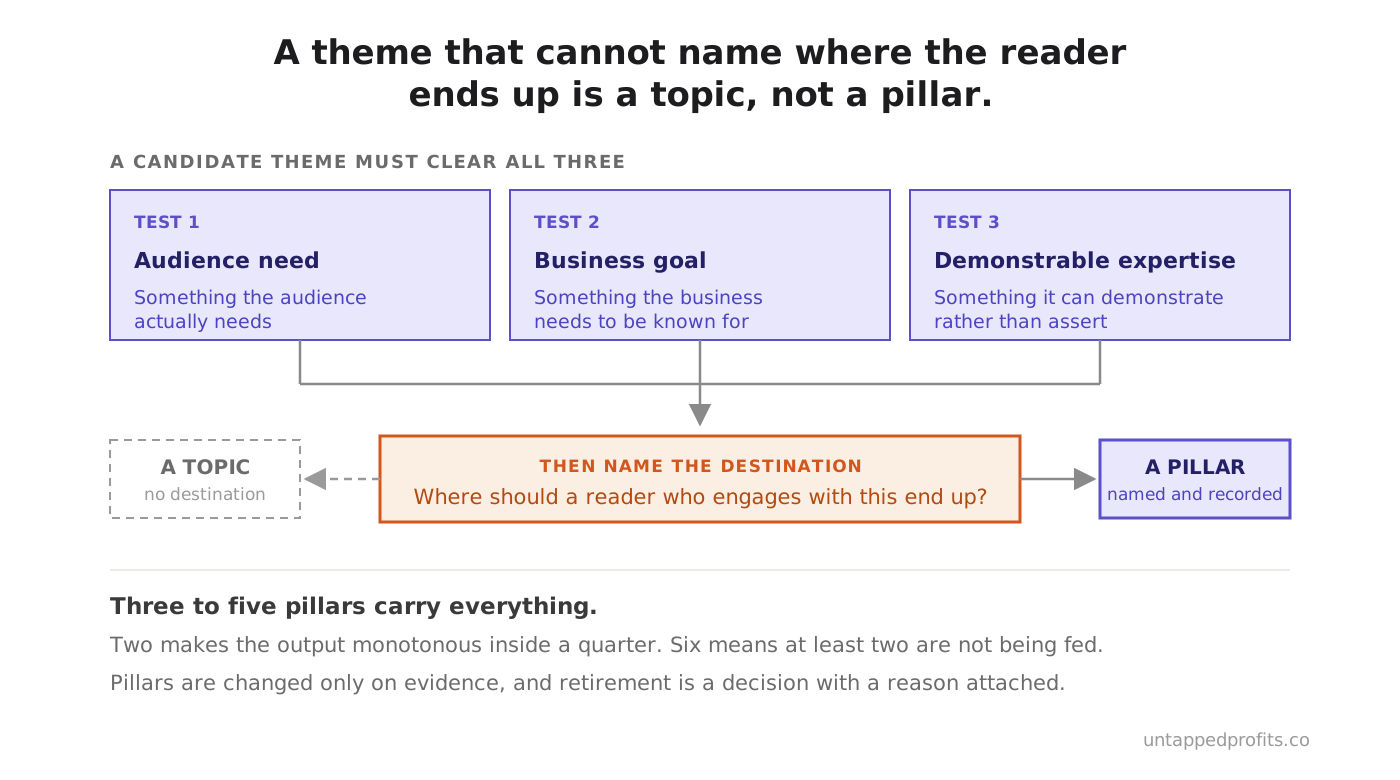
A pillar is a theme the business publishes on repeatedly, sitting where three things overlap: something the audience actually needs, something the business needs to be known for, and something it can demonstrate rather than assert. Three to five is the working range. Two makes the output monotonous inside a quarter, and six means at least two are not being fed.
Pillars are named memorably, recorded once, and changed only on evidence. That last rule matters more than it sounds, because a pillar that gets quietly abandoned in month three leaves an archive that argues for nothing in particular. Retirement is a decision with a reason attached, taken when the performance data says so.
Each pillar carries a destination as part of its definition. If a theme cannot name where a reader who engages with it should end up, it is a topic, not a pillar — and topics feed the dashboard while feeding nothing else. The rotation across the week is also wearout insurance — Why Your Marketing Stops Working Even When You're Doing Everything Right is that slow death, watched happening, where the claim stops landing because the market has heard it too many times.
Why does the middle layer always get starved?
Because both ends of the range are easier to justify. Visibility content is measurable in reach, conversion content is measurable in leads, and connection content, the behind-the-scenes and the conversational and the genuinely useful, is measurable in neither for months. It gets cut first in every review. Then conversion content lands on an audience with no relationship to the business and reads as pushy.
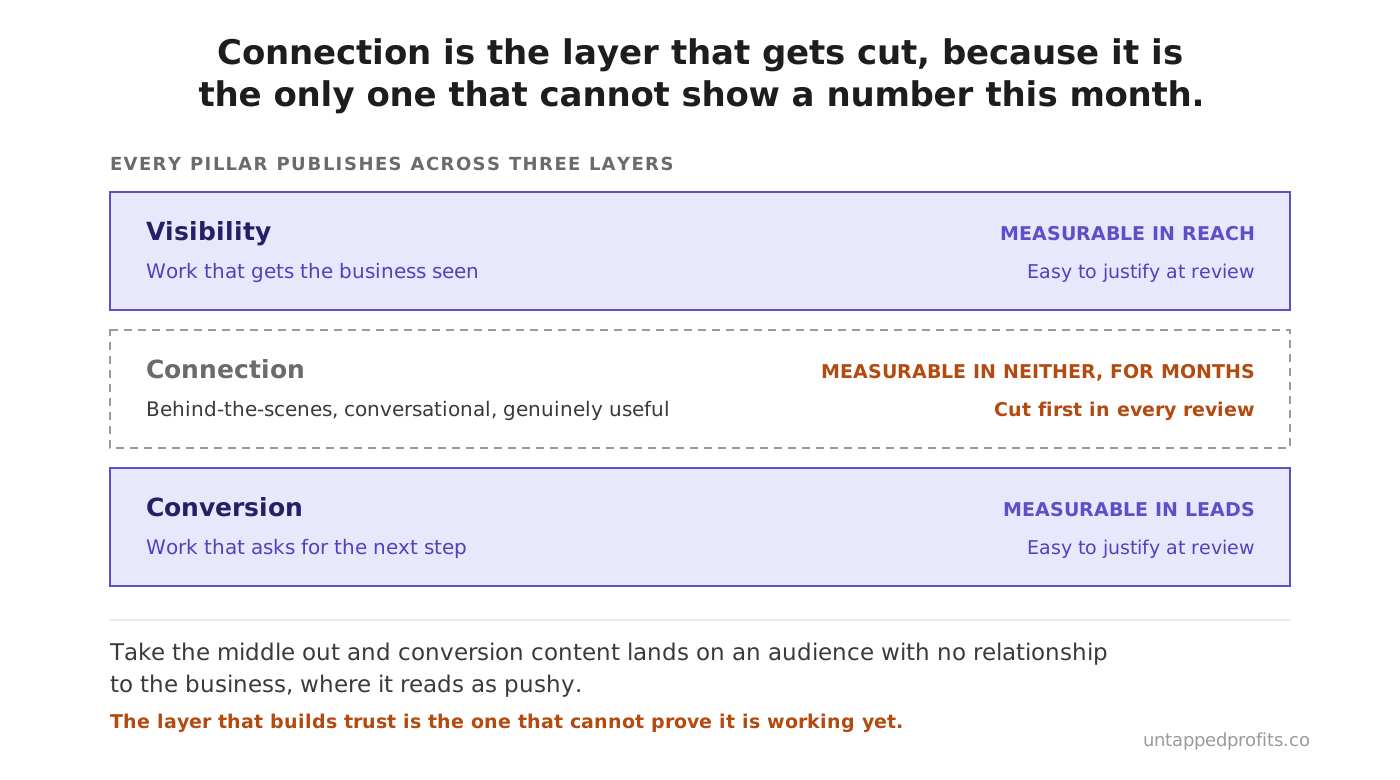
This is the same imbalance Binet and Field found in advertising budgets, and the correction is the same shape. Their 2013 report warned that marketing was "sleepwalking towards a precipice" by letting short-term metrics drive investment, and the balance they landed on gave the majority of the budget to work that does not ask for the sale.1 A calendar weighted to conversion is that same mistake with a smaller budget attached, and it runs into the ceiling The Brand vs Performance Debate Will Never Be Solved maps.
A second distinction sits on top of the layers. Hero work is the campaign moment with real production behind it, made to be noticed. Hub is the recurring series that gives people a reason to come back. Hygiene is the always-on evergreen material that answers what people search for. That three-tier structure is Google's, published for YouTube creators as Hero, Hub, Help; this method uses Hygiene for the third tier, following the common industry naming, and the structure is adopted here rather than invented.
How much of the calendar should sell?
Less than instinct suggests, and the right amount depends on what is being sold. The longer the consideration window, the further the balance tips towards the educational and away from the promotional, because on a high-ticket purchase the selling happens on the owned property and not in the feed. Where the purchase decision is small, the feed can carry more of the sell. Business audiences run a four to one to one rotation,2 and personal brands run in thirds.
| Business type | Balance | Where the sell actually happens |
|---|---|---|
| High ticket, long consideration | Heavily educational | On the owned property, after the reader arrives convinced |
| Standard ecommerce | More room for the promotional | In the feed, because the purchase decision is small |
| Business audiences | 4:1:1 | Four curated from other people, one the business's own original, one promotional, across the month |
| Personal brands | Thirds | Split across the personal, the useful and the promotional |
Whichever ratio applies, it is checked monthly and never per post. Judging a single promotional post against the ratio produces an argument every week. Judging the month against it produces a decision once, which is the whole reason the ratio is written down in the first place.
In practice
Tag every slot in the calendar with five things before anything is written: its pillar, its layer, whether it is Hero, Hub or Hygiene, its format, and its destination. A slot missing any of the five is not a brief, it is a reminder to panic on the day. The tagging also turns the monthly ratio check into a sort instead of a reading exercise.
How does the calendar get built and held?
By batching to a model the Operator can actually run, and by leaving somewhere between a fifth and a third of it empty on purpose. Weekly batching suits three or four posts a week. Monthly batching suits higher volume. Each model names its creation day, its derivative day and its scheduling day, so the work has a place in the week and stops competing with everything else for attention.
The reactive share is the part people get wrong in both directions. Planning the whole calendar leaves no room for anything happening in the world, and planning none of it means the month is improvised. That reactive share stays open, and what fills it has to earn the slot against the pillars rather than displacing them, which is the point The Trend Is the Seasoning, Not the Meal makes.
Two operational rules keep the machine honest. Scheduling, reporting pulls and asset backup are automated without hesitation. Replies, community management and anything carrying a claim are never automated, because a claim answers to the Proof Bank whether it appears in an ad or in a comment. The pre-publish check runs the same list every time: pillar and layer mapped, ratio still holding for the month, opener passing the hook standard, claims banked, ejection sweep clear, brand codes carried, destination named and tracked.
Watch for
The calendar that fills with whatever was easiest to make that week. It happens gradually and it always drifts the same way, toward short reactive posts and away from the pillar work that takes a day. The tell is a month with no Hub series in it. Check the tags monthly and the drift shows up while it is still a fortnight of slippage.
Frequently asked questions
How do I choose pillars for a business that does one thing?
Split by the buyer's questions instead of by the product. A roofer sells roofs and the pillars underneath that might be what fails and why, what a fair quote looks like, and what happens after the job. Three genuine angles on one service beat three invented services.
What if a pillar clearly is not working?
Retire it deliberately and record why. The evidence is a run of underperformance across enough posts to be a pattern, not one quiet week. Replace it from the same overlap test that produced it, and leave the archive in place, because published work keeps earning search traffic long after a pillar stops being fed.
Does the mix ratio apply to every platform equally?
The ratio is set once for the business and holds across the month everywhere. What changes by platform is the format and the register, not how much of the output asks for something. A business that has settled on a heavily educational balance does not flip to a promotional one because a platform feels more commercial.
Is Hero content worth it for a small business?
Two moments a year, at most, and only when there is something real behind them. Hero work justifies its cost through the attention it earns and the material it generates for months afterwards. A Hero piece with nothing behind it is an expensive Hygiene post.
What produces the pillar asset itself?
The long-form work runs through its own phase-gated process: prior-art check, anchors gathered, draft, humanity pass, audit, then assets. It hands the finished pillar to this layer, and the cutting up of it is the next chapter's job. Nothing enters the calendar as a derivative of something that was never properly made.
The bottom line
A content calendar is not a plan. It is what a plan produces once the pillars are named, the layers are balanced, the ratio is set and the destination is attached to every slot. Businesses that skip those four and start with the calendar end up publishing whatever was easiest that week, which is why so much content is competent, consistent and commercially inert. Decide the architecture and the calendar becomes an administrative task.
Where this connects
Content Architecture sits under Content & Channel and takes its platforms and cadence from Social Strategy. The pillars answer to the objectives in The Campaign Plan and to the buyer mapped in Customer Intelligence. Claims in any slot answer to The Proof Bank, and openers to The Hook Law. What the calendar teaches goes back through The Return Arrow.
Part 6 · Content & Channel · Chapter 26 of the One Brain Guide
Previous: Social Strategy ·
Next: Content Ideation ·
All chapters
Sources
- Les Binet and Peter Field, The Long and the Short of It: Balancing Short and Long-Term Marketing Strategies, Institute of Practitioners in Advertising, 2013. The report states that its data come from the IPA Effectiveness Databank, holding 996 campaigns covering more than 700 brands in over 80 categories, entered between 1980 and 2010. The 60:40 balance, and the later 62:38 figure from Effectiveness in Context (2018), are stated on the IPA's own site. The quoted phrase appears in the report's own text. The IPA is the advertising industry's trade body and has an interest in a finding that argues for larger, longer-term advertising budgets. The findings concern advertising budget allocation, and applying the balance to a content calendar is this method's inference, not Binet and Field's.
- The four to one to one rotation is the 4-1-1 rule: for every six posts, four share useful content from other people, one is the business's own original content, and one is promotional. It originated with Tippingpoint Labs and was popularised by Joe Pulizzi of the Content Marketing Institute. The personal-brand split in thirds is the social-media rule of thirds, an industry convention adopted here rather than invented.
Every statistic and quotation on this page has been checked against its primary source. Last verified 27 August 2026.
Free guide
Take the method with you. The complete One Brain Method as one PDF: every chapter, the diagrams, and every named framework, ready to hand to whoever runs your marketing. Enter your email and it's yours.
A calendar built on decisions beats a calendar built on whatever was easiest that week.
Book a 30-minute call → See what it takes to have this installed