
Infotainment is the finalisation step that decides how a locked message earns attention. Entertainment is the delivery mechanism. The value is the payload, and the payload never changes to suit the delivery.
Key takeaways
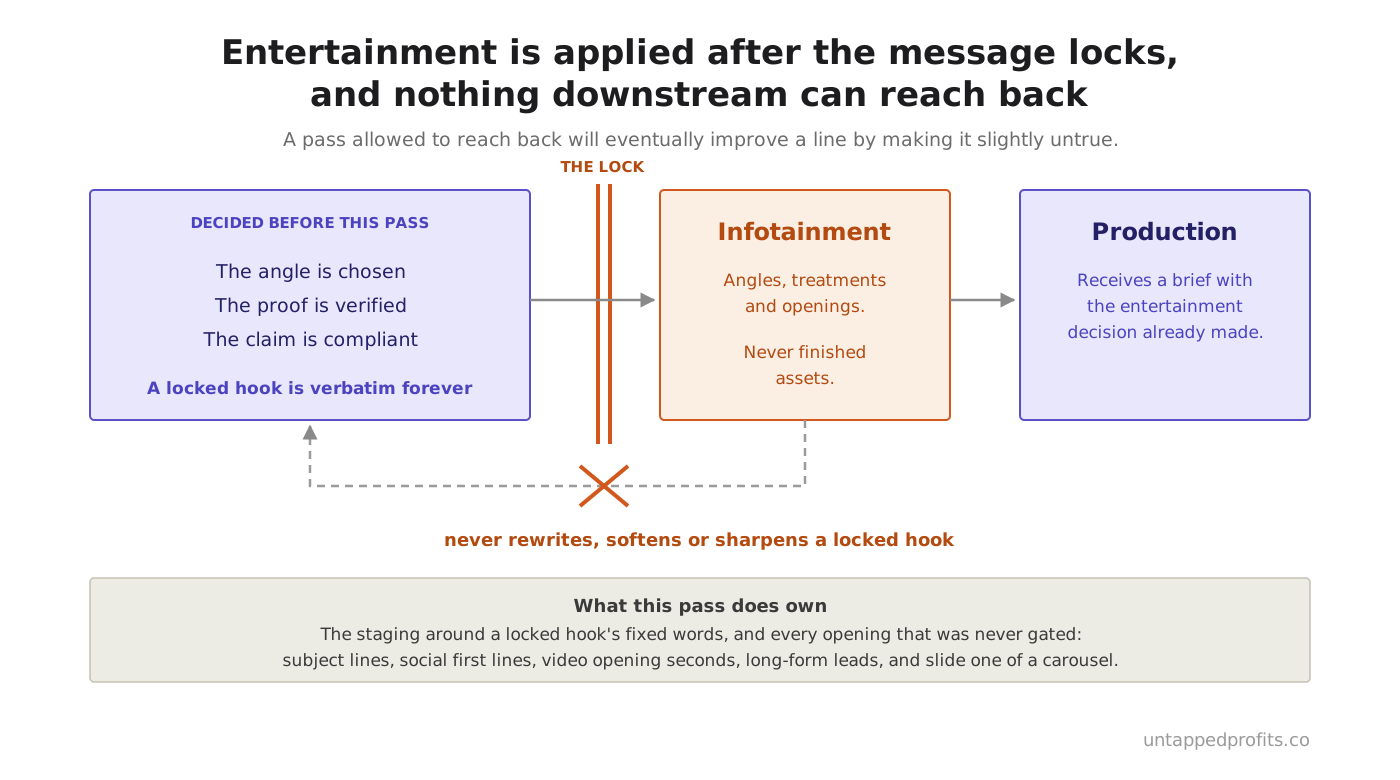
- The pass runs after the message is locked, and it never rewrites a hook that was locked at the concepts stage. It owns the staging around that hook, and it owns every opening the gates never covered.
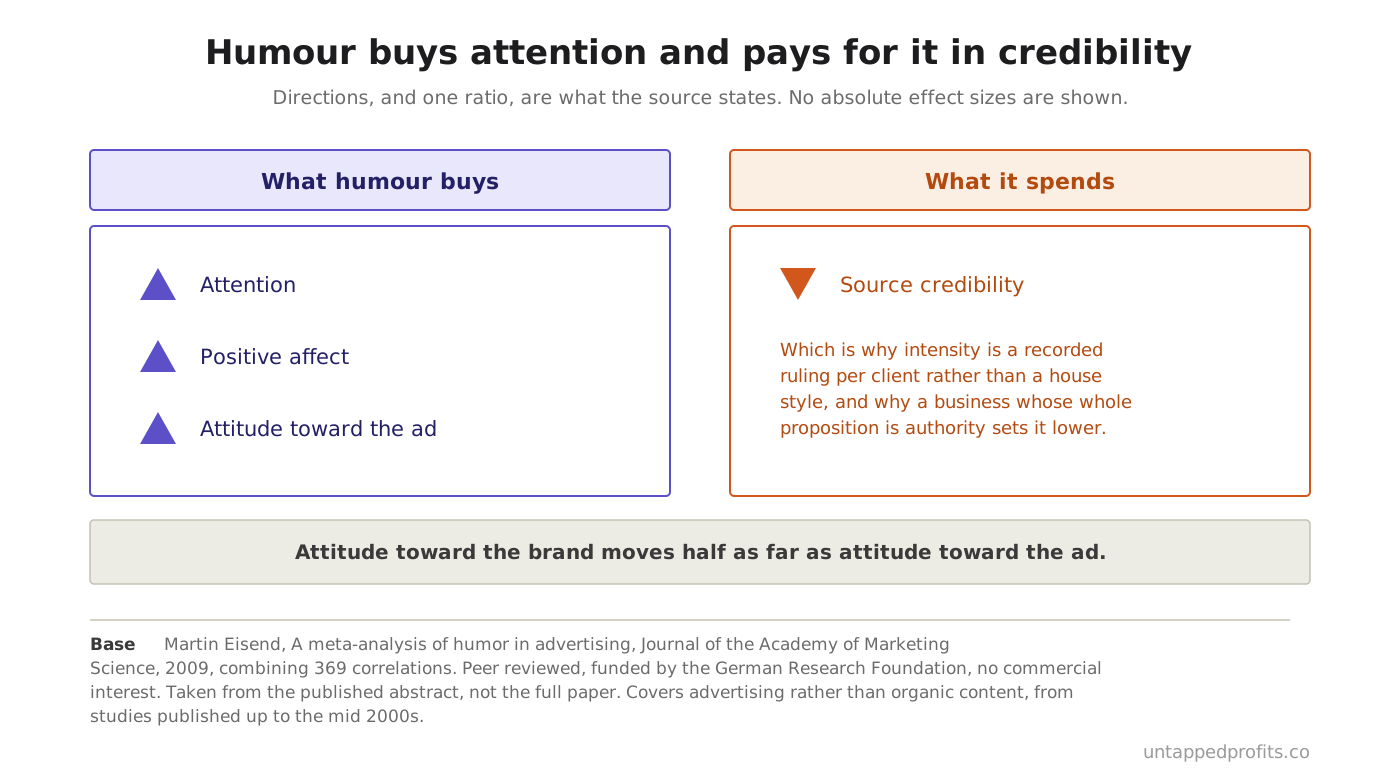
- Eisend pooled 369 correlations on humour in advertising: it reliably lifts attention and warmth toward the ad, with the effect on the brand only half that size.1
- The same analysis found that humour reduces the perceived credibility of the source, which is why this pass has hard gates and not a style guide.
- Every idea is produced at three intensities. The setting is an Operator ruling recorded per client, not a choice the pass makes.
- The enemy is always a practice or an idea, never a named person, a real competitor, or a group.
Where does this pass sit, and what does it produce?
After the gates and before generation. The angle is chosen, the proof is verified and the claim is compliant before this pass touches anything. It produces angles, treatments and platform-specific openings, never finished assets. It hands the production skills a brief with the entertainment decision already made, and once a string is finalised here it locks, with nothing downstream permitted to rewrite it.
The reason for the sequence is that entertainment applied earlier changes the message. A pass allowed to reach back into what is being claimed will eventually improve a line by making it slightly untrue, and it will do so gradually enough that nobody catches the moment it happened. Locking the message first makes that impossible by construction.
The scope has a hard edge and it is worth stating plainly. An ad hook locked at the concepts stage is verbatim forever, and this pass never rewrites, softens or sharpens one. Where a locked hook is genuinely wrong the remedy is a fresh pass through that gate producing a new lock, tested again from scratch. A lock any later step may re-open is not a lock. What this pass owns on an ad is the staging around the fixed words, and what it owns outright is every opening that was never gated: subject lines, social first lines, video opening seconds, long-form leads, and the promise on slide one of a carousel.
The case for the pass existing at all is that attention is decided before anyone reads anything. A pre-conscious filter rejects most marketing before a word of it is processed — Your Marketing Gets Rejected Before Anyone Reads It follows that rejection frame by frame. The most valuable information in a business dies in the feed if nothing gets it past that.
What makes a message hard to ignore?
Twenty-one methods across seven groups: personality, story, humour, conflict, attention, authority and positioning. They are combined and never used singly, and the strong combinations carry furthest. Story carried by a cultural analogy, controversy with a prediction attached, mockery with a genuine educational payload underneath it. The combination is chosen for the message and the surface, never for whichever one the Operator reaches for out of habit.
Four principles sit underneath the methods. A named voice with opinions outperforms a brand voice with none, and bland is the only failure with no recovery from it. A precise figure beats a magnitude, though this pass never invents specificity to create an effect and every number is already banked. Emotion carries and logic justifies afterwards. And positioning against something builds an audience faster than a list of benefits, which is why structural ingredients matter more than charisma — How to Cook a Hotdog lists the five that do the work.
Unpredictability is the one most businesses drop first. A recognisable format that never surprises stops being watched, because the opening promise is the only thing the format still delivers and the audience learns to predict the rest. A hook buys the three seconds a platform counts as a view, and nothing after that — You Stopped Them, Then You Lost Them is about the cliff on the other side.
How far is too far?
That is a ruling, not a judgement made mid-production. Every idea is generated at three intensities. Low is safe, professional and subtle, medium is engaging with clear opinions stated plainly, and high is polarising on purpose. The client's setting is recorded and stands until it is re-ruled. All three are shown to the Operator and only the ruled one is delivered, so moving the dial is a deliberate act.
| Setting | What it sounds like | Where it fits |
|---|---|---|
| Low | Professional, subtle, opinions implied | Regulated categories, conservative buyers, anything with a compliance officer |
| Medium | Engaging, memorable, opinions stated plainly | Most trades, dealerships and service businesses |
| High | Polarising, a named enemy practice, full send | Founder-led brands whose positioning is the argument |
Eisend's meta-analysis is why the dial exists rather than a house style. Across 369 correlations, humour raised attention and warmth toward the ad, and the effect on attitude to the brand came out at half the size of the effect on the ad itself. The same analysis found that humour "significantly reduces source credibility".1 Entertainment buys attention and spends a little authority to do it, so a business whose whole proposition is authority sets the dial lower than one whose proposition is a point of view.
In practice
Write the client's dial setting into the Cartridge at onboarding and treat it as standing instruction. The alternative is deciding intensity per piece, which means deciding it under deadline, which means it drifts upward on the weeks when something needs to land and downward after anyone complains. A recorded setting turns a running argument into a single decision.
What does entertainment never buy?
An exemption from anything. Every claim clears two checks: the Proof Bank confirms the fact is evidenced, and the compliance reference confirms it may lawfully be said that way. Regulated categories obey their law at every intensity, and where compliance and entertainment conflict, compliance wins and the idea gets re-framed. Prose law applies to every string. An opening failing the five tests fails them however good the line is.
Re-framed is the operative word in all of that. An idea blocked by a gate is rebuilt to make the same point another way, never quietly softened until it passes, because softening produces the bland output the whole pass exists to prevent. A gate is a redirection and not a volume knob.
Every finalised string also faces the cold review before the Operator sees it, which is the same rule that governs sentences everywhere else in the system. A writer reviewing its own punchy line is the least reliable reader it will ever have.
The enemy rule deserves its own line. Mockery points at conventional wisdom, at category norms, and at the Operator's own past mistakes, the one target that costs nothing and buys the most. It never points at a named individual, a real competitor or a group. Manufactured authority is detectable and the tells are known, which Four Tells of Manufactured Authority lays out, and a business that punches at people is generating one of them.
Watch for
Entertainment that has quietly become the message. The signal is a piece everyone enjoyed that nobody can summarise afterwards. If the audience remembers the joke and not the point, the delivery mechanism ate the payload, and the fix is upstream in what the piece was supposed to say rather than in the jokes themselves.
Frequently asked questions
Does this work for a serious or regulated business?
Yes, at a lower setting. Infotainment is not a synonym for comedy. Specificity, a clear point of view, a story with a real person in it and a well-chosen analogy are all methods here, and none of them create a compliance problem. What changes with the dial is how far the opinion goes, not whether the work is interesting.
Isn't this just chasing engagement?
Engagement is the entry fee and the payload is the point. A piece that earns attention and teaches nothing has spent the audience's patience on nothing, and the method requires an educational payload inside the entertainment. The two are not in tension unless the entertainment came first.
Why can't the pass choose the intensity itself?
Because intensity is a commercial risk and the Operator carries it. A polarising piece that wins an audience and loses a referral partner is a trade the business owner should make knowingly. Findings Are Not Decisions, and this is a decision.
What if the funniest version fails a gate?
It gets rebuilt, and the good line often survives attached to a different claim. Gates block the specific problem and not the idea behind it. The one thing that never happens is the line shipping with the claim unverified because the line was too good to lose.
How does pop culture age?
Badly, and it is checked before use. A reference the audience no longer resolves instantly is a failure of the Referent Test and it dates the whole piece. Cultural material is read against current platform and audience knowledge every time, never carried forward from a library assembled two years ago.
The bottom line
Businesses lose to boring far more often than they lose to wrong. The answer is not to loosen the standards but to separate the two jobs. Decide what is true and worth saying under the usual gates, then decide how it earns attention under a pass that cannot reach back and change the claim. Set the intensity once, aim the mockery at practices rather than people, and the work gets watched without costing the business the authority it was built on.
Where this connects
Infotainment sits inside Content & Channel and finalises what Content Ideation ranked. The message it dresses is locked upstream at The Five Gates, every claim inside it answers to The Proof Bank, and every hook it finalises still faces The Hook Law. Sentences answer to Writing for Clarity and the codes it may stretch are governed by The Brand Codes Register.
Part 6 · Content & Channel · Chapter 30 of the One Brain Guide
Previous: Content Repurposing ·
Next: Community and Governance ·
All chapters
Sources
- Martin Eisend, A meta-analysis of humor in advertising, Journal of the Academy of Marketing Science, vol. 37 no. 2, 2009, pages 191 to 203. The analysis combines 369 correlations. It finds that humour significantly raises attention, positive affect and attitude toward the ad, that the effect size on attitude toward the ad is twice that on attitude toward the brand, and that humour significantly reduces source credibility. Peer reviewed, funded by the German Research Foundation, with no commercial interest in the finding. The full text sits behind subscription. These findings and the quoted phrase are taken from the author's abstract on the publisher's own page and not from the full paper, and the same abstract appears on the author's university record. Institutional and author-hosted copies of the full paper exist for anyone wanting the underlying tables. The research covers advertising and not organic content, and the studies analysed were published up to the mid 2000s.
Every statistic and quotation on this page has been checked against its primary source. Last verified 27 August 2026.
Free guide
Take the method with you. The complete One Brain Method as one PDF: every chapter, the diagrams, and every named framework, ready to hand to whoever runs your marketing. Enter your email and it's yours.
Being right is not enough if nobody stops to read it.
Book a 30-minute call → See what it takes to have this installed