
Funnel Engineering decides how the information a buyer needs gets divided between the ad, the page and everything in between. The total is fixed by the offer and the market. The arrangement is the only thing you control.
Key takeaways
- The information a qualified buyer needs is roughly fixed. Long educating ads pair with a short page. Short curiosity ads need a long page to carry what they dropped.
- Speed decides what the funnel captures: answering an enquiry within the hour made a firm nearly 7x likelier to qualify the lead than answering an hour later, and over 60x likelier than waiting a day.1
- The named diagnostic: click-through rate up and conversion down after shortening the ads means information was cut, not friction.
- A lead magnet is a complete solution to a narrow problem that reveals the next one. A magnet that satisfies the buyer completely sells nothing.
- At breakeven, four levers move an account, and two of them produce the same result through different bottlenecks. Work one at a time or neither result is attributable.
What does funnel engineering actually decide?
Three things, in order. Work out the minimum information a qualified prospect needs to be convinced. Allocate that information across the steps: ads, a bridge or advertorial page, the landing page, the checkout or the form. Then test the arrangement, lengthening or shortening steps and adding or removing them, until it suits the traffic. This is a planning decision and not something the page runs into later.
The reason it sits above the page is that the page cannot fix a distribution problem. If a prospect needs to understand why they have the problem, why other solutions fail, why this one works, why the brand is credible and why the price is reasonable, that information exists somewhere in the sequence or the sale does not happen. Rebuilding the page changes where it sits, not whether it is needed.
This is also why a website refresh so rarely moves sales. The new site is prettier and carries the same information in the same arrangement — The $15,000 Brochure paid to find that out.
Why do short ads and long pages go together?
Because they are two arrangements of the same total. Neither is correct in the abstract. An ad that educates thoroughly hands the page a reader who already understands, so a long page then re-teaches them and adds friction before the button. A short curiosity ad sells the click and nothing else, so the page has to carry everything the ad left out.
| Arrangement | Points | When it suits |
|---|---|---|
| Long ads to a short page | 3 + 1 = 4 | Expensive traffic, one clear segment, creative capacity to make long ads well |
| Short ads to a long page | 1 + 3 = 4 | Cheap traffic, limited creative production, a single strong page to maintain |
| Short ads, an advertorial, a short page | 1 + 2 + 1 = 4 | Several segments that a single page cannot serve without hedging |
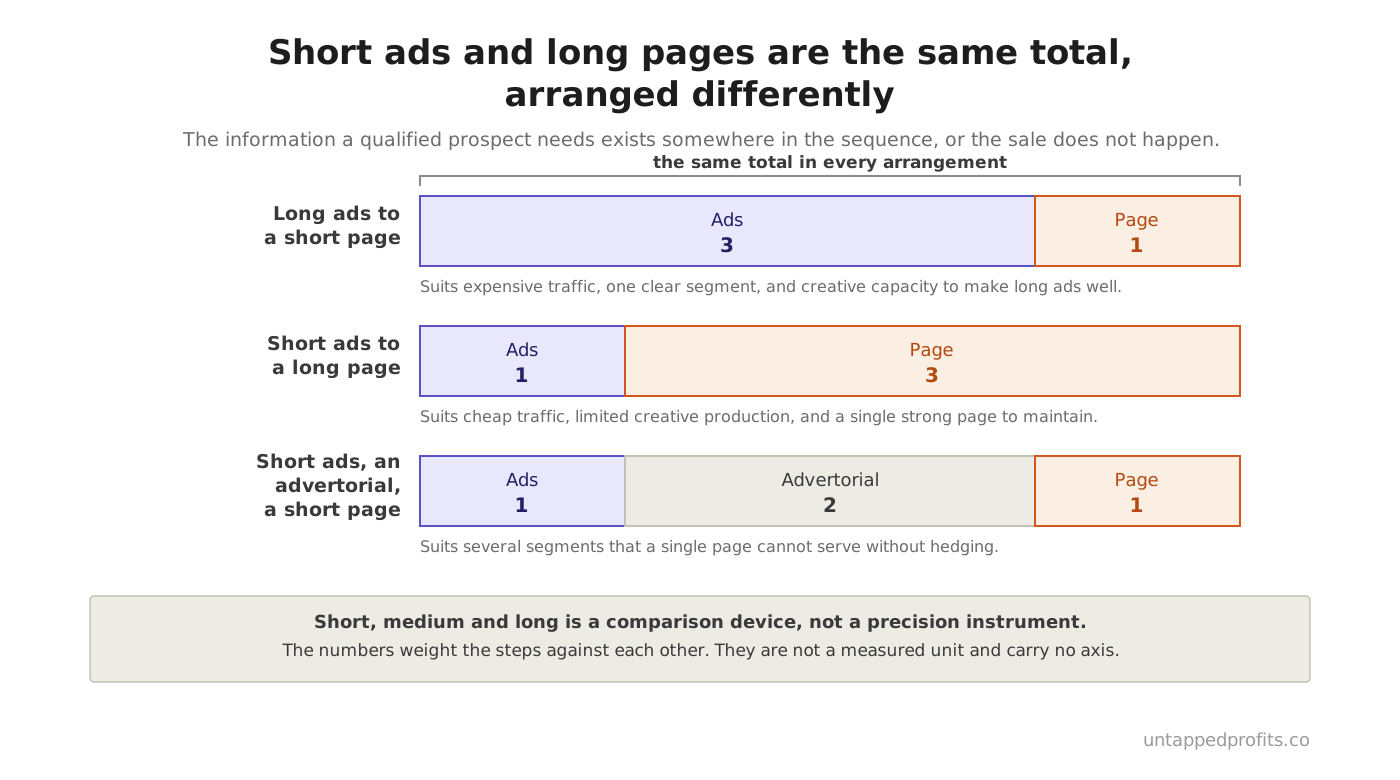
Scoring each step as short, medium or long is a comparison device and not a precision instrument. Its value is making the trade explicit before the money is committed. All three arrangements above deliver the same total, and the right one depends on traffic cost, production capacity and how many segments are being served.
One diagnostic makes the whole law usable. If click-through rate rises but conversion falls after the ads are shortened, too much information was cut and it has to go back, either into the ads or onto the page. The mirror failure is quieter: educated visitors landing on a long page that re-explains what they already know, working through material to reach a button they were ready to press.
In practice
Reach for an advertorial step when the page copy has started hedging. Copy that accommodates two readers at once is the symptom of a segment problem, and the usual response is to compromise the page further until it serves everyone and converts nobody. A step in front of it lets each segment get its own framing while the page stays sharp.
What captures the lead, and why does the response matter more?
A lead magnet is a complete solution to a narrow problem, valuable enough to charge for, that solves one thing in a way that reveals the next. It is the first rung of a value ladder and not a list-building trinket. What decides revenue afterwards is not the magnet but the response, and the evidence on response speed is more dramatic than most operators expect.
Oldroyd, McElheran and Elkington studied 1.25 million online sales leads across 42 American companies and found that firms attempting contact within an hour were nearly seven times more likely to qualify a lead than firms trying an hour later, and more than 60 times more likely than firms that waited a day or longer. Their own summary of the problem is that "most companies are not responding nearly fast enough".1 Every funnel specification therefore carries an instant-response layer: an automated acknowledgement, the personalised result, and a way to book time.
Two rules follow from the same logic. Capture the minimum viable fields, because every extra one costs conversion and the rest can be enriched later. And gate later and less, keeping top-of-funnel education open so it earns visibility while the genuinely valuable middle assets sit behind a form. Forty qualified leads beat four hundred anonymous ones, and the follow-up is where the difference shows. Your Proposal Isn't Dead reads that silence correctly: inattention, not rejection.
What moves an account at breakeven?
Four levers, and only four. Page conversion rate, which lowers the cost of acquiring a customer. Order or deal value at the front and back end, which makes a higher acquisition cost affordable. Lifetime value, which raises the ceiling on what a customer may cost. And more and better ads, which lowers average acquisition cost. Everything else that feels like a lever is one of these four renamed.
Levers one and four produce the same outcome through different bottlenecks, which is exactly why they are worked one at a time. Improving the page and refreshing the creative in the same fortnight means neither result is attributable, the test is wasted, and the account has learned nothing it can reuse. That is the evidence law applied to funnel work, not just to reporting.
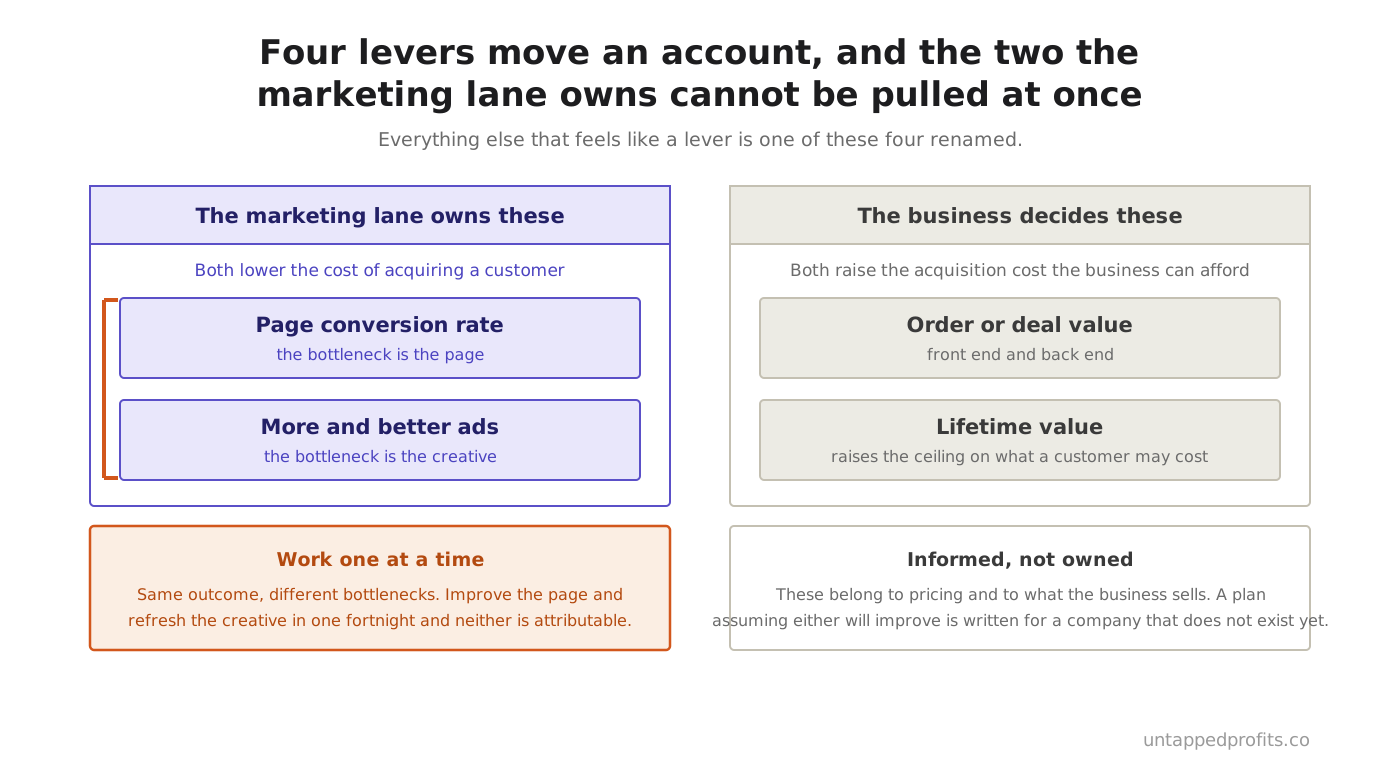
The other two are business decisions the marketing lane informs without owning. Deal value and lifetime value belong to pricing and to what the business sells, and a marketing plan that quietly assumes either will improve has written a strategy for a company that does not exist yet.
Watch for
The funnel that gets longer every time something underperforms. Adding a step is a real answer to a segment problem and a bad answer to a weak offer, and the two feel similar from inside a slow month. Before adding anything, check whether the total information is right and simply badly arranged. Most struggling funnels are misallocated, not too short.
Frequently asked questions
How long should a landing page be?
As long as the ads in front of it are short. There is no correct page length in the abstract, only a correct total across the sequence. A page that works behind educating ads will underperform behind curiosity ads, and the page did not change.
Is a PDF still a reasonable lead magnet?
It is the last option on a ranked list of eight, and it exists on the list because clients ask for one. A downloaded PDF is forgotten, while a diagnostic or audit produces a personalised result the reader acts on. If a PDF is genuinely the answer, it should be good enough to sell.
What if the opt-in rate is poor?
On an interactive magnet, the problem is usually the traffic source or a promise that is too broad, and not the format. Narrowing the promise and checking traffic quality comes before rebuilding anything, because rebuilding is the expensive way to find out the traffic was wrong.
Does every funnel need an advertorial?
No, and most do not. It is a device for scaling across segments when a single page has started compromising. A business serving one clear segment with working ads and a working page has no problem for it to solve and would be adding a step that costs attention.
Who decides the funnel shape?
The Operator, at planning, with the arrangement written into the plan and not settled later by default. The lead magnet is a named decision in the plan too. Both were assumptions in most accounts before they were decisions, and assumptions are what get tested last.
The bottom line
Most funnel problems are distribution problems wearing a page's clothing. The buyer needs a fixed amount of convincing, and the only real question is which step carries which part of it. Decide that at planning, keep the capture mechanism honest enough to be worth someone's email address, answer fast enough to matter, and work one lever at a time. The page then has a job it can actually do rather than a shortfall it was never going to cover.
Where this connects
Funnel Engineering is where Content & Channel sends its traffic and where the promise made in Paid Acquisition is kept or broken. The arrangement is set in The Campaign Plan, the argument each step carries comes from The Big Idea, and every claim on every step answers to The Proof Bank. What the funnel learns returns through The Return Arrow.
Part 7 · Funnel Engineering · Chapter 33 of the One Brain Guide
Previous: Organic Search ·
Next: Landing Page Build ·
All chapters
Sources
- James B. Oldroyd, Kristina McElheran and David Elkington, The Short Life of Online Sales Leads, Harvard Business Review, vol. 89 no. 3, March 2011. The quoted sentence appears in the article's opening on the publisher's own page. The figures were read in the published article text: 1.25 million online sales leads received by 29 business-to-consumer and 13 business-to-business companies in the United States, with firms attempting contact within an hour nearly seven times more likely to qualify a lead than those attempting an hour later, and more than 60 times more likely than those waiting 24 hours or longer. The authors qualified a lead as having a meaningful conversation with a key decision maker. Two points of precision matter here. The article describes those 1.25 million leads as a separate study the authors explored, distinct from the audit reported in the article itself, which tested how quickly 2,241 American companies responded to submitted web enquiries. And the widely circulated figures of 100 times and 21 times are routinely attributed to this article and do not appear in it. The article body sits behind a paywall on the publisher's site, so the text was read in a reprint of the published article. Note the authorship: David Elkington was chairman and chief executive of InsideSales.com, which sold lead-response software, so one author had a direct commercial interest in the finding. The study covers American companies in 2011.
Every statistic and quotation on this page has been checked against its primary source. Last verified 27 August 2026.
Free guide
Take the method with you. The complete One Brain Method as one PDF: every chapter, the diagrams, and every named framework, ready to hand to whoever runs your marketing. Enter your email and it's yours.
A better page will not rescue a funnel carrying the wrong information in the wrong place.
Book a 30-minute call → See what it takes to have this installed