
The Seam Rule is the law that the engine is built as a self-contained portable block, physically separate from any client Cartridge. It is the least visible law in the One Brain Method and the one doing the most structural work.
Key takeaways
- The rule draws one boundary, the Seam: engine logic is never baked into client-specific instructions, and client material never enters the engine.
- One test sorts everything. Methods are engine, client outputs are Cartridge. How segments are derived is engine. The segments themselves are Cartridge.
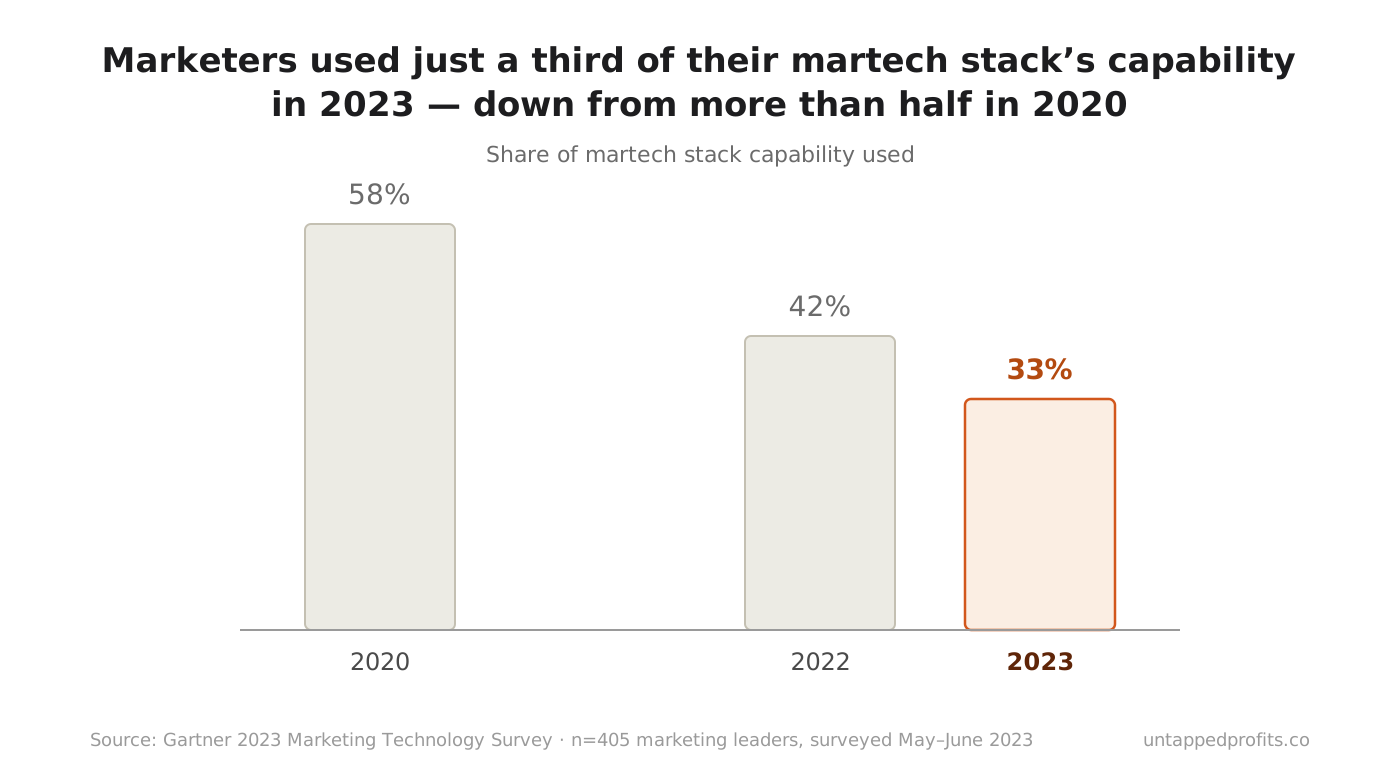
- The industry shows what entanglement costs: organisations used just 33% of their martech stack's capability in Gartner's 2023 survey, down from 58% in 2020.1 Stacks grew; usable capability shrank.
- Fred Brooks named the property this protects: conceptual integrity, the most important consideration in system design. One boundary, drawn once, answers every "where does this live?" question.2
- The payoff is portability: the whole engine can one day move behind a hosted service without a single client project being untangled, because nothing was ever tangled.
Why do marketing systems become impossible to untangle?
Because nobody builds a tangle on purpose. It happens one reasonable shortcut at a time: campaign logic written straight into one client's setup, a brand rule embedded in a tool's template, a workflow living half in an ad account and half in someone's head. Each shortcut works, and the sum of them is a system where nobody can say what is method and what is client.
Once that line blurs, nothing can be moved, reused or even inspected without an archaeology project. The failure is structural in the same way agency slowness is structural: queues and tangles get designed in by a hundred sensible local decisions, the pattern Your Agency Isn't Slow Because of Bad People traces through handoffs. Nobody chose the tangle. Everybody built it.
You can watch the industry paying for the consequences. Gartner's 2023 marketing technology survey of 405 marketing leaders found organisations using just 33% of their martech stack's capability, down from 42% in 2022 and 58% in 2020.1 Stacks kept growing while utilisation collapsed. Gartner attributes that to sprawl and tool overlap, which is the same disease one layer down: capability nobody separated from the mess around it, until nobody could use it.
Fred Brooks named the missing property half a century ago in The Mythical Man-Month: "Conceptual integrity is the most important consideration in system design."2 He also argued the design must come from one mind, or a very few resonant ones, which is the same argument Your Marketing Conductor Can't Hear the Flat Note makes about marketing itself. A marketing system has conceptual integrity when one boundary, drawn once, answers every "where does this live?" question. That boundary is the Seam.
How does the Seam Rule work?
By drawing one boundary and policing it in both directions. The named framework is the Seam. Engine material is client-agnostic, held in one place, and portable by construction. Client material lives in the Cartridge, and only there. One sorting test decides every artefact: methods are engine, client outputs are Cartridge.
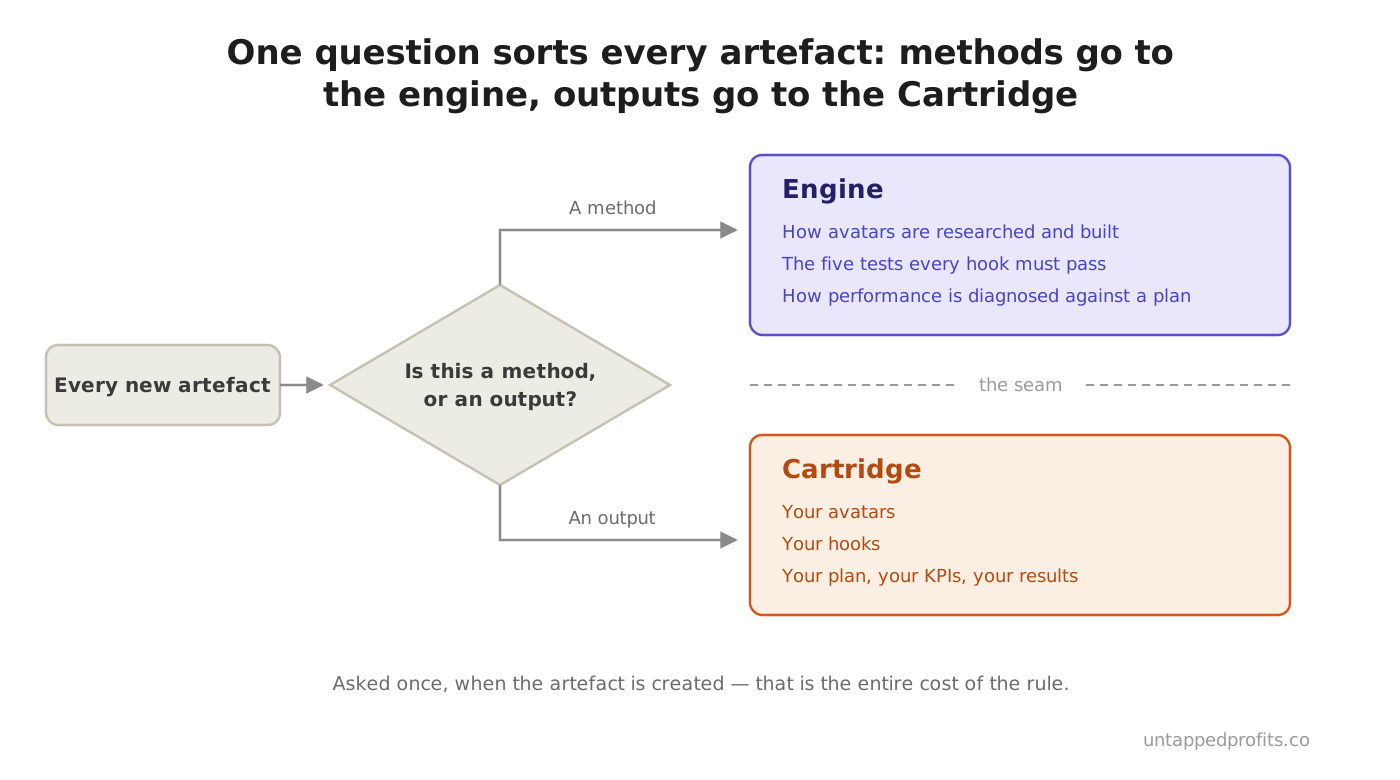
The rule is enforced in four disciplines and cashed in by a fifth:
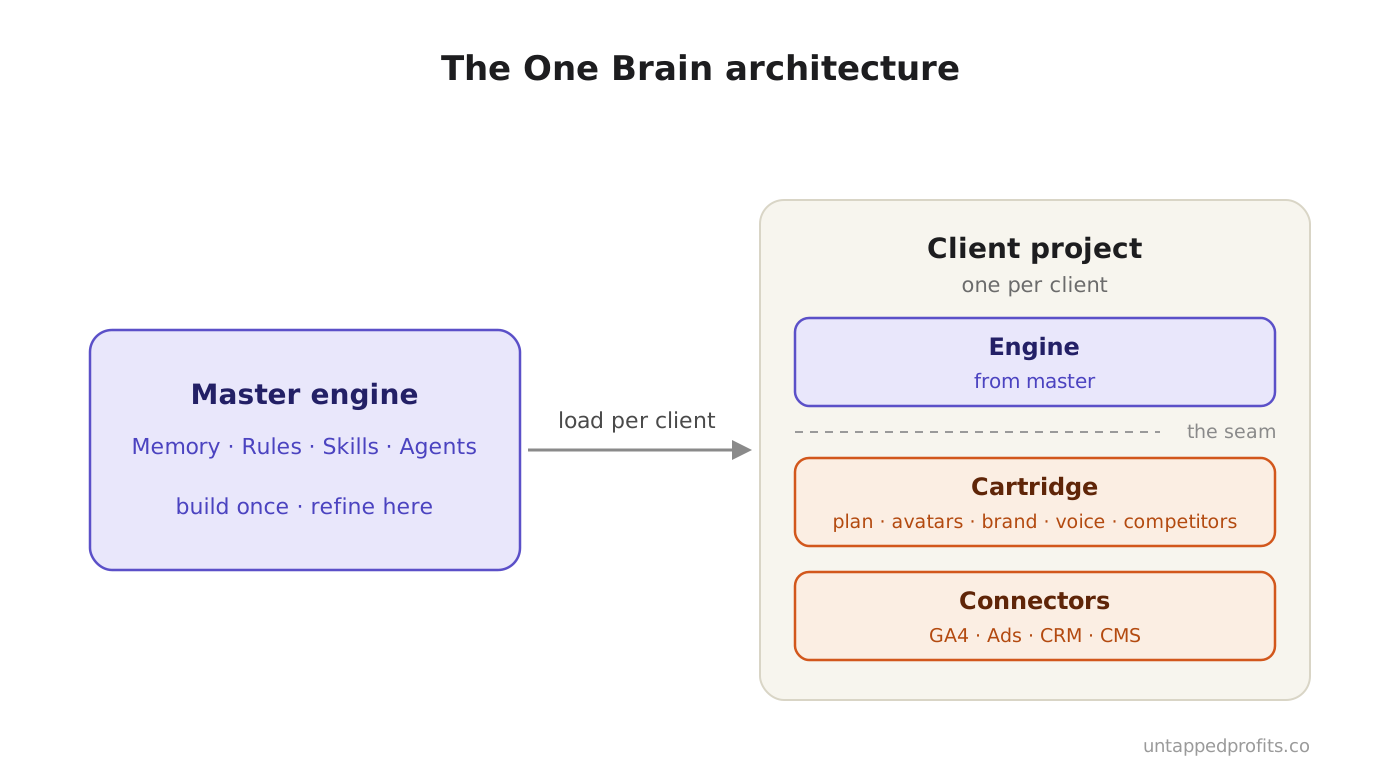
- The engine is a self-contained block. Memory, Rules, Skills, Agents: written client-agnostic, held in one place, portable by construction. If the engine can't be lifted out whole, the rule is already broken.
- Everything is sorted by one test. The way segments are derived is engine. The segments themselves are Cartridge. The tests a hook must pass are engine. The hooks are Cartridge.
- The boundary is policed in both directions. Client-identifiable material never enters the engine. Engine logic never gets written into a client project's instructions, even "just for now", because "just for now" is how tangles start.
- Connectors stay swappable. The system plugs into GA4, Ads, CRM and CMS through connectors so that no platform ever becomes structural. Don't marry a tool: the method survives every platform migration because it was never welded to one.
- The payoff: the engine can move without touching a single client. When the method goes to a hosted service, the engine lifts behind a private connection (MCP, a standard for wiring AI systems to tools) while every client project keeps its Cartridge and connectors and simply calls it. No untangling, because nothing was ever tangled.
| Belongs in the engine | Belongs in the Cartridge |
|---|---|
| How avatars are researched and built | Your avatars |
| The five tests every hook must pass | Your hooks |
| The brand-QA gate every ad clears | Your brand codes and approved ads |
| How performance is diagnosed against a plan | Your plan, your KPIs, your results |
| The rule that claims need verified proof | Your Proof Bank |
In practice
One question per artefact keeps the Seam real: is this a method, or an output? It gets asked when the artefact is created, because asking at cleanup time is archaeology. The answer takes seconds, and it is the entire cost of the rule.
What should you measure at the Seam?
Both directions of the boundary, plus the drill that proves it. Client-identifiable material found in the engine and engine logic found in client instructions are both counted, and both counts have exactly one acceptable value, which is zero. The portability drill asks the harder question: could the engine lift out whole, today, with no client project touched?
| Measure | What it tells you | Target |
|---|---|---|
| Client-identifiable material found in the engine | Whether the boundary is real in the inbound direction | Zero, always |
| Engine logic found in client-specific instructions | Whether it's real in the outbound direction | Zero, with no temporary exceptions |
| The portability drill: could the engine lift out whole, today? | Whether "self-contained" is fact or aspiration | Yes, at any time, with no client project touched |
| Cost of swapping a connector | Whether any tool has become structural | A wiring change, never a rebuild |
Watch for
The words "just for now". Every tangle in every marketing system started as a temporary exception someone meant to move later. The Seam has no temporary side, and the audit that polices it runs on a schedule — because the person who says "just for now" genuinely means it, and that is exactly why the exception outlives them.
What does ignoring the Seam cost?
Nothing in the short term, which is exactly the trap. Every violation is individually convenient, and the interest compounds quietly: each one adds a thread between method and client that someone must eventually find, understand and cut. By the time the tangle matters, the untangling is a project of its own, priced in months.
The tangle matters on a predictable list of days: a migration, a new client load, a platform change, a sale of the business. Skipping boundaries is the same expensive habit whether the boundary is a Seam or a phase gate, and the automation version of the argument is Stop Automating Across Phases. Start Automating Inside Them.
There is a nearer-term cost too: inspectability. A tangled system can't be shown to anyone. Nobody can hand it to a buyer evaluating the method, and no fresh session can rebuild it from the record. This guide can only exist because the Seam Rule held, and the engine is publishable precisely because there is no client in it.
Frequently asked questions
Why should I care about your internal architecture?
Because you inherit its consequences. The Seam is why your material is separable and yours on the day you leave, why no other client's work is entangled with yours, and why the method you're buying can be read rather than taken on faith. Architecture is invisible right up until the day it's the only thing that matters.
Doesn't the discipline slow the work down?
By seconds. Deciding "engine or Cartridge?" is one sorting question per artefact, answered by one test. Boundaries cost attention. Their absence costs projects.
Is the Seam Rule the same thing as the engine and Cartridge split?
The split is the anatomy, and the Seam Rule is the law that keeps it true. Engine, Cartridge and Connectors describes what the parts are. This rule governs the boundary between them: what may cross it, in which direction, and the audits that prove the separation is real rather than aspirational.
What actually crosses the Seam, then?
Two things, in opposite directions. Facts about the business flow in at load, into the Cartridge. Method-level lessons flow back to the Master Engine, stripped of anything client-identifiable, so every future load inherits them. Client data, proof, copy and competitive intelligence never cross at all.
What if MCP is obsolete in three years?
Then the connector changes and the Seam doesn't. The rule deliberately avoids marrying any transport, platform or tool: MCP today, whatever wins tomorrow. What's permanent is the boundary, and the plumbing that crosses it can be anything.
The bottom line
Marketing systems become impossible to untangle one reasonable shortcut at a time, and no single shortcut ever looks like the problem. The Seam Rule refuses all of them with one boundary and one sorting question, asked at the moment each artefact is created. The discipline costs seconds per decision. Its absence is bought back at a thousand times the rate, on the day a migration, a new load or a sale makes the tangle everyone's problem.
Where this connects
The Seam presumes the anatomy drawn in Engine, Cartridge and Connectors, so read that first if you haven't. Its record-keeping counterpart is The Build Ledger, where the whole build stays reconstructable from one artefact. The laws the engine enforces day to day live in The Operator's Laws, and the separation the Seam protects is what lets learning flow safely back through The Return Arrow. Back to the One Brain Method hub.
Part 1 · Architecture · Chapter 2 of the One Brain Guide
Previous: Engine, Cartridge and Connectors ·
Next: The Build Ledger ·
All chapters
Sources
- Gartner, 2023 Marketing Technology Survey press release, 23 August 2023. Utilisation of the overall martech stack's capability dropped to 33% on average in 2023, from 42% in 2022 and 58% in 2020, per 405 marketing leaders surveyed May to June 2023.
- Frederick P. Brooks Jr., The Mythical Man-Month. Wording per the published excerpt.
Every statistic and quotation on this page has been checked against its primary source. Last verified 24 August 2026.
Free guide
Take the method with you. The complete One Brain Method as one PDF: every chapter, the diagrams, and every named framework, ready to hand to whoever runs your marketing. Enter your email and it's yours.
Want a marketing system built with the seams in from day one?
Book a 30-minute call → See what it takes to have this installed