
Lead Nurture decides which emails exist, in what order, on what timing, and what stops them. A brilliant email in the wrong position on the wrong day is a sequencing failure, and no amount of rewriting fixes it.
Key takeaways
- Every sequence declares a trigger, a goal and an exit. Without all three it is a broadcast list wearing a costume.
- The compliance floor is enforced and priced: Australia's regulator penalised one retailer $702,900 over more than 370,000 emails that carried promotional content with no way to unsubscribe, and recorded it as the fifth such action in 18 months.1
- Calls to action escalate and never open at maximum. A hard ask in the first email spends trust that has not been earned.
- A sequence that gets clicks and no conversions is a page or offer problem, not a sequence problem, and rewriting emails will not touch it.
What makes a sequence a sequence?
Three declarations. The trigger, meaning the action that puts someone in it. The goal, stated as the single thing the reader does, measured against the campaign plan's own definition of a qualified lead. And the exit, meaning what stops it. A run of emails with no declared exit is not a sequence, and if the goal cannot be named as one action, it has not been designed yet.
The governing principle underneath those three is continuity. A sequence continues the value the reader already accepted, so the bridge from the free thing to the paid thing is built, never jumped. The pivot from generous to salesy in email two is the most common way a list gets burned, and it is a design choice rather than an accident.
Four rules follow from that. One job per email, meaning one primary idea, one structure, one call to action. Calls to action escalate through soft, then medium, then hard. No two consecutive emails lead with the same kind of material, which is what stops six emails reading as one long email cut into pieces. And where the copy is already sound, adding emails beats tweaking them, because sequence length is usually the lever with the most left in it.
What shapes are there?
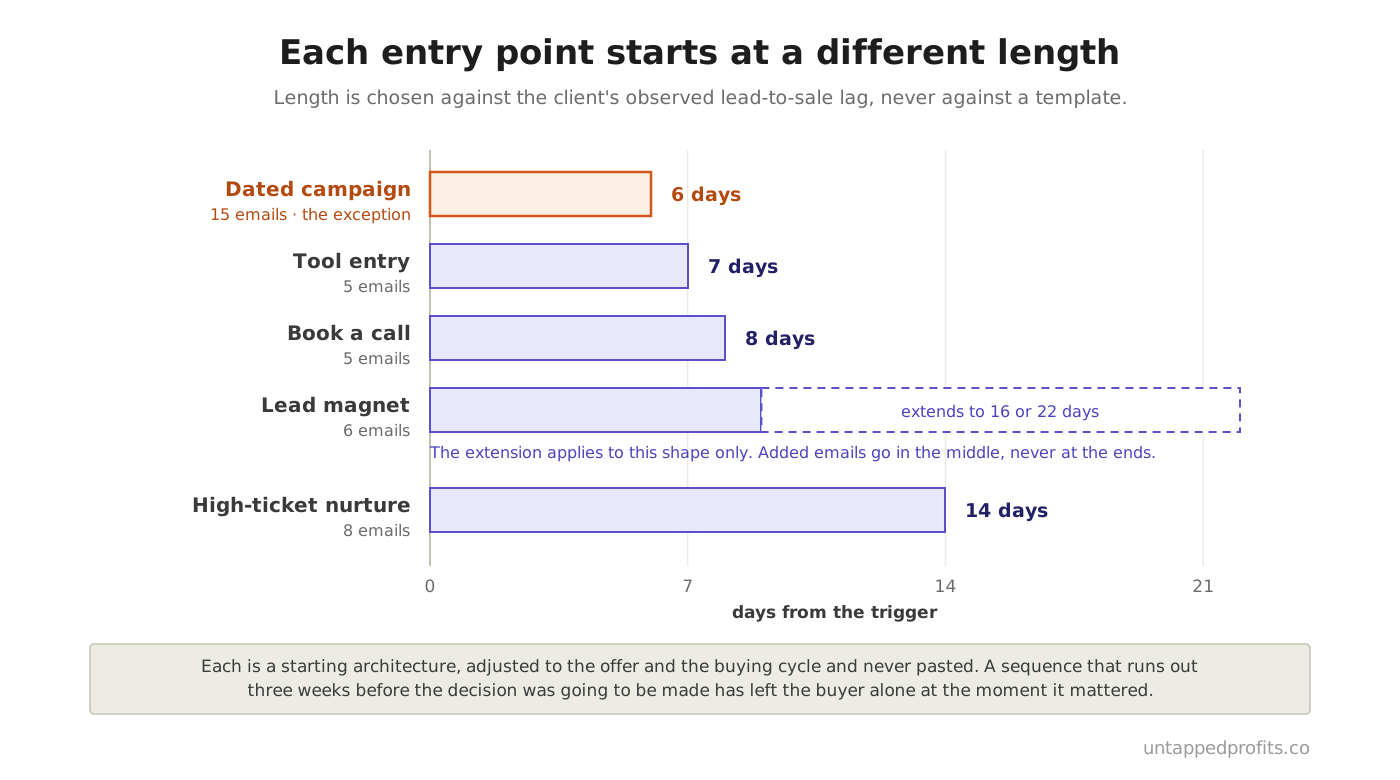
Five, each a starting architecture adjusted to the offer and the buying cycle, never pasted. A lead-magnet sequence runs six emails over nine days as standard, extending to sixteen or twenty-two days for longer and higher-value cycles. Tool entry runs five over seven, high-ticket nurture eight over fourteen, and a book-a-call sequence five over eight. A dated campaign is the exception and runs at a completely different frequency.
| Day | Its job | Ask | |
|---|---|---|---|
| 1 | 0 | Deliver the asset and set expectations | Soft |
| 2 | 1 | One quick win from the asset | Soft |
| 3 | 3 | The framework behind the win | Soft |
| 4 | 5 | Proof it worked for someone real | Medium |
| 5 | 7 | The common mistake and why they are stuck | Medium |
| 6 | 9 | The invitation, stated plainly | Hard |
Extensions go in the middle and never at the ends. The delivery email stays first, the invitation stays last, and what gets inserted between them is a second quick win, another case, and objection handlers placed where the objection actually arises. Every objection the reader will raise gets assigned to an email during design, because an objection with no email against it turns up on the sales call instead — and the ones people say out loud are rarely the real ones. Sam Jones Didn't Buy an Encyclopedia met the real one at the door.
The length is chosen against the client's observed lead-to-sale lag, not against a template. A long buying cycle gets a long sequence, because a sequence that runs out three weeks before the decision was going to be made has left the buyer alone at the moment it mattered.
What stops a sequence?
Six conditions, declared during design and never bolted on afterwards. The most important is the first: when the goal is completed, the sequence exits immediately. Nothing that sells the thing somebody has already taken ever sends to them again. A reply pauses automation, because a human conversation outranks a queued email. Completion without action moves them to the standing list, never into silence and never into the same sequence again.
| Condition | What happens | Why |
|---|---|---|
| The goal is completed | Exits immediately | Nothing that sells what somebody has already taken ever sends to them again |
| The reader replies | Automation pauses | A human conversation outranks a queued email |
| The run completes with no action | Moves to the standing list | Never into silence, and never into the same sequence again |
| Hard disengagement: no opens across the whole run | Exits to a re-engagement path, then to suppression | Sending to a dead address is a deliverability cost paid by every other email the business sends |
| Unsubscribe or complaint | Total and immediate, across every sequence | The legal floor, and the courteous one |
| The offer closes or changes | The sequence pauses | A live sequence selling a dead offer is worse than no sequence at all |
The last three are about the cost of continuing rather than the reader's own signal, and that is where compliance and courtesy stop being separable. Australia's regulator penalised one retailer $702,900 for sending more than 370,000 emails that carried promotional content without an unsubscribe option, and its authority member Samantha Yorke stated the position plainly: "providing the ability to opt-out is mandatory for marketing messages".1 The messages in question were order confirmations and shipping updates that also carried sales links, which is exactly the kind of email a business assumes is exempt.
In practice
Keep transactional messages clean. The moment a delivery confirmation carries a promotional banner or a link to a sale, it stops being a service message and becomes a marketing one with all the obligations attached. Splitting the two costs an afternoon of template work and removes an entire category of risk that has cost Australian businesses millions in penalties.
Is it the sequence, or is it the page?
The diagnosis splits cleanly if the sequence was designed to be diagnosed. The subject line owns the open. The opening owns the read. The body owns the click. The offer and the page own the conversion. So a sequence with healthy clicks and poor conversions has done its job and handed the problem downstream, and rewriting emails will not move it.
Sequences are judged on the goal action, meaning bookings, qualified leads or sales, and never on opens alone, which measure a subject line and nothing else. That is the same separation the ad lane enforces between a creative problem and an account problem, and it exists for the same reason: without it, every disappointing month produces a rewrite of whatever is easiest to rewrite.
Branching is available and is used only where the email platform actually reports the behaviour being branched on. A branch built on data the client does not have is a diagram, not a system. Where the data exists, the most valuable segment is the one that reached the offer and stopped, because they are the closest buyers there are and their objection is specific. Timing matters too: a buyer under financial pressure processes an aspirational message differently, and Your Customers Stopped Buying Futures follows what they buy instead.
Watch for
The part of this discipline that is not finished. The sequence layer is fully specified, but list sources, capture mechanism, segmentation, sending cadence and the path from subscriber to enquiry are Operator rulings and not method, and until a business writes them down its email lane runs at reduced power. This is the thinnest joint in the system and it is named here rather than glossed over.
Frequently asked questions
How many emails should a nurture sequence have?
Six over nine days is the standard starting point, and the right answer is set by how long the buying decision actually takes in this business. Where the copy is already good, adding emails usually returns more than editing the ones that exist.
Isn't sending fifteen emails in six days excessive?
For nurture, yes. For a dated campaign with a closing window, that frequency is the design. The first day exists so the market knows the offer is happening, not to sell, and the last day carries most of the revenue, which is an argument for stamina and not for front-loading.
What happens when someone replies?
Automation pauses and a person answers. The sequence resumes only if the conversation goes nowhere. An automated email arriving in the middle of a live exchange tells the reader precisely how much attention they are actually receiving.
Do we need consent for every email?
For anything with a commercial purpose, yes, along with a working unsubscribe and clear identification of the sender. A message that is mostly factual but carries a promotional link is treated as commercial, and that specific misunderstanding has produced repeated enforcement action.
Who signs off the sequence?
The Operator, on the map, before a single email is written. Emails are far more expensive to re-cut after they exist than to rearrange while they are still rows in a table, so the ordering, the timing and the exits are ruled first.
The bottom line
Most nurture sequences are a set of emails somebody wrote once, running on nobody's decision, selling to people who already bought. The fix is unglamorous. Declare what starts it, what counts as success, and what stops it. Escalate the ask instead of opening at maximum. Assign every objection to an email. Keep the transactional messages clean of sales links. Then rule the map before writing a word of it.
Where this connects
Lead Nurture receives what Funnel Engineering captures and carries whatever the page could not. The goal it drives toward is the qualified-lead definition in The Campaign Plan, the objections it answers come from Customer Intelligence, and every claim in every email answers to The Proof Bank. Subject lines face The Hook Law, sentences answer to Writing for Clarity, and what a sequence teaches returns through The Return Arrow.
Part 8 · Lead Nurture · Chapter 35 of the One Brain Guide
Previous: Landing Page Build ·
Next: Performance Analytics ·
All chapters
Sources
- Australian Communications and Media Authority, Lululemon penalised $702K for spam breaches, March 2026. The ACMA states that Lululemon Athletica Australia paid a $702,900 penalty after sending more than 370,000 emails with commercial content that contained no way to unsubscribe, between 1 December 2024 and 5 January 2025, and that the messages were service emails such as shipping and order confirmations that also carried sales material and links to promotions. The release records this as the fifth enforcement action in 18 months against businesses treating commercial messages as non-commercial, and states that businesses have paid over $6.7 million in spam penalties over the same period. Enforcement has continued since: by July 2026 the ACMA put the total paid in spam and telemarketing penalties over the preceding 18 months at more than $12 million. The quoted words are those of ACMA Authority Member Samantha Yorke. Figures are as at March 2026 and the ACMA continues to take enforcement action, so the count and the total will both move, which is why the running total is carried here rather than in the body.
Every statistic and quotation on this page has been checked against its primary source. Last verified 27 August 2026.
Free guide
Take the method with you. The complete One Brain Method as one PDF: every chapter, the diagrams, and every named framework, ready to hand to whoever runs your marketing. Enter your email and it's yours.
A sequence nobody designed is a set of emails hoping to become a decision.
Book a 30-minute call → See what it takes to have this installed